×
Deadspin | Munetaka Murakami extends HR streak as White Sox pound D-backs  Apr 21, 2026; Phoenix, Arizona, USA; Chicago White Sox first baseman Munetaka Murakami hits a home run in the second inning against the Arizona Diamondbacks at Chase Field. Mandatory Credit: Mark J. Rebilas-Imagn Images   Rookie Munetaka Murakami homered for the fourth straight game, Colson Montgomery went deep for the third straight and the Chicago White Sox slugged four homers in an 11-5 victory over the Arizona Diamondbacks in Phoenix on Tuesday.  Murakami, Michael Vargas and Montgomery hit consecutive solo shots with two outs in the second inning to help stake Sean Burke (1-2) to a 7-0 lead.  Murakami, who has nine homers in 23 games, reached base four times, adding two infield singles and a walk. He singled and scored in a four-run first off Merrill Kelly (1-1).  Vargas homered for the second straight game, Montgomery and Sam Antonacci notched two hits and three RBIs apiece and Tristan Peters had three hits. The White Sox have won three of four and scored 33 runs over that span.  Arizona’s Ildemaro Vargas had a three-run homer in the ninth to extend his season-opening hitting streak to 16 games, the longest in the majors. Dating back to the end of the 2025 season, Vargas has hit in 18 straight. Alek Thomas had two hits, including his first homer of the season for the Diamondbacks, who had won 10 of 14.  The White Sox have 11 homers in their last three games and 14 in their last five.   Antonacci had a two-run inside-the-park homer in the ninth when his ground ball inside the bag at third appeared to be touched by the ball boy along the left field line. Left fielder Lourdes Gurriel Jr. did not immediately attempt to field it as Antonacci circled the bases for his first career homer.  Burke gave up two runs on five hits in six innings in his first road victory since a 4-0 decision at Detroit on Sept. 28, 2024. He struck out three and walked one.  Kelly gave up eight runs and 10 hits before leaving with one out in the fifth. He struck out five and walked three in his second start of the season after opening on the injured list.  The first four White Sox batters reached in the first. Andrew Benintendi singled, Murakami reached on an infield single, Vargas walked and Montgomery doubled in two. Everson Pereira hit a sacrifice fly and Antonacci tripled for a 4-0 lead.  Murakami, Vargas and Montgomery homered in the second for a 7-0 lead after 13 batters.  –Field Level Media    #Deadspin #Munetaka #Murakami #extends #streak #White #Sox #pound #Dbacks
Deadspin | Munetaka Murakami extends HR streak as White Sox pound D-backs
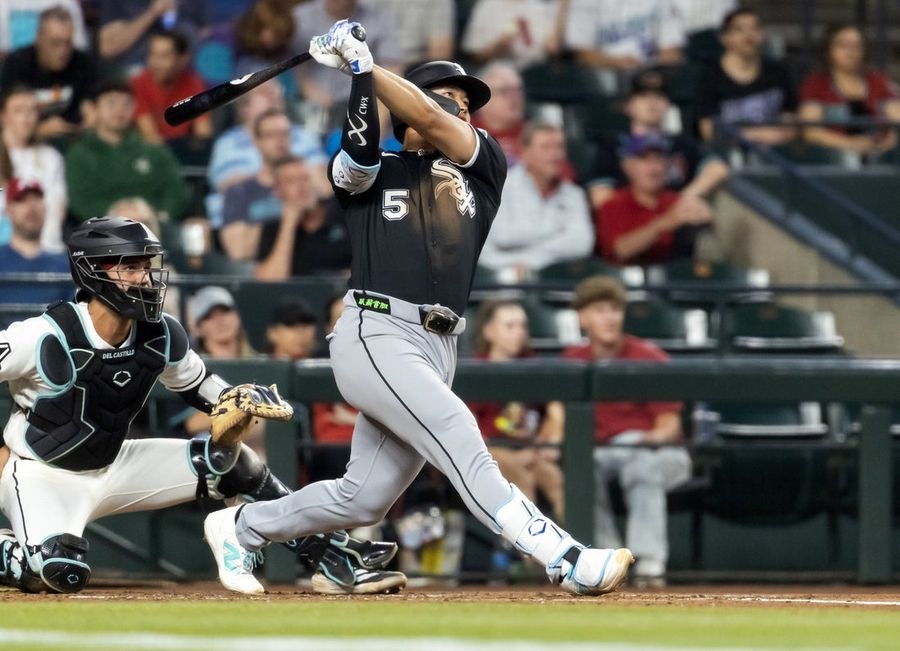
Deadspin | Munetaka Murakami extends HR streak as White Sox pound D-backs  Apr 21, 2026; Phoenix, Arizona, USA; Chicago White Sox first baseman Munetaka Murakami hits a home run in the second inning against the Arizona Diamondbacks at Chase Field. Mandatory Credit: Mark J. Rebilas-Imagn Images   Rookie Munetaka Murakami homered for the fourth straight game, Colson Montgomery went deep for the third straight and the Chicago White Sox slugged four homers in an 11-5 victory over the Arizona Diamondbacks in Phoenix on Tuesday.  Murakami, Michael Vargas and Montgomery hit consecutive solo shots with two outs in the second inning to help stake Sean Burke (1-2) to a 7-0 lead.  Murakami, who has nine homers in 23 games, reached base four times, adding two infield singles and a walk. He singled and scored in a four-run first off Merrill Kelly (1-1).  Vargas homered for the second straight game, Montgomery and Sam Antonacci notched two hits and three RBIs apiece and Tristan Peters had three hits. The White Sox have won three of four and scored 33 runs over that span.  Arizona’s Ildemaro Vargas had a three-run homer in the ninth to extend his season-opening hitting streak to 16 games, the longest in the majors. Dating back to the end of the 2025 season, Vargas has hit in 18 straight. Alek Thomas had two hits, including his first homer of the season for the Diamondbacks, who had won 10 of 14.  The White Sox have 11 homers in their last three games and 14 in their last five.   Antonacci had a two-run inside-the-park homer in the ninth when his ground ball inside the bag at third appeared to be touched by the ball boy along the left field line. Left fielder Lourdes Gurriel Jr. did not immediately attempt to field it as Antonacci circled the bases for his first career homer.  Burke gave up two runs on five hits in six innings in his first road victory since a 4-0 decision at Detroit on Sept. 28, 2024. He struck out three and walked one.  Kelly gave up eight runs and 10 hits before leaving with one out in the fifth. He struck out five and walked three in his second start of the season after opening on the injured list.  The first four White Sox batters reached in the first. Andrew Benintendi singled, Murakami reached on an infield single, Vargas walked and Montgomery doubled in two. Everson Pereira hit a sacrifice fly and Antonacci tripled for a 4-0 lead.  Murakami, Vargas and Montgomery homered in the second for a 7-0 lead after 13 batters.  –Field Level Media    #Deadspin #Munetaka #Murakami #extends #streak #White #Sox #pound #DbacksApr 21, 2026; Phoenix, Arizona, USA; Chicago White Sox first baseman Munetaka Murakami hits a home run in the second inning against the Arizona Diamondbacks at Chase Field. Mandatory Credit: Mark J. Rebilas-Imagn Images

Rookie Munetaka Murakami homered for the fourth straight game, Colson Montgomery went deep for the third straight and the Chicago White Sox slugged four homers in an 11-5 victory over the Arizona Diamondbacks in Phoenix on Tuesday.

Murakami, Michael Vargas and Montgomery hit consecutive solo shots with two outs in the second inning to help stake Sean Burke (1-2) to a 7-0 lead.

Murakami, who has nine homers in 23 games, reached base four times, adding two infield singles and a walk. He singled and scored in a four-run first off Merrill Kelly (1-1).

Vargas homered for the second straight game, Montgomery and Sam Antonacci notched two hits and three RBIs apiece and Tristan Peters had three hits. The White Sox have won three of four and scored 33 runs over that span.

Arizona’s Ildemaro Vargas had a three-run homer in the ninth to extend his season-opening hitting streak to 16 games, the longest in the majors. Dating back to the end of the 2025 season, Vargas has hit in 18 straight. Alek Thomas had two hits, including his first homer of the season for the Diamondbacks, who had won 10 of 14.


The White Sox have 11 homers in their last three games and 14 in their last five.

Antonacci had a two-run inside-the-park homer in the ninth when his ground ball inside the bag at third appeared to be touched by the ball boy along the left field line. Left fielder Lourdes Gurriel Jr. did not immediately attempt to field it as Antonacci circled the bases for his first career homer.

Burke gave up two runs on five hits in six innings in his first road victory since a 4-0 decision at Detroit on Sept. 28, 2024. He struck out three and walked one.

Kelly gave up eight runs and 10 hits before leaving with one out in the fifth. He struck out five and walked three in his second start of the season after opening on the injured list.

The first four White Sox batters reached in the first. Andrew Benintendi singled, Murakami reached on an infield single, Vargas walked and Montgomery doubled in two. Everson Pereira hit a sacrifice fly and Antonacci tripled for a 4-0 lead.

Murakami, Vargas and Montgomery homered in the second for a 7-0 lead after 13 batters.


–Field Level Media

#Deadspin #Munetaka #Murakami #extends #streak #White #Sox #pound #Dbacks

Apr 21, 2026; Phoenix, Arizona, USA; Chicago White Sox first baseman Munetaka Murakami hits a home run in the second inning against the Arizona Diamondbacks at Chase Field. Mandatory Credit: Mark J. Rebilas-Imagn Images

Rookie Munetaka Murakami homered for the fourth straight game, Colson Montgomery went deep for the third straight and the Chicago White Sox slugged four homers in an 11-5 victory over the Arizona Diamondbacks in Phoenix on Tuesday.

Murakami, Michael Vargas and Montgomery hit consecutive solo shots with two outs in the second inning to help stake Sean Burke (1-2) to a 7-0 lead.

Murakami, who has nine homers in 23 games, reached base four times, adding two infield singles and a walk. He singled and scored in a four-run first off Merrill Kelly (1-1).

Vargas homered for the second straight game, Montgomery and Sam Antonacci notched two hits and three RBIs apiece and Tristan Peters had three hits. The White Sox have won three of four and scored 33 runs over that span.

Arizona’s Ildemaro Vargas had a three-run homer in the ninth to extend his season-opening hitting streak to 16 games, the longest in the majors. Dating back to the end of the 2025 season, Vargas has hit in 18 straight. Alek Thomas had two hits, including his first homer of the season for the Diamondbacks, who had won 10 of 14.

The White Sox have 11 homers in their last three games and 14 in their last five.

Antonacci had a two-run inside-the-park homer in the ninth when his ground ball inside the bag at third appeared to be touched by the ball boy along the left field line. Left fielder Lourdes Gurriel Jr. did not immediately attempt to field it as Antonacci circled the bases for his first career homer.

Burke gave up two runs on five hits in six innings in his first road victory since a 4-0 decision at Detroit on Sept. 28, 2024. He struck out three and walked one.

Kelly gave up eight runs and 10 hits before leaving with one out in the fifth. He struck out five and walked three in his second start of the season after opening on the injured list.

The first four White Sox batters reached in the first. Andrew Benintendi singled, Murakami reached on an infield single, Vargas walked and Montgomery doubled in two. Everson Pereira hit a sacrifice fly and Antonacci tripled for a 4-0 lead.

Murakami, Vargas and Montgomery homered in the second for a 7-0 lead after 13 batters.

–Field Level Media

Source link
#Deadspin #Munetaka #Murakami #extends #streak #White #Sox #pound #Dbacks

Previous post

SpaceX cuts a deal to maybe buy Cursor for $60 billion<div id=""><p class="duet--article--dangerously-set-cms-markup ewrhy38 _1xwtict1">SpaceX and Cursor are now working closely together to create the world’s best coding and knowledge work AI.</p><p class="duet--article--dangerously-set-cms-markup ewrhy38 _1xwtict1">The combination of Cursor’s leading product and distribution to expert software engineers with SpaceX’s million H100 equivalent Colossus training supercomputer will allow us to build the world’s most useful models.</p><p class="duet--article--dangerously-set-cms-markup ewrhy38 _1xwtict1">Cursor has also given SpaceX the right to acquire Cursor later this year for $60 billion or pay $10 billion for our work together.</p></div>#SpaceX #cuts #deal #buy #Cursor #billionAI,Business,Elon Musk,News,Science,Space,SpaceX,Tech,Twitter – X,xAI

Next post

इंदौर में बेटे के सामने चाकू मारकर पिता की जान लेने वाले चार आरोपी गिरफ्तार, दो की तलाश में सागर पहुंची पुलिस

Deadspin | Victor Wembanyama sustains concussion in Spurs’ Game 2 loss  Apr 21, 2026; San Antonio, Texas, USA; Portland Trail Blazers forward Deni Avdija (8) drives to the basket past San Antonio Spurs forward Victor Wembanyama (1) during the first half of game two of the first round of the 2026 NBA Playoffs at Frost Bank Center. Mandatory Credit: Scott Wachter-Imagn Images   San Antonio star center Victor Wembanyama was concussed during Game 2 of the Spurs’ first-round playoff series with the Portland Trail Blazers on Tuesday, his coach confirmed following the contest.  “I just know he has a concussion and he’s in the protocol and we’ll obviously take the proper and appropriate steps,” San Antonio coach Mitch Johnson said. “You know, it’s tough. That protocol is the protocol, so we’ll just follow it, as everyone else does, and plan accordingly.”  Wembanyama was forced from Game 2 after hitting his face on the floor early in the second quarter. The Spurs later announced that Wembanyama had entered concussion protocol and would not return to the game before it was confirmed after the contest — a 106-103 Blazers win that leveled the series — that a concussion had been sustained.  Wembanyama hit his face on the floor at near-full speed after being knocked off his feet during a drive to the basket at the 8:57 mark of the second period, with the contact leaving him dazed enough to struggle standing up before jogging off the floor to the locker room.  San Antonio trailed 34-32 at the time, and Wembanyama had amassed five points, four rebounds, an assist and a blocked shot in 11:41 of court time when he was injured. The game was tied 57-57 by halftime.   The Spurs have had plenty of success without their star this season. Wembanyama missed 18 games this season with various injuries, with San Antonio going 12-6 in those games.  However, Wembanyama’s absence for Game 3 and potentially beyond would loom large in a series that suddenly swung to Portland’s advantage after the Blazers wrested away the home-court edge on Tuesday.  Wembanyama is scheduled to receive further testing on Wednesday but must remain inactive for a minimum of 24 hours and can’t resume full participation before 48 hours, per NBA concussion guidelines.  The teams won’t play again until Friday, when Game 3 will be contested in Portland.  –Field Level Media    #Deadspin #Victor #Wembanyama #sustains #concussion #Spurs #Game #lossApr 21, 2026; San Antonio, Texas, USA; Portland Trail Blazers forward Deni Avdija (8) drives to the basket past San Antonio Spurs forward Victor Wembanyama (1) during the first half of game two of the first round of the 2026 NBA Playoffs at Frost Bank Center. Mandatory Credit: Scott Wachter-Imagn Images

San Antonio star center Victor Wembanyama was concussed during Game 2 of the Spurs’ first-round playoff series with the Portland Trail Blazers on Tuesday, his coach confirmed following the contest.

“I just know he has a concussion and he’s in the protocol and we’ll obviously take the proper and appropriate steps,” San Antonio coach Mitch Johnson said. “You know, it’s tough. That protocol is the protocol, so we’ll just follow it, as everyone else does, and plan accordingly.”

Wembanyama was forced from Game 2 after hitting his face on the floor early in the second quarter. The Spurs later announced that Wembanyama had entered concussion protocol and would not return to the game before it was confirmed after the contest — a 106-103 Blazers win that leveled the series — that a concussion had been sustained.

Wembanyama hit his face on the floor at near-full speed after being knocked off his feet during a drive to the basket at the 8:57 mark of the second period, with the contact leaving him dazed enough to struggle standing up before jogging off the floor to the locker room.


San Antonio trailed 34-32 at the time, and Wembanyama had amassed five points, four rebounds, an assist and a blocked shot in 11:41 of court time when he was injured. The game was tied 57-57 by halftime.

The Spurs have had plenty of success without their star this season. Wembanyama missed 18 games this season with various injuries, with San Antonio going 12-6 in those games.

However, Wembanyama’s absence for Game 3 and potentially beyond would loom large in a series that suddenly swung to Portland’s advantage after the Blazers wrested away the home-court edge on Tuesday.

Wembanyama is scheduled to receive further testing on Wednesday but must remain inactive for a minimum of 24 hours and can’t resume full participation before 48 hours, per NBA concussion guidelines.

The teams won’t play again until Friday, when Game 3 will be contested in Portland.


–Field Level Media

#Deadspin #Victor #Wembanyama #sustains #concussion #Spurs #Game #loss">Deadspin | Victor Wembanyama sustains concussion in Spurs’ Game 2 loss  Apr 21, 2026; San Antonio, Texas, USA; Portland Trail Blazers forward Deni Avdija (8) drives to the basket past San Antonio Spurs forward Victor Wembanyama (1) during the first half of game two of the first round of the 2026 NBA Playoffs at Frost Bank Center. Mandatory Credit: Scott Wachter-Imagn Images   San Antonio star center Victor Wembanyama was concussed during Game 2 of the Spurs’ first-round playoff series with the Portland Trail Blazers on Tuesday, his coach confirmed following the contest.  “I just know he has a concussion and he’s in the protocol and we’ll obviously take the proper and appropriate steps,” San Antonio coach Mitch Johnson said. “You know, it’s tough. That protocol is the protocol, so we’ll just follow it, as everyone else does, and plan accordingly.”  Wembanyama was forced from Game 2 after hitting his face on the floor early in the second quarter. The Spurs later announced that Wembanyama had entered concussion protocol and would not return to the game before it was confirmed after the contest — a 106-103 Blazers win that leveled the series — that a concussion had been sustained.  Wembanyama hit his face on the floor at near-full speed after being knocked off his feet during a drive to the basket at the 8:57 mark of the second period, with the contact leaving him dazed enough to struggle standing up before jogging off the floor to the locker room.  San Antonio trailed 34-32 at the time, and Wembanyama had amassed five points, four rebounds, an assist and a blocked shot in 11:41 of court time when he was injured. The game was tied 57-57 by halftime.   The Spurs have had plenty of success without their star this season. Wembanyama missed 18 games this season with various injuries, with San Antonio going 12-6 in those games.  However, Wembanyama’s absence for Game 3 and potentially beyond would loom large in a series that suddenly swung to Portland’s advantage after the Blazers wrested away the home-court edge on Tuesday.  Wembanyama is scheduled to receive further testing on Wednesday but must remain inactive for a minimum of 24 hours and can’t resume full participation before 48 hours, per NBA concussion guidelines.  The teams won’t play again until Friday, when Game 3 will be contested in Portland.  –Field Level Media    #Deadspin #Victor #Wembanyama #sustains #concussion #Spurs #Game #loss

The FIFA World Cup, nearly a century since its inception, has remained the crown jewel of international men’s football.

Despite India never playing in the tournament, the spectacle has always taken centre stage among football fans. But 2026 carries a different writing on the wall.

The quadrennial carnival does not have a broadcaster. No TV channel, no streaming company has put its foot forward to take it up. Why is that so?

“Football viewership in India has been on the decline for some time now. If you look at the Premier League, its valuation has fallen from $145 million in 2013-14 to $60 million in the latest deal,” an industry expert tells  Sportstar.

Sony Sports acquired the commercial rights for the FIFA World Cup 2014, 2018, and Euro 2016 for around $90 million in 2013, which would be almost double the value today, adjusted for inflation.

Eight years later, Reliance picked up the 2022 World Cup rights for $60 million.

FIFA had offered rights for the next two World Cups as a package to the Indian market for $100 million last year. However, a lack of interest saw the global football body reconsider the valuation to $35 million.

Even then, interest did not emerge, exposing the broken economics of World Cup broadcasting in this part of the world.

“In India, the picture appears more nuanced than a simple lack of takers. Broadcasters are likely weighing a combination of structural and commercial considerations,” says Rohit Potphode, Managing Partner – Sports, Gaming, eSports & Live Experiences, Dentsu India.

Rohit Potphode discussed why the company went for broadcasting rights in Japan for FIFA World Cup 2026 and not in India.

Rohit Potphode discussed why the company went for broadcasting rights in Japan for FIFA World Cup 2026 and not in India. | Photo Credit: Special Arrangement

FIFA World Cup 2026 not available to fans in India yet — What’s going wrong?  The FIFA World Cup, nearly a century since its inception, has remained the crown jewel of international men’s football.Despite India never playing in the tournament, the spectacle has always taken centre stage among football fans. But 2026 carries a different writing on the wall.The quadrennial carnival does not have a broadcaster. No TV channel, no streaming company has put its foot forward to take it up. Why is that so?“Football viewership in India has been on the decline for some time now. If you look at the Premier League, its valuation has fallen from 5 million in 2013-14 to  million in the latest deal,” an industry expert tells        Sportstar.Sony Sports acquired the commercial rights for the FIFA World Cup 2014, 2018, and Euro 2016 for around  million in 2013, which would be almost double the value today, adjusted for inflation.Eight years later, Reliance picked up the 2022 World Cup rights for  million.FIFA had offered rights for the next two World Cups as a package to the Indian market for 0 million last year. However, a lack of interest saw the global football body reconsider the valuation to  million.Even then, interest did not emerge, exposing the broken economics of World Cup broadcasting in this part of the world.“In India, the picture appears more nuanced than a simple lack of takers. Broadcasters are likely weighing a combination of structural and commercial considerations,” says Rohit Potphode, Managing Partner – Sports, Gaming, eSports & Live Experiences, Dentsu India. Rohit Potphode discussed why the company went for broadcasting rights in Japan for FIFA World Cup 2026 and not in India.
                                                            | Photo Credit: 
                                Special Arrangement
                            

                            Rohit Potphode discussed why the company went for broadcasting rights in Japan for FIFA World Cup 2026 and not in India.
                                                            | Photo Credit: 
                                Special Arrangement
                                                    Dentsu is the commercial partner for the FIFA World Cup 2026 in Japan, which was also among the top viewers of the tournament in 2022.“Japan is significantly different from India in terms of audience appetite, advertisers, and overall media ecosystem.”“One significant factor is match timing; fixtures scheduled at late-night or early-morning hours for Indian audiences can materially impact viewership peaks, which in turn affects advertising inventory and revenue potential. Even marquee events can struggle to deliver optimal returns when they fall outside prime viewing windows,” he adds.The FIFA World Cup 2026 is being played in the United States of America, Canada and Mexico, placing most matches outside prime Indian viewing hours.Of the 104 games in the World Cup this time, only 14 begin before midnight. In comparison, Qatar 2022 had 44 of its 64 matches before midnight, while Russia 2018 had 63.Profitability the only priority“The business scenario in sports in India has shifted primarily to profitability,” a source from one of the broadcasters says.“Subscription is a limited option in this country, despite the appetite being there. In the West, football is mostly behind paywalls. You cannot do that in India.”Sky Sports charges a subscription fee of about £22 per month to show the Premier League in the UK, while FOX Sports, the World Cup broadcaster in the US, sells its FOX One + ESPN Bundle for  per month.The FIFA World Cup 2022 was streamed on JioCinema and Sports18HD, with the former offering it for free and the latter charging Rs. 12 for the channel.The result: India saw one of the steepest individual market drops, losing 87 million linear viewers in four years. The audience moved to digital, which was free, not away from football. Meanwhile, JioStar reportedly lost millions with the free-to-air service.In general, though, football viewership in the country has declined. The Indian Super League, the top flight of men’s football, has seen its broadcast rights valuation fall by 97 per cent in the last year.World Cup football has followed the same trend: The 2022 edition had every match worth Rs. 6.94 crore. Four years later, that value has fallen to Rs. 1.56 crore per match — a 77.5 per cent drop. Most fans in India watched the FIFA World Cup 2022 free of cost on JioCinema, not on linear television.
                                                            | Photo Credit: 
                                Getty Images
                            

                            Most fans in India watched the FIFA World Cup 2022 free of cost on JioCinema, not on linear television.
                                                            | Photo Credit: 
                                Getty Images
                                                    “The lack of advertising opportunities in football is another issue. While commercial partners can have ad slots after every over or dismissal in cricket, or maybe every set in tennis, in football, it’s largely restricted to pre-match, half-time and full-time, with limited additional breaks,” another individual from an Indian broadcaster says.Potphode adds further insight. “The advertising market remains highly value-conscious, with brands increasingly seeking measurable and consistent returns across both television and digital platforms.“With a crowded sports calendar and the continued rise of on-demand consumption, rights holders and broadcasters may be taking a more calibrated approach, evaluating not just scale, but the quality and timing of audience engagement.”Will there be a solution?FIFA is expected to hold negotiations with leading Indian broadcasters — JioStar, FanCode, Sony Sports and ZEE Entertainment — in search of a last-ditch solution. It is unlikely for DAZN to enter the conversation, while Netflix and YouTube have chosen not to comment.If all options fail, the World Cup could return to Doordarshan, India’s public broadcaster, after 28 years. Under the Sports Broadcasting Signals (Mandatory Sharing with Prasar Bharati) Act, sporting events of national importance must be shared with the broadcaster. Prasar Bharati, Doordarshan’s parent company, had made a profit of Rs. 3.5 crore from the 1998 rights.
                                                            | Photo Credit: 
                                The Hindu Photo Library
                            

                            Prasar Bharati, Doordarshan’s parent company, had made a profit of Rs. 3.5 crore from the 1998 rights.
                                                            | Photo Credit: 
                                The Hindu Photo Library
                                                    That could offer a lifeline, with marquee matches — likely the knockouts and the final — broadcast on Doordarshan irrespective of the primary rights holder.Prasar Bharati, Doordarshan’s parent company, had made a profit of Rs. 3.5 crore from the 1998 rights. A return to public broadcasting could yet make the World Cup viable again in India.Published on Apr 22, 2026  #FIFA #World #Cup #fans #India #Whats #wrong

Rohit Potphode discussed why the company went for broadcasting rights in Japan for FIFA World Cup 2026 and not in India. | Photo Credit: Special Arrangement

Dentsu is the commercial partner for the FIFA World Cup 2026 in Japan, which was also among the top viewers of the tournament in 2022.

“Japan is significantly different from India in terms of audience appetite, advertisers, and overall media ecosystem.”

“One significant factor is match timing; fixtures scheduled at late-night or early-morning hours for Indian audiences can materially impact viewership peaks, which in turn affects advertising inventory and revenue potential. Even marquee events can struggle to deliver optimal returns when they fall outside prime viewing windows,” he adds.

The FIFA World Cup 2026 is being played in the United States of America, Canada and Mexico, placing most matches outside prime Indian viewing hours.

Of the 104 games in the World Cup this time, only 14 begin before midnight. In comparison, Qatar 2022 had 44 of its 64 matches before midnight, while Russia 2018 had 63.

Profitability the only priority

“The business scenario in sports in India has shifted primarily to profitability,” a source from one of the broadcasters says.

“Subscription is a limited option in this country, despite the appetite being there. In the West, football is mostly behind paywalls. You cannot do that in India.”

Sky Sports charges a subscription fee of about £22 per month to show the Premier League in the UK, while FOX Sports, the World Cup broadcaster in the US, sells its FOX One + ESPN Bundle for $40 per month.

visualization

The FIFA World Cup 2022 was streamed on JioCinema and Sports18HD, with the former offering it for free and the latter charging Rs. 12 for the channel.

The result: India saw one of the steepest individual market drops, losing 87 million linear viewers in four years. The audience moved to digital, which was free, not away from football. Meanwhile, JioStar reportedly lost millions with the free-to-air service.

In general, though, football viewership in the country has declined. The Indian Super League, the top flight of men’s football, has seen its broadcast rights valuation fall by 97 per cent in the last year.

World Cup football has followed the same trend: The 2022 edition had every match worth Rs. 6.94 crore. Four years later, that value has fallen to Rs. 1.56 crore per match — a 77.5 per cent drop.

Most fans in India watched the FIFA World Cup 2022 free of cost on JioCinema, not on linear television.

Most fans in India watched the FIFA World Cup 2022 free of cost on JioCinema, not on linear television. | Photo Credit: Getty Images

FIFA World Cup 2026 not available to fans in India yet — What’s going wrong?  The FIFA World Cup, nearly a century since its inception, has remained the crown jewel of international men’s football.Despite India never playing in the tournament, the spectacle has always taken centre stage among football fans. But 2026 carries a different writing on the wall.The quadrennial carnival does not have a broadcaster. No TV channel, no streaming company has put its foot forward to take it up. Why is that so?“Football viewership in India has been on the decline for some time now. If you look at the Premier League, its valuation has fallen from 5 million in 2013-14 to  million in the latest deal,” an industry expert tells        Sportstar.Sony Sports acquired the commercial rights for the FIFA World Cup 2014, 2018, and Euro 2016 for around  million in 2013, which would be almost double the value today, adjusted for inflation.Eight years later, Reliance picked up the 2022 World Cup rights for  million.FIFA had offered rights for the next two World Cups as a package to the Indian market for 0 million last year. However, a lack of interest saw the global football body reconsider the valuation to  million.Even then, interest did not emerge, exposing the broken economics of World Cup broadcasting in this part of the world.“In India, the picture appears more nuanced than a simple lack of takers. Broadcasters are likely weighing a combination of structural and commercial considerations,” says Rohit Potphode, Managing Partner – Sports, Gaming, eSports & Live Experiences, Dentsu India. Rohit Potphode discussed why the company went for broadcasting rights in Japan for FIFA World Cup 2026 and not in India.
                                                            | Photo Credit: 
                                Special Arrangement
                            

                            Rohit Potphode discussed why the company went for broadcasting rights in Japan for FIFA World Cup 2026 and not in India.
                                                            | Photo Credit: 
                                Special Arrangement
                                                    Dentsu is the commercial partner for the FIFA World Cup 2026 in Japan, which was also among the top viewers of the tournament in 2022.“Japan is significantly different from India in terms of audience appetite, advertisers, and overall media ecosystem.”“One significant factor is match timing; fixtures scheduled at late-night or early-morning hours for Indian audiences can materially impact viewership peaks, which in turn affects advertising inventory and revenue potential. Even marquee events can struggle to deliver optimal returns when they fall outside prime viewing windows,” he adds.The FIFA World Cup 2026 is being played in the United States of America, Canada and Mexico, placing most matches outside prime Indian viewing hours.Of the 104 games in the World Cup this time, only 14 begin before midnight. In comparison, Qatar 2022 had 44 of its 64 matches before midnight, while Russia 2018 had 63.Profitability the only priority“The business scenario in sports in India has shifted primarily to profitability,” a source from one of the broadcasters says.“Subscription is a limited option in this country, despite the appetite being there. In the West, football is mostly behind paywalls. You cannot do that in India.”Sky Sports charges a subscription fee of about £22 per month to show the Premier League in the UK, while FOX Sports, the World Cup broadcaster in the US, sells its FOX One + ESPN Bundle for  per month.The FIFA World Cup 2022 was streamed on JioCinema and Sports18HD, with the former offering it for free and the latter charging Rs. 12 for the channel.The result: India saw one of the steepest individual market drops, losing 87 million linear viewers in four years. The audience moved to digital, which was free, not away from football. Meanwhile, JioStar reportedly lost millions with the free-to-air service.In general, though, football viewership in the country has declined. The Indian Super League, the top flight of men’s football, has seen its broadcast rights valuation fall by 97 per cent in the last year.World Cup football has followed the same trend: The 2022 edition had every match worth Rs. 6.94 crore. Four years later, that value has fallen to Rs. 1.56 crore per match — a 77.5 per cent drop. Most fans in India watched the FIFA World Cup 2022 free of cost on JioCinema, not on linear television.
                                                            | Photo Credit: 
                                Getty Images
                            

                            Most fans in India watched the FIFA World Cup 2022 free of cost on JioCinema, not on linear television.
                                                            | Photo Credit: 
                                Getty Images
                                                    “The lack of advertising opportunities in football is another issue. While commercial partners can have ad slots after every over or dismissal in cricket, or maybe every set in tennis, in football, it’s largely restricted to pre-match, half-time and full-time, with limited additional breaks,” another individual from an Indian broadcaster says.Potphode adds further insight. “The advertising market remains highly value-conscious, with brands increasingly seeking measurable and consistent returns across both television and digital platforms.“With a crowded sports calendar and the continued rise of on-demand consumption, rights holders and broadcasters may be taking a more calibrated approach, evaluating not just scale, but the quality and timing of audience engagement.”Will there be a solution?FIFA is expected to hold negotiations with leading Indian broadcasters — JioStar, FanCode, Sony Sports and ZEE Entertainment — in search of a last-ditch solution. It is unlikely for DAZN to enter the conversation, while Netflix and YouTube have chosen not to comment.If all options fail, the World Cup could return to Doordarshan, India’s public broadcaster, after 28 years. Under the Sports Broadcasting Signals (Mandatory Sharing with Prasar Bharati) Act, sporting events of national importance must be shared with the broadcaster. Prasar Bharati, Doordarshan’s parent company, had made a profit of Rs. 3.5 crore from the 1998 rights.
                                                            | Photo Credit: 
                                The Hindu Photo Library
                            

                            Prasar Bharati, Doordarshan’s parent company, had made a profit of Rs. 3.5 crore from the 1998 rights.
                                                            | Photo Credit: 
                                The Hindu Photo Library
                                                    That could offer a lifeline, with marquee matches — likely the knockouts and the final — broadcast on Doordarshan irrespective of the primary rights holder.Prasar Bharati, Doordarshan’s parent company, had made a profit of Rs. 3.5 crore from the 1998 rights. A return to public broadcasting could yet make the World Cup viable again in India.Published on Apr 22, 2026  #FIFA #World #Cup #fans #India #Whats #wrong

Most fans in India watched the FIFA World Cup 2022 free of cost on JioCinema, not on linear television. | Photo Credit: Getty Images

“The lack of advertising opportunities in football is another issue. While commercial partners can have ad slots after every over or dismissal in cricket, or maybe every set in tennis, in football, it’s largely restricted to pre-match, half-time and full-time, with limited additional breaks,” another individual from an Indian broadcaster says.

Potphode adds further insight. “The advertising market remains highly value-conscious, with brands increasingly seeking measurable and consistent returns across both television and digital platforms.

“With a crowded sports calendar and the continued rise of on-demand consumption, rights holders and broadcasters may be taking a more calibrated approach, evaluating not just scale, but the quality and timing of audience engagement.”

Will there be a solution?

FIFA is expected to hold negotiations with leading Indian broadcasters — JioStar, FanCode, Sony Sports and ZEE Entertainment — in search of a last-ditch solution. It is unlikely for DAZN to enter the conversation, while Netflix and YouTube have chosen not to comment.

If all options fail, the World Cup could return to Doordarshan, India’s public broadcaster, after 28 years. Under the Sports Broadcasting Signals (Mandatory Sharing with Prasar Bharati) Act, sporting events of national importance must be shared with the broadcaster.

Prasar Bharati, Doordarshan’s parent company, had made a profit of Rs. 3.5 crore from the 1998 rights.

Prasar Bharati, Doordarshan’s parent company, had made a profit of Rs. 3.5 crore from the 1998 rights. | Photo Credit: The Hindu Photo Library

FIFA World Cup 2026 not available to fans in India yet — What’s going wrong?  The FIFA World Cup, nearly a century since its inception, has remained the crown jewel of international men’s football.Despite India never playing in the tournament, the spectacle has always taken centre stage among football fans. But 2026 carries a different writing on the wall.The quadrennial carnival does not have a broadcaster. No TV channel, no streaming company has put its foot forward to take it up. Why is that so?“Football viewership in India has been on the decline for some time now. If you look at the Premier League, its valuation has fallen from 5 million in 2013-14 to  million in the latest deal,” an industry expert tells        Sportstar.Sony Sports acquired the commercial rights for the FIFA World Cup 2014, 2018, and Euro 2016 for around  million in 2013, which would be almost double the value today, adjusted for inflation.Eight years later, Reliance picked up the 2022 World Cup rights for  million.FIFA had offered rights for the next two World Cups as a package to the Indian market for 0 million last year. However, a lack of interest saw the global football body reconsider the valuation to  million.Even then, interest did not emerge, exposing the broken economics of World Cup broadcasting in this part of the world.“In India, the picture appears more nuanced than a simple lack of takers. Broadcasters are likely weighing a combination of structural and commercial considerations,” says Rohit Potphode, Managing Partner – Sports, Gaming, eSports & Live Experiences, Dentsu India. Rohit Potphode discussed why the company went for broadcasting rights in Japan for FIFA World Cup 2026 and not in India.
                                                            | Photo Credit: 
                                Special Arrangement
                            

                            Rohit Potphode discussed why the company went for broadcasting rights in Japan for FIFA World Cup 2026 and not in India.
                                                            | Photo Credit: 
                                Special Arrangement
                                                    Dentsu is the commercial partner for the FIFA World Cup 2026 in Japan, which was also among the top viewers of the tournament in 2022.“Japan is significantly different from India in terms of audience appetite, advertisers, and overall media ecosystem.”“One significant factor is match timing; fixtures scheduled at late-night or early-morning hours for Indian audiences can materially impact viewership peaks, which in turn affects advertising inventory and revenue potential. Even marquee events can struggle to deliver optimal returns when they fall outside prime viewing windows,” he adds.The FIFA World Cup 2026 is being played in the United States of America, Canada and Mexico, placing most matches outside prime Indian viewing hours.Of the 104 games in the World Cup this time, only 14 begin before midnight. In comparison, Qatar 2022 had 44 of its 64 matches before midnight, while Russia 2018 had 63.Profitability the only priority“The business scenario in sports in India has shifted primarily to profitability,” a source from one of the broadcasters says.“Subscription is a limited option in this country, despite the appetite being there. In the West, football is mostly behind paywalls. You cannot do that in India.”Sky Sports charges a subscription fee of about £22 per month to show the Premier League in the UK, while FOX Sports, the World Cup broadcaster in the US, sells its FOX One + ESPN Bundle for  per month.The FIFA World Cup 2022 was streamed on JioCinema and Sports18HD, with the former offering it for free and the latter charging Rs. 12 for the channel.The result: India saw one of the steepest individual market drops, losing 87 million linear viewers in four years. The audience moved to digital, which was free, not away from football. Meanwhile, JioStar reportedly lost millions with the free-to-air service.In general, though, football viewership in the country has declined. The Indian Super League, the top flight of men’s football, has seen its broadcast rights valuation fall by 97 per cent in the last year.World Cup football has followed the same trend: The 2022 edition had every match worth Rs. 6.94 crore. Four years later, that value has fallen to Rs. 1.56 crore per match — a 77.5 per cent drop. Most fans in India watched the FIFA World Cup 2022 free of cost on JioCinema, not on linear television.
                                                            | Photo Credit: 
                                Getty Images
                            

                            Most fans in India watched the FIFA World Cup 2022 free of cost on JioCinema, not on linear television.
                                                            | Photo Credit: 
                                Getty Images
                                                    “The lack of advertising opportunities in football is another issue. While commercial partners can have ad slots after every over or dismissal in cricket, or maybe every set in tennis, in football, it’s largely restricted to pre-match, half-time and full-time, with limited additional breaks,” another individual from an Indian broadcaster says.Potphode adds further insight. “The advertising market remains highly value-conscious, with brands increasingly seeking measurable and consistent returns across both television and digital platforms.“With a crowded sports calendar and the continued rise of on-demand consumption, rights holders and broadcasters may be taking a more calibrated approach, evaluating not just scale, but the quality and timing of audience engagement.”Will there be a solution?FIFA is expected to hold negotiations with leading Indian broadcasters — JioStar, FanCode, Sony Sports and ZEE Entertainment — in search of a last-ditch solution. It is unlikely for DAZN to enter the conversation, while Netflix and YouTube have chosen not to comment.If all options fail, the World Cup could return to Doordarshan, India’s public broadcaster, after 28 years. Under the Sports Broadcasting Signals (Mandatory Sharing with Prasar Bharati) Act, sporting events of national importance must be shared with the broadcaster. Prasar Bharati, Doordarshan’s parent company, had made a profit of Rs. 3.5 crore from the 1998 rights.
                                                            | Photo Credit: 
                                The Hindu Photo Library
                            

                            Prasar Bharati, Doordarshan’s parent company, had made a profit of Rs. 3.5 crore from the 1998 rights.
                                                            | Photo Credit: 
                                The Hindu Photo Library
                                                    That could offer a lifeline, with marquee matches — likely the knockouts and the final — broadcast on Doordarshan irrespective of the primary rights holder.Prasar Bharati, Doordarshan’s parent company, had made a profit of Rs. 3.5 crore from the 1998 rights. A return to public broadcasting could yet make the World Cup viable again in India.Published on Apr 22, 2026  #FIFA #World #Cup #fans #India #Whats #wrong

Prasar Bharati, Doordarshan’s parent company, had made a profit of Rs. 3.5 crore from the 1998 rights. | Photo Credit: The Hindu Photo Library

That could offer a lifeline, with marquee matches — likely the knockouts and the final — broadcast on Doordarshan irrespective of the primary rights holder.

Prasar Bharati, Doordarshan’s parent company, had made a profit of Rs. 3.5 crore from the 1998 rights. A return to public broadcasting could yet make the World Cup viable again in India.

Published on Apr 22, 2026

#FIFA #World #Cup #fans #India #Whats #wrong">FIFA World Cup 2026 not available to fans in India yet — What’s going wrong?  The FIFA World Cup, nearly a century since its inception, has remained the crown jewel of international men’s football.Despite India never playing in the tournament, the spectacle has always taken centre stage among football fans. But 2026 carries a different writing on the wall.The quadrennial carnival does not have a broadcaster. No TV channel, no streaming company has put its foot forward to take it up. Why is that so?“Football viewership in India has been on the decline for some time now. If you look at the Premier League, its valuation has fallen from 5 million in 2013-14 to  million in the latest deal,” an industry expert tells        Sportstar.Sony Sports acquired the commercial rights for the FIFA World Cup 2014, 2018, and Euro 2016 for around  million in 2013, which would be almost double the value today, adjusted for inflation.Eight years later, Reliance picked up the 2022 World Cup rights for  million.FIFA had offered rights for the next two World Cups as a package to the Indian market for 0 million last year. However, a lack of interest saw the global football body reconsider the valuation to  million.Even then, interest did not emerge, exposing the broken economics of World Cup broadcasting in this part of the world.“In India, the picture appears more nuanced than a simple lack of takers. Broadcasters are likely weighing a combination of structural and commercial considerations,” says Rohit Potphode, Managing Partner – Sports, Gaming, eSports & Live Experiences, Dentsu India. Rohit Potphode discussed why the company went for broadcasting rights in Japan for FIFA World Cup 2026 and not in India.
                                                            | Photo Credit: 
                                Special Arrangement
                            

                            Rohit Potphode discussed why the company went for broadcasting rights in Japan for FIFA World Cup 2026 and not in India.
                                                            | Photo Credit: 
                                Special Arrangement
                                                    Dentsu is the commercial partner for the FIFA World Cup 2026 in Japan, which was also among the top viewers of the tournament in 2022.“Japan is significantly different from India in terms of audience appetite, advertisers, and overall media ecosystem.”“One significant factor is match timing; fixtures scheduled at late-night or early-morning hours for Indian audiences can materially impact viewership peaks, which in turn affects advertising inventory and revenue potential. Even marquee events can struggle to deliver optimal returns when they fall outside prime viewing windows,” he adds.The FIFA World Cup 2026 is being played in the United States of America, Canada and Mexico, placing most matches outside prime Indian viewing hours.Of the 104 games in the World Cup this time, only 14 begin before midnight. In comparison, Qatar 2022 had 44 of its 64 matches before midnight, while Russia 2018 had 63.Profitability the only priority“The business scenario in sports in India has shifted primarily to profitability,” a source from one of the broadcasters says.“Subscription is a limited option in this country, despite the appetite being there. In the West, football is mostly behind paywalls. You cannot do that in India.”Sky Sports charges a subscription fee of about £22 per month to show the Premier League in the UK, while FOX Sports, the World Cup broadcaster in the US, sells its FOX One + ESPN Bundle for  per month.The FIFA World Cup 2022 was streamed on JioCinema and Sports18HD, with the former offering it for free and the latter charging Rs. 12 for the channel.The result: India saw one of the steepest individual market drops, losing 87 million linear viewers in four years. The audience moved to digital, which was free, not away from football. Meanwhile, JioStar reportedly lost millions with the free-to-air service.In general, though, football viewership in the country has declined. The Indian Super League, the top flight of men’s football, has seen its broadcast rights valuation fall by 97 per cent in the last year.World Cup football has followed the same trend: The 2022 edition had every match worth Rs. 6.94 crore. Four years later, that value has fallen to Rs. 1.56 crore per match — a 77.5 per cent drop. Most fans in India watched the FIFA World Cup 2022 free of cost on JioCinema, not on linear television.
                                                            | Photo Credit: 
                                Getty Images
                            

                            Most fans in India watched the FIFA World Cup 2022 free of cost on JioCinema, not on linear television.
                                                            | Photo Credit: 
                                Getty Images
                                                    “The lack of advertising opportunities in football is another issue. While commercial partners can have ad slots after every over or dismissal in cricket, or maybe every set in tennis, in football, it’s largely restricted to pre-match, half-time and full-time, with limited additional breaks,” another individual from an Indian broadcaster says.Potphode adds further insight. “The advertising market remains highly value-conscious, with brands increasingly seeking measurable and consistent returns across both television and digital platforms.“With a crowded sports calendar and the continued rise of on-demand consumption, rights holders and broadcasters may be taking a more calibrated approach, evaluating not just scale, but the quality and timing of audience engagement.”Will there be a solution?FIFA is expected to hold negotiations with leading Indian broadcasters — JioStar, FanCode, Sony Sports and ZEE Entertainment — in search of a last-ditch solution. It is unlikely for DAZN to enter the conversation, while Netflix and YouTube have chosen not to comment.If all options fail, the World Cup could return to Doordarshan, India’s public broadcaster, after 28 years. Under the Sports Broadcasting Signals (Mandatory Sharing with Prasar Bharati) Act, sporting events of national importance must be shared with the broadcaster. Prasar Bharati, Doordarshan’s parent company, had made a profit of Rs. 3.5 crore from the 1998 rights.
                                                            | Photo Credit: 
                                The Hindu Photo Library
                            

                            Prasar Bharati, Doordarshan’s parent company, had made a profit of Rs. 3.5 crore from the 1998 rights.
                                                            | Photo Credit: 
                                The Hindu Photo Library
                                                    That could offer a lifeline, with marquee matches — likely the knockouts and the final — broadcast on Doordarshan irrespective of the primary rights holder.Prasar Bharati, Doordarshan’s parent company, had made a profit of Rs. 3.5 crore from the 1998 rights. A return to public broadcasting could yet make the World Cup viable again in India.Published on Apr 22, 2026  #FIFA #World #Cup #fans #India #Whats #wrong

Post Comment