×
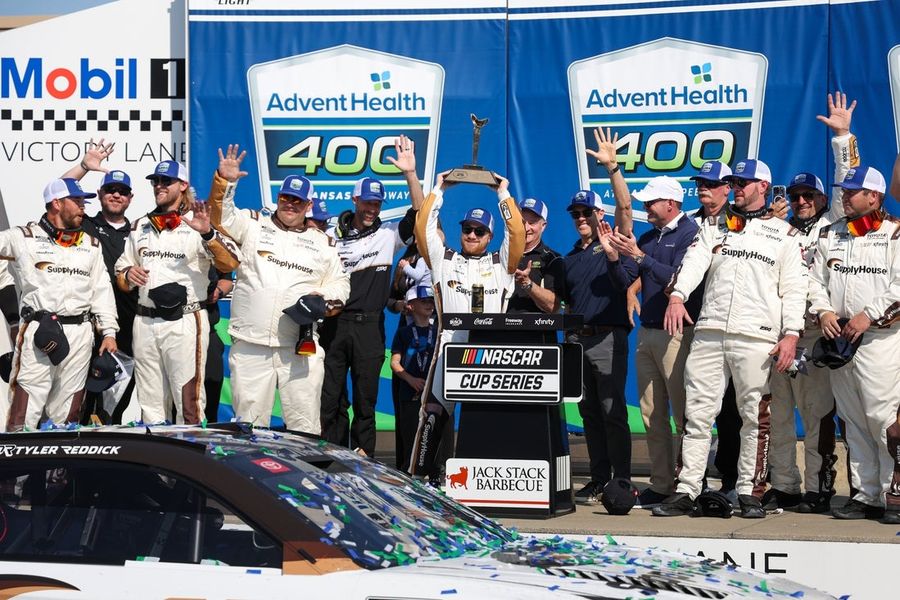
Deadspin | Saved by a spin: Tyler Reddick needs OT at Kansas to claim fifth win  Apr 19, 2026; Kansas City, Kansas, USA; NASCAR Cup Series driver Tyler Reddick (45) holds up the winner’s trophy after winning the AdventHealth 400 at Kansas Speedway. Mandatory Credit: Scott Sewell-Imagn Images   It’s still more than a week until May, but Tyler Reddick already has racked up a fistful of wins.  The 23XI Racing hotshoe passed Kyle Larson in overtime to win the NASCAR Cup Series’ AdventHealth 400 on Sunday afternoon in Kansas City, Kan. for his fifth victory in nine races.  After Cody Ware spun while leader Denny Hamlin and second-place Reddick were coming to the white flag for the race’s only caution for cause, the field pitted to set up a green-white-checker finish in overtime at Kansas Speedway.  From third, Larson charged past Hamlin on the restart to claim the lead. But second-place Reddick used his No. 45 Toyota to fly by Larson’s No. 5 Chevrolet in Turn 1 after the white flag.  He held on to beat the Hendrick Motorsports driver by 0.118 seconds for his 13th career win and become the first driver since Dale Earnhardt in 1987 to claim five of a season’s first nine races.  Reddick also won for the fourth time in a row when being the polesitter – a run that began Feb. 22 in Atlanta and included victories at Circuit of The Americas and Darlington.  Reddick appeared doomed with a few laps left when he screamed over the radio that he was out of gas, which allowed Hamlin to make what appeared to be the winning pass for the lead.  However, Ware’s spin sent the cars to pit road one last time.  “Just really blessed with the late caution,” said Reddick, who led only 10 laps and spun a Toyota stablemate in overtime’s frantic finish. “Not thrilled that I got Christopher Bell. … These late-race restarts get really crazy. Obviously, I had a run on the 5, and I was just shocked to get to his inside.”  Larson’s car would not turn in the corners.  “It all worked out great, but I was plowing in (Turns) 3 and 4,” said Larson, the race’s defending winner who became the track’s all-time lap leader — he paced 78 of them — but had his winless streak stretch to 33 races. “Reddick was really good there (at the end).”   Chase Briscoe, Hamlin and Bubba Wallace completed the first five finishers.  A Toyota won for the sixth time in the past 11 races at the Midwest speedway.  Polesitter Reddick, Hamlin and Briscoe showed Toyota supremacy early with the first two drivers swapping the lead. Then Hamlin stormed away to a 1.25-second lead 15 circuits into the 267-lap race.  Hamlin lapped up to the 21st-place car — Todd Gilliland — as drivers such as Joey Logano, Kyle Busch and Ross Chastain all were put a lap down. Larson was able to pass Reddick, but Hamlin claimed the 80-lap Stage 1 over Larson followed by Reddick, Ty Gibbs and Christopher Bell.  In the second segment, Larson began to assert himself. He immediately snatched the point from Hamlin and led until Lap 125 when he, Hamlin, Chase Elliott and Reddick pitted to split Stage 2’s 85 laps.  The completion of the second stage also was rather tame. Larson claimed the segment followed by Hamlin, Reddick, Elliot and Bell as the only problems were drivers having minor setbacks with tires.  The only cautions through the first two stages were for stage-breaks, not incidents.  On Lap 175 shortly after the restart for the run to the race’s end, Bell maneuvered by Hamlin for the lead. Wallace and Reddick rounded out a four-car Camry train with six of the top nine being Toyotas.  Running third to leader Bell and Reddick, Hamlin and Joe Gibbs Racing teammate Briscoe began the cycle of pits with 52 laps remaining to set up the finish while Reddick and Bell waited five more circuits for service.  –Field Level Media   #Deadspin #Saved #spin #Tyler #Reddick #Kansas #claim #win
Deadspin | Saved by a spin: Tyler Reddick needs OT at Kansas to claim fifth win
Deadspin | Saved by a spin: Tyler Reddick needs OT at Kansas to claim fifth win  Apr 19, 2026; Kansas City, Kansas, USA; NASCAR Cup Series driver Tyler Reddick (45) holds up the winner’s trophy after winning the AdventHealth 400 at Kansas Speedway. Mandatory Credit: Scott Sewell-Imagn Images   It’s still more than a week until May, but Tyler Reddick already has racked up a fistful of wins.  The 23XI Racing hotshoe passed Kyle Larson in overtime to win the NASCAR Cup Series’ AdventHealth 400 on Sunday afternoon in Kansas City, Kan. for his fifth victory in nine races.  After Cody Ware spun while leader Denny Hamlin and second-place Reddick were coming to the white flag for the race’s only caution for cause, the field pitted to set up a green-white-checker finish in overtime at Kansas Speedway.  From third, Larson charged past Hamlin on the restart to claim the lead. But second-place Reddick used his No. 45 Toyota to fly by Larson’s No. 5 Chevrolet in Turn 1 after the white flag.  He held on to beat the Hendrick Motorsports driver by 0.118 seconds for his 13th career win and become the first driver since Dale Earnhardt in 1987 to claim five of a season’s first nine races.  Reddick also won for the fourth time in a row when being the polesitter – a run that began Feb. 22 in Atlanta and included victories at Circuit of The Americas and Darlington.  Reddick appeared doomed with a few laps left when he screamed over the radio that he was out of gas, which allowed Hamlin to make what appeared to be the winning pass for the lead.  However, Ware’s spin sent the cars to pit road one last time.  “Just really blessed with the late caution,” said Reddick, who led only 10 laps and spun a Toyota stablemate in overtime’s frantic finish. “Not thrilled that I got Christopher Bell. … These late-race restarts get really crazy. Obviously, I had a run on the 5, and I was just shocked to get to his inside.”  Larson’s car would not turn in the corners.  “It all worked out great, but I was plowing in (Turns) 3 and 4,” said Larson, the race’s defending winner who became the track’s all-time lap leader — he paced 78 of them — but had his winless streak stretch to 33 races. “Reddick was really good there (at the end).”   Chase Briscoe, Hamlin and Bubba Wallace completed the first five finishers.  A Toyota won for the sixth time in the past 11 races at the Midwest speedway.  Polesitter Reddick, Hamlin and Briscoe showed Toyota supremacy early with the first two drivers swapping the lead. Then Hamlin stormed away to a 1.25-second lead 15 circuits into the 267-lap race.  Hamlin lapped up to the 21st-place car — Todd Gilliland — as drivers such as Joey Logano, Kyle Busch and Ross Chastain all were put a lap down. Larson was able to pass Reddick, but Hamlin claimed the 80-lap Stage 1 over Larson followed by Reddick, Ty Gibbs and Christopher Bell.  In the second segment, Larson began to assert himself. He immediately snatched the point from Hamlin and led until Lap 125 when he, Hamlin, Chase Elliott and Reddick pitted to split Stage 2’s 85 laps.  The completion of the second stage also was rather tame. Larson claimed the segment followed by Hamlin, Reddick, Elliot and Bell as the only problems were drivers having minor setbacks with tires.  The only cautions through the first two stages were for stage-breaks, not incidents.  On Lap 175 shortly after the restart for the run to the race’s end, Bell maneuvered by Hamlin for the lead. Wallace and Reddick rounded out a four-car Camry train with six of the top nine being Toyotas.  Running third to leader Bell and Reddick, Hamlin and Joe Gibbs Racing teammate Briscoe began the cycle of pits with 52 laps remaining to set up the finish while Reddick and Bell waited five more circuits for service.  –Field Level Media   #Deadspin #Saved #spin #Tyler #Reddick #Kansas #claim #winApr 19, 2026; Kansas City, Kansas, USA; NASCAR Cup Series driver Tyler Reddick (45) holds up the winner’s trophy after winning the AdventHealth 400 at Kansas Speedway. Mandatory Credit: Scott Sewell-Imagn Images

It’s still more than a week until May, but Tyler Reddick already has racked up a fistful of wins.

The 23XI Racing hotshoe passed Kyle Larson in overtime to win the NASCAR Cup Series’ AdventHealth 400 on Sunday afternoon in Kansas City, Kan. for his fifth victory in nine races.

After Cody Ware spun while leader Denny Hamlin and second-place Reddick were coming to the white flag for the race’s only caution for cause, the field pitted to set up a green-white-checker finish in overtime at Kansas Speedway.

From third, Larson charged past Hamlin on the restart to claim the lead. But second-place Reddick used his No. 45 Toyota to fly by Larson’s No. 5 Chevrolet in Turn 1 after the white flag.

He held on to beat the Hendrick Motorsports driver by 0.118 seconds for his 13th career win and become the first driver since Dale Earnhardt in 1987 to claim five of a season’s first nine races.

Reddick also won for the fourth time in a row when being the polesitter – a run that began Feb. 22 in Atlanta and included victories at Circuit of The Americas and Darlington.

Reddick appeared doomed with a few laps left when he screamed over the radio that he was out of gas, which allowed Hamlin to make what appeared to be the winning pass for the lead.

However, Ware’s spin sent the cars to pit road one last time.

“Just really blessed with the late caution,” said Reddick, who led only 10 laps and spun a Toyota stablemate in overtime’s frantic finish. “Not thrilled that I got Christopher Bell. … These late-race restarts get really crazy. Obviously, I had a run on the 5, and I was just shocked to get to his inside.”

Larson’s car would not turn in the corners.


“It all worked out great, but I was plowing in (Turns) 3 and 4,” said Larson, the race’s defending winner who became the track’s all-time lap leader — he paced 78 of them — but had his winless streak stretch to 33 races. “Reddick was really good there (at the end).”

Chase Briscoe, Hamlin and Bubba Wallace completed the first five finishers.

A Toyota won for the sixth time in the past 11 races at the Midwest speedway.

Polesitter Reddick, Hamlin and Briscoe showed Toyota supremacy early with the first two drivers swapping the lead. Then Hamlin stormed away to a 1.25-second lead 15 circuits into the 267-lap race.

Hamlin lapped up to the 21st-place car — Todd Gilliland — as drivers such as Joey Logano, Kyle Busch and Ross Chastain all were put a lap down. Larson was able to pass Reddick, but Hamlin claimed the 80-lap Stage 1 over Larson followed by Reddick, Ty Gibbs and Christopher Bell.

In the second segment, Larson began to assert himself. He immediately snatched the point from Hamlin and led until Lap 125 when he, Hamlin, Chase Elliott and Reddick pitted to split Stage 2’s 85 laps.

The completion of the second stage also was rather tame. Larson claimed the segment followed by Hamlin, Reddick, Elliot and Bell as the only problems were drivers having minor setbacks with tires.

The only cautions through the first two stages were for stage-breaks, not incidents.

On Lap 175 shortly after the restart for the run to the race’s end, Bell maneuvered by Hamlin for the lead. Wallace and Reddick rounded out a four-car Camry train with six of the top nine being Toyotas.

Running third to leader Bell and Reddick, Hamlin and Joe Gibbs Racing teammate Briscoe began the cycle of pits with 52 laps remaining to set up the finish while Reddick and Bell waited five more circuits for service.

–Field Level Media

#Deadspin #Saved #spin #Tyler #Reddick #Kansas #claim #win

Apr 19, 2026; Kansas City, Kansas, USA; NASCAR Cup Series driver Tyler Reddick (45) holds up the winner’s trophy after winning the AdventHealth 400 at Kansas Speedway. Mandatory Credit: Scott Sewell-Imagn Images

It’s still more than a week until May, but Tyler Reddick already has racked up a fistful of wins.

The 23XI Racing hotshoe passed Kyle Larson in overtime to win the NASCAR Cup Series’ AdventHealth 400 on Sunday afternoon in Kansas City, Kan. for his fifth victory in nine races.

After Cody Ware spun while leader Denny Hamlin and second-place Reddick were coming to the white flag for the race’s only caution for cause, the field pitted to set up a green-white-checker finish in overtime at Kansas Speedway.

From third, Larson charged past Hamlin on the restart to claim the lead. But second-place Reddick used his No. 45 Toyota to fly by Larson’s No. 5 Chevrolet in Turn 1 after the white flag.

He held on to beat the Hendrick Motorsports driver by 0.118 seconds for his 13th career win and become the first driver since Dale Earnhardt in 1987 to claim five of a season’s first nine races.

Reddick also won for the fourth time in a row when being the polesitter – a run that began Feb. 22 in Atlanta and included victories at Circuit of The Americas and Darlington.

Reddick appeared doomed with a few laps left when he screamed over the radio that he was out of gas, which allowed Hamlin to make what appeared to be the winning pass for the lead.

However, Ware’s spin sent the cars to pit road one last time.

“Just really blessed with the late caution,” said Reddick, who led only 10 laps and spun a Toyota stablemate in overtime’s frantic finish. “Not thrilled that I got Christopher Bell. … These late-race restarts get really crazy. Obviously, I had a run on the 5, and I was just shocked to get to his inside.”

Larson’s car would not turn in the corners.

“It all worked out great, but I was plowing in (Turns) 3 and 4,” said Larson, the race’s defending winner who became the track’s all-time lap leader — he paced 78 of them — but had his winless streak stretch to 33 races. “Reddick was really good there (at the end).”

Chase Briscoe, Hamlin and Bubba Wallace completed the first five finishers.

A Toyota won for the sixth time in the past 11 races at the Midwest speedway.

Polesitter Reddick, Hamlin and Briscoe showed Toyota supremacy early with the first two drivers swapping the lead. Then Hamlin stormed away to a 1.25-second lead 15 circuits into the 267-lap race.

Hamlin lapped up to the 21st-place car — Todd Gilliland — as drivers such as Joey Logano, Kyle Busch and Ross Chastain all were put a lap down. Larson was able to pass Reddick, but Hamlin claimed the 80-lap Stage 1 over Larson followed by Reddick, Ty Gibbs and Christopher Bell.

In the second segment, Larson began to assert himself. He immediately snatched the point from Hamlin and led until Lap 125 when he, Hamlin, Chase Elliott and Reddick pitted to split Stage 2’s 85 laps.

The completion of the second stage also was rather tame. Larson claimed the segment followed by Hamlin, Reddick, Elliot and Bell as the only problems were drivers having minor setbacks with tires.

The only cautions through the first two stages were for stage-breaks, not incidents.

On Lap 175 shortly after the restart for the run to the race’s end, Bell maneuvered by Hamlin for the lead. Wallace and Reddick rounded out a four-car Camry train with six of the top nine being Toyotas.

Running third to leader Bell and Reddick, Hamlin and Joe Gibbs Racing teammate Briscoe began the cycle of pits with 52 laps remaining to set up the finish while Reddick and Bell waited five more circuits for service.

–Field Level Media

Source link
#Deadspin #Saved #spin #Tyler #Reddick #Kansas #claim #win

Previous post

Wolves relegated from Premier League after West Ham draws goalless with Palace <div id="content-body-70887060" itemprop="articleBody"><p>Wolverhampton Wanderers was relegated from the Premier League on Monday after West Ham’s goalless draw at Crystal Palace sealed their fate.</p><p>The Midlands club is now 16 points behind fourth-bottom West Ham with just five games to go and is mathematically certain to drop down to the Championship.</p><p>The Wolves, managed by Rob Edwards since November, have endured a miserable campaign, winning just three league matches from their 33 games to date.</p><p>Despite notable recent wins against Aston Villa and Liverpool, they have looked relegation certainties for months and their eight-year stay in the Premier League is coming to an end.</p><p>Vitor Pereira, now in charge of Nottingham Forest, started the season in charge of the Molineux club but the Portuguese coach was sacked in early November after a terrible start to the campaign.</p><p>Former Middlesbrough boss Edwards was brought in but he had an almost impossible task and has been unable to work a miracle.</p><p>Second from bottom Burnley looks certain to join Wolves in the second tier next season. It will be relegated if it loses to title-chasing Manchester City on Wednesday.</p><p>Tottenham came agonisingly close to climbing out of the relegation zone on Saturday but conceded a last-gasp equaliser in a 2-2 draw against Brighton.</p><p>The north Londoners have not won a Premier League match since December, with new boss Roberto De Zerbi winless in his first two games.</p><p>Nottingham Forest and Leeds are also in the relegation battle, but both won at the weekend to pull well clear of the drop zone.</p><p>Frank Lampard’s Coventry, currently top of the Championship, on Friday sealed its return to the Premier League next season after a 25-year absence.</p><p class="publish-time" id="end-of-article">Published on Apr 21, 2026</p></div> #Wolves #relegated #Premier #League #West #Ham #draws #goalless #Palace

Next post

French Open 2026: Alcaraz may skip Roland Garros rather than rush injury comeback <div id="content-body-70887072" itemprop="articleBody"><p>French Open champion Carlos Alcaraz insisted Monday he would rather miss defending the Roland Garros title in May rather than rush treatment on a “serious” wrist injury.</p><p>The 22-year-old pulled out of the Barcelona clay-court tournament last week when he felt his wrist “give out on a return” and then revealed the injury to be “a more serious injury than any of us expected”.</p><p>He then pulled out of the Madrid Open on Friday, casting doubt on his participation in Paris as of May 18.</p><p>On Monday that doubt deepened when he told press at an award ceremony he was taking a long term view.</p><p>“I’d rather come back a little later but in great shape than come back early, rushing around, and unwell.”</p><p>“God willing, I have a very long career ahead of me, many years, and pushing myself too hard at this Roland Garros could seriously harm me in future tournaments,” he said Monday.</p><p>“Things happen in the professional world. You have to accept them,” he said. “I need to recover really well if I don’t want it to affect me later on.”</p><p>The World No. 2 lost his top ranking following his defeat by Jannik Sinner in the Monte Carlo Masters final April 12.</p><p>Before that, Alcaraz had won his past 17 matches on clay, dating back to last season when he lifted titles in Rome and at Roland Garros.</p><p class="publish-time" id="end-of-article">Published on Apr 21, 2026</p></div> #French #Open #Alcaraz #skip #Roland #Garros #rush #injury #comeback

CHICAGO – Indiana Pacers president of basketball operations Kevin Pritchard could hardly sleep the night before the NBA Draft lottery.

Who could, in his situation? In a daring trade to acquire Ivica Zubac back in February, the Pacers sent, among other things, their 2026 first-round draft pick to the Los Angeles Clippers. It was protected 1-4 and 10-30, meaning the Clippers could only receive the selection if it landed 5-9. On Sunday, a machine full of ping pong balls would decide which team would be blessed by fate. 52.1% of the time, the answer would be the Pacers. The other 47.9% would benefit L.A.

It was basically a coin flip, at least by odds. Maybe that’s too tame. It was closer to Russian Roulette but with a shade under 2.9 bullets; with just a couple of spins in a chamber they didn’t have eyes on to decide their fate.

Coin flip odds are more instructive. Heads, the trade looks incredible for the Pacers. They acquire a center that they covet, one who nearly made an All–NBA team in 2024-25. They send out two first-rounders in future seasons with worse lottery odds, plus two players who were fading in their plans. A near-perfect addition. Tails, it looks much worse for them. Add a top-five prospect in a very strong draft to that above trade package, and that’s after Zubac barely suited up thanks to injuries. Worst of all, it would mean the Pacers finished with the second-worst record in the NBA and didn’t get the lotto luck for it. How the deal feels could change over the next five years as assets continue to be exchanged, but the Pacers 2026 first-rounder was the best non-Zubac asset moved in the deal. Who would actually use that pick came down to the lottery.

“The truth is, I didn’t sleep much last night. And [Pacers general manager] Chad (Buchanan) and I kind of got away and walked. And we were trying to plan out everything, for the good, for the bad,” Pritchard explained.

As the lottery results were being revealed, Pritchard said his heart was beating like Game 7 of the NBA Finals. He would have been a terrible poker player on Sunday – his emotional state was obvious even to onlookers 30 feet away. And truly, as a trio of Pacers involved in the lottery broadcast sat to witness their fate, only one was able to hide their emotions as a Clippers logo was shown to a room filled with hundreds of people. Millions more watched on television.

The draft lottery and subsequent unveiling of results were held in Chicago’s Navy Pier. A massive Festival Hall was sectioned off, with about one-fourth of the room converted into a stage and viewing area for the proceedings. Every team involved in the lottery had a table in the front of the room for their executives to sit at – the Pacers’ was in the middle row on the left side between the Washington Wizards and Brooklyn Nets.

The only two at the Pacers table were Pritchard and Buchanan. They’ve worked together for years, originally overlapping with the Portland Trail Blazers over two decades ago. Now, they’re the leaders of Indiana’s front office – the other top figure of the group, vice president of basketball operations Ted Wu, was the team’s lottery representative who was in the room for the drawing.

So it was just Buchanan and Pritchard, the smallest number of team representatives at any table. The third figure in the room was guard T.J. McConnell, the Pacers’ on-stage lottery representative. He’s the longest-tenured Pacer and was a rookie with the 2015-16 Philadelphia 76ers, a team that went 10-72 before winning the 2016 draft lottery. McConnell wanted to bring that luck to the Pacers.

There was a hope emanating from the Pacers about 30 minutes before the big reveal. Pritchard and Buchanan spoke with league figures like any other big NBA event – Pritchard congratulated new Mavericks president Masai Ujiri on his new job. Buchanan caught up with executives on another lottery team. There were smiles, at first. They believed they were due for some luck.

“Obviously not good news,” McConnell would be saying about a half hour later.

The two executives sat down, still awaiting the results. Something about doing so made reality settle in. For the next eternity – okay, still just 30 minutes – the Pacers front office leaders had to sit there, powerless against their fate, with judgment coming their way regardless of the result. For a few minutes, neither said a word.

Pritchard showed the most outward emotion. He chewed gum the entire event. At 1:48 p.m. local time, he put on his glasses. Four minutes later, he took them off to fidget with them on the table. The next minute, he put them on for the second time in five minutes.

Buchanan was far more rigid. At 1:51, he adjusted his collar, then was still for several minutes. Next to Pritchard, he looked like a statue. It was the perfect picture of the two and their personalities – and a display of why they’ve worked so well together for all these years as partners in the NBA.

At 1:59, Buchanan’s trance ended as he checked his phone. At the same time, Pritchard did the same. He put his phone away four minutes later, then frantically looked around the room before running his hands through his hair. Both executives were looking for something, anything, to distract them at that moment.

“I know the Twitterverse is probably going to be a little brutal. And I get it, man, I get it,” Pritchard would say later, fitting for someone whose phone became a key prop for fiddling and posting during the day. ”To those people, I’m sorry.”

In came McConnell to provide that diversion. In a sea of suit-wearing lottery representatives, McConnell took the court in a yellow button-up shirt and black pants. He was situated on the same side of the room as the Pacers’ executive table, so he had a clear view of Pritchard and Buchanan.

McConnell reached his seat. He gave John Wall – the Washington Wizards lottery representative – a high five before pulling his phone out and putting it on silent. The next moment, he gave a quick glance to the Pacers front office members gathered about 40 feet away from him. They all made eye contact. Suddenly, McConnell’s mood was serious. Nerves returned for everyone.

The broadcast began as ESPN’s Malika Andrews began to walk across the front of the room to interview the consensus top-three prospects in the coming draft. AJ Dybantsa was first. Right in the background of the interview, Pritchard could be seen as clear as day. Six minutes later, Andrews was finished and NBA deputy commissioner Mark Tatum took the stage. He was about to reveal the results.

As Tatum pulled the first card out of a folder to reveal which team would be picking 14th, Buchanan put his elbows on the table. It was his first movement in over five minutes. The Pacers had nothing to worry about until the sixth pick, but the start of the process increased the tension.

No teams jumped into the top four until the Chicago Bulls, who entered the day with the ninth-best odds to do so. When the Dallas Mavericks were revealed to have the ninth pick, that meant the Bulls jumped into the top four. Pritchard stroked his chin, thinking about how that would impact his team.

One minute later, the Memphis Grizzlies also jumped up into the top four. It’s 2:17 now, and both Buchanan and Pritchard are rubbing their chins. They each leaned forward. The team picking sixth was about to be announced. Time for the stressful part.

Tatum pulled out the card for the sixth slot. Up came a Brooklyn Nets logo. There was little reaction from Pacers executives. McConnell looked out over the crowd. There was one final reveal to go.

Between Tatum saying “Nets” and pulling out the card for the fifth pick, 13 seconds passed. To Pritchard and Buchanan, it felt like 13 days. Tatum began his lines. “The fifth pick in the NBA Draft will be made by…

“The LA Clippers,” he said, holding up a Clippers logo. McConnell stared off into space. Buchanan didn’t move. Pritchard took a few seconds before re-adjusting in his chair.

The team’s gamble was a loss. The best possible pick they could send to the Clippers is, in fact, going to the Clippers. It took five minutes before Buchanan moved at all, slightly loosening his posture at 2:23. McConnell walked off the stage and chatted briefly with Charlotte Hornets forward and lottery representative Kon Knueppel.

There was a commercial break before the top-four picks were announced, but that break in the action did little to change the demeanor of Buchanan, Pritchard, or McConnell. All three looked almost shell-shocked despite knowing the odds entering the event.

McConnell’s darting glances after it became reality the pick was going to the Clippers were intentional. Moments earlier, his heart was beating “so fast,” yet there wasn’t a thing he could do about it. LA got the pick, and McConnell couldn’t even look at his front office reps

“In a way, I felt like I was letting him down,” McConnell said. “I know there’s no reason to feel that way, but just weirdly do.”

Wall’s Wizards were announced as the winners of the lottery a few minutes later. The broadcast ended, then executives and some high-profile draft prospects all chatted at the front of the room. Buchanan and Pritchard stayed near their table area but stood up and joined in on some conversations.

The 47.9% chance of losing their pick had actually happened. The odds said that was the most likely outcome for the team, but something about the draft lottery messes with everyone’s brain. It just seems like nothing bad will happen, until it does.

Pritchard couldn’t hide his emotions all afternoon. He was so fidgety that it was clear he was nervous in some way. As he began to speak with reporters not long after the event ended, the team president made his mental state even more clear.

“We’re all disappointed,” Pritchard said. That was a theme. “Disappointed because this is a great draft,” he added later. As he continued speaking, Pritchard kept making it clear how talented the team thinks Zubac is. But he would also catch himself by repeating that emotion.

“What we’ve learned from (Zubac) so far is he’s super smart, and he wants to fit in, and he’s all about winning. And again, disappointed. I’m not trying to smooth over that. We wanted to pick, but we’ll be okay,” Pritchard said. Just over 30 seconds later, a repeat. “Again, I wanted to pick. We wanted to pick, and I know people are going to be disappointed. But you have to remember, our top seven or eight players are still with us. So today it stings. But wait till next season. Let’s give this group an opportunity to go compete for a championship. Because they’ve proven they can do it.”

Indeed they have. The Pacers made the NBA Finals in 2025, then upgraded at center from Myles Turner to Zubac. A top-four would have been a perfect addition to round out the team for the next few years.

Many Pacers players couldn’t sleep before Game 7 of that series. They were nervous for the big stage. That was identical to Pritchard on Sunday, who had a ton of anticipation and wanted the lottery win for his owner, longtime Pacers governor Herb Simon.

“My heart hurts for Mr. Simon, if I’m honest. He’s such a good person and he wants it for Indiana like we all want it. In a way, I feel like I’ve let the organization down,” Pritchard said.

He and McConnell shared that emotion. The lottery brings out the hope in everybody. But instead, the Clippers will pick fifth, a painful twist of fate. It’s why Pritchard couldn’t sleep the night before and why the Pacers trade was viewed as risky. This risk didn’t pay off, but the Zubac trade still can. If Pritchard has his way, his next sleepless night will come before an NBA Finals game with Zubac leading his team’s defense. But there could be more tossing and turning in store for him if Zubac isn’t a perfect fit right away or, worse, the fifth pick turns into a star for the Clippers. Time, as with all trades, will tell if Pritchard’s future sleepless nights will be for positive or negative reasons. He’ll just have to hope for better than 52.1% odds of positive outcomes this time.

#NBA #Draft #Lottery #Pacers #big #gamble #agonizingly #short">Inside the NBA Draft Lottery, where the Pacers’ big gamble came up agonizingly short  CHICAGO – Indiana Pacers president of basketball operations Kevin Pritchard could hardly sleep the night before the NBA Draft lottery.Who could, in his situation? In a daring trade to acquire Ivica Zubac back in February, the Pacers sent, among other things, their 2026 first-round draft pick to the Los Angeles Clippers. It was protected 1-4 and 10-30, meaning the Clippers could only receive the selection if it landed 5-9. On Sunday, a machine full of ping pong balls would decide which team would be blessed by fate. 52.1% of the time, the answer would be the Pacers. The other 47.9% would benefit L.A.It was basically a coin flip, at least by odds. Maybe that’s too tame. It was closer to Russian Roulette but with a shade under 2.9 bullets; with just a couple of spins in a chamber they didn’t have eyes on to decide their fate.Coin flip odds are more instructive. Heads, the trade looks incredible for the Pacers. They acquire a center that they covet, one who nearly made an All–NBA team in 2024-25. They send out two first-rounders in future seasons with worse lottery odds, plus two players who were fading in their plans. A near-perfect addition. Tails, it looks much worse for them. Add a top-five prospect in a very strong draft to that above trade package, and that’s after Zubac barely suited up thanks to injuries. Worst of all, it would mean the Pacers finished with the second-worst record in the NBA and didn’t get the lotto luck for it. How the deal feels could change over the next five years as assets continue to be exchanged, but the Pacers 2026 first-rounder was the best non-Zubac asset moved in the deal. Who would actually use that pick came down to the lottery.“The truth is, I didn’t sleep much last night. And [Pacers general manager] Chad (Buchanan) and I kind of got away and walked. And we were trying to plan out everything, for the good, for the bad,” Pritchard explained.As the lottery results were being revealed, Pritchard said his heart was beating like Game 7 of the NBA Finals. He would have been a terrible poker player on Sunday – his emotional state was obvious even to onlookers 30 feet away. And truly, as a trio of Pacers involved in the lottery broadcast sat to witness their fate, only one was able to hide their emotions as a Clippers logo was shown to a room filled with hundreds of people. Millions more watched on television.The draft lottery and subsequent unveiling of results were held in Chicago’s Navy Pier. A massive Festival Hall was sectioned off, with about one-fourth of the room converted into a stage and viewing area for the proceedings. Every team involved in the lottery had a table in the front of the room for their executives to sit at – the Pacers’ was in the middle row on the left side between the Washington Wizards and Brooklyn Nets.The only two at the Pacers table were Pritchard and Buchanan. They’ve worked together for years, originally overlapping with the Portland Trail Blazers over two decades ago. Now, they’re the leaders of Indiana’s front office – the other top figure of the group, vice president of basketball operations Ted Wu, was the team’s lottery representative who was in the room for the drawing.So it was just Buchanan and Pritchard, the smallest number of team representatives at any table. The third figure in the room was guard T.J. McConnell, the Pacers’ on-stage lottery representative. He’s the longest-tenured Pacer and was a rookie with the 2015-16 Philadelphia 76ers, a team that went 10-72 before winning the 2016 draft lottery. McConnell wanted to bring that luck to the Pacers.There was a hope emanating from the Pacers about 30 minutes before the big reveal. Pritchard and Buchanan spoke with league figures like any other big NBA event – Pritchard congratulated new Mavericks president Masai Ujiri on his new job. Buchanan caught up with executives on another lottery team. There were smiles, at first. They believed they were due for some luck.“Obviously not good news,” McConnell would be saying about a half hour later.The two executives sat down, still awaiting the results. Something about doing so made reality settle in. For the next eternity – okay, still just 30 minutes – the Pacers front office leaders had to sit there, powerless against their fate, with judgment coming their way regardless of the result. For a few minutes, neither said a word.Pritchard showed the most outward emotion. He chewed gum the entire event. At 1:48 p.m. local time, he put on his glasses. Four minutes later, he took them off to fidget with them on the table. The next minute, he put them on for the second time in five minutes.Buchanan was far more rigid. At 1:51, he adjusted his collar, then was still for several minutes. Next to Pritchard, he looked like a statue. It was the perfect picture of the two and their personalities – and a display of why they’ve worked so well together for all these years as partners in the NBA.At 1:59, Buchanan’s trance ended as he checked his phone. At the same time, Pritchard did the same. He put his phone away four minutes later, then frantically looked around the room before running his hands through his hair. Both executives were looking for something, anything, to distract them at that moment.“I know the Twitterverse is probably going to be a little brutal. And I get it, man, I get it,” Pritchard would say later, fitting for someone whose phone became a key prop for fiddling and posting during the day. ”To those people, I’m sorry.”In came McConnell to provide that diversion. In a sea of suit-wearing lottery representatives, McConnell took the court in a yellow button-up shirt and black pants. He was situated on the same side of the room as the Pacers’ executive table, so he had a clear view of Pritchard and Buchanan.McConnell reached his seat. He gave John Wall – the Washington Wizards lottery representative – a high five before pulling his phone out and putting it on silent. The next moment, he gave a quick glance to the Pacers front office members gathered about 40 feet away from him. They all made eye contact. Suddenly, McConnell’s mood was serious. Nerves returned for everyone.The broadcast began as ESPN’s Malika Andrews began to walk across the front of the room to interview the consensus top-three prospects in the coming draft. AJ Dybantsa was first. Right in the background of the interview, Pritchard could be seen as clear as day. Six minutes later, Andrews was finished and NBA deputy commissioner Mark Tatum took the stage. He was about to reveal the results.As Tatum pulled the first card out of a folder to reveal which team would be picking 14th, Buchanan put his elbows on the table. It was his first movement in over five minutes. The Pacers had nothing to worry about until the sixth pick, but the start of the process increased the tension.No teams jumped into the top four until the Chicago Bulls, who entered the day with the ninth-best odds to do so. When the Dallas Mavericks were revealed to have the ninth pick, that meant the Bulls jumped into the top four. Pritchard stroked his chin, thinking about how that would impact his team.One minute later, the Memphis Grizzlies also jumped up into the top four. It’s 2:17 now, and both Buchanan and Pritchard are rubbing their chins. They each leaned forward. The team picking sixth was about to be announced. Time for the stressful part.Tatum pulled out the card for the sixth slot. Up came a Brooklyn Nets logo. There was little reaction from Pacers executives. McConnell looked out over the crowd. There was one final reveal to go.Between Tatum saying “Nets” and pulling out the card for the fifth pick, 13 seconds passed. To Pritchard and Buchanan, it felt like 13 days. Tatum began his lines. “The fifth pick in the NBA Draft will be made by…“The LA Clippers,” he said, holding up a Clippers logo. McConnell stared off into space. Buchanan didn’t move. Pritchard took a few seconds before re-adjusting in his chair.The team’s gamble was a loss. The best possible pick they could send to the Clippers is, in fact, going to the Clippers. It took five minutes before Buchanan moved at all, slightly loosening his posture at 2:23. McConnell walked off the stage and chatted briefly with Charlotte Hornets forward and lottery representative Kon Knueppel.There was a commercial break before the top-four picks were announced, but that break in the action did little to change the demeanor of Buchanan, Pritchard, or McConnell. All three looked almost shell-shocked despite knowing the odds entering the event.McConnell’s darting glances after it became reality the pick was going to the Clippers were intentional. Moments earlier, his heart was beating “so fast,” yet there wasn’t a thing he could do about it. LA got the pick, and McConnell couldn’t even look at his front office reps“In a way, I felt like I was letting him down,” McConnell said. “I know there’s no reason to feel that way, but just weirdly do.”Wall’s Wizards were announced as the winners of the lottery a few minutes later. The broadcast ended, then executives and some high-profile draft prospects all chatted at the front of the room. Buchanan and Pritchard stayed near their table area but stood up and joined in on some conversations.The 47.9% chance of losing their pick had actually happened. The odds said that was the most likely outcome for the team, but something about the draft lottery messes with everyone’s brain. It just seems like nothing bad will happen, until it does.Pritchard couldn’t hide his emotions all afternoon. He was so fidgety that it was clear he was nervous in some way. As he began to speak with reporters not long after the event ended, the team president made his mental state even more clear.“We’re all disappointed,” Pritchard said. That was a theme. “Disappointed because this is a great draft,” he added later. As he continued speaking, Pritchard kept making it clear how talented the team thinks Zubac is. But he would also catch himself by repeating that emotion.“What we’ve learned from (Zubac) so far is he’s super smart, and he wants to fit in, and he’s all about winning. And again, disappointed. I’m not trying to smooth over that. We wanted to pick, but we’ll be okay,” Pritchard said. Just over 30 seconds later, a repeat. “Again, I wanted to pick. We wanted to pick, and I know people are going to be disappointed. But you have to remember, our top seven or eight players are still with us. So today it stings. But wait till next season. Let’s give this group an opportunity to go compete for a championship. Because they’ve proven they can do it.”Indeed they have. The Pacers made the NBA Finals in 2025, then upgraded at center from Myles Turner to Zubac. A top-four would have been a perfect addition to round out the team for the next few years.Many Pacers players couldn’t sleep before Game 7 of that series. They were nervous for the big stage. That was identical to Pritchard on Sunday, who had a ton of anticipation and wanted the lottery win for his owner, longtime Pacers governor Herb Simon.“My heart hurts for Mr. Simon, if I’m honest. He’s such a good person and he wants it for Indiana like we all want it. In a way, I feel like I’ve let the organization down,” Pritchard said.He and McConnell shared that emotion. The lottery brings out the hope in everybody. But instead, the Clippers will pick fifth, a painful twist of fate. It’s why Pritchard couldn’t sleep the night before and why the Pacers trade was viewed as risky. This risk didn’t pay off, but the Zubac trade still can. If Pritchard has his way, his next sleepless night will come before an NBA Finals game with Zubac leading his team’s defense. But there could be more tossing and turning in store for him if Zubac isn’t a perfect fit right away or, worse, the fifth pick turns into a star for the Clippers. Time, as with all trades, will tell if Pritchard’s future sleepless nights will be for positive or negative reasons. He’ll just have to hope for better than 52.1% odds of positive outcomes this time.  #NBA #Draft #Lottery #Pacers #big #gamble #agonizingly #short

He’s the longest-tenured Pacer and was a rookie with the 2015-16 Philadelphia 76ers, a team that went 10-72 before winning the 2016 draft lottery. McConnell wanted to bring that luck to the Pacers.

There was a hope emanating from the Pacers about 30 minutes before the big reveal. Pritchard and Buchanan spoke with league figures like any other big NBA event – Pritchard congratulated new Mavericks president Masai Ujiri on his new job. Buchanan caught up with executives on another lottery team. There were smiles, at first. They believed they were due for some luck.

“Obviously not good news,” McConnell would be saying about a half hour later.

The two executives sat down, still awaiting the results. Something about doing so made reality settle in. For the next eternity – okay, still just 30 minutes – the Pacers front office leaders had to sit there, powerless against their fate, with judgment coming their way regardless of the result. For a few minutes, neither said a word.

Pritchard showed the most outward emotion. He chewed gum the entire event. At 1:48 p.m. local time, he put on his glasses. Four minutes later, he took them off to fidget with them on the table. The next minute, he put them on for the second time in five minutes.

Buchanan was far more rigid. At 1:51, he adjusted his collar, then was still for several minutes. Next to Pritchard, he looked like a statue. It was the perfect picture of the two and their personalities – and a display of why they’ve worked so well together for all these years as partners in the NBA.

At 1:59, Buchanan’s trance ended as he checked his phone. At the same time, Pritchard did the same. He put his phone away four minutes later, then frantically looked around the room before running his hands through his hair. Both executives were looking for something, anything, to distract them at that moment.

“I know the Twitterverse is probably going to be a little brutal. And I get it, man, I get it,” Pritchard would say later, fitting for someone whose phone became a key prop for fiddling and posting during the day. ”To those people, I’m sorry.”

In came McConnell to provide that diversion. In a sea of suit-wearing lottery representatives, McConnell took the court in a yellow button-up shirt and black pants. He was situated on the same side of the room as the Pacers’ executive table, so he had a clear view of Pritchard and Buchanan.

McConnell reached his seat. He gave John Wall – the Washington Wizards lottery representative – a high five before pulling his phone out and putting it on silent. The next moment, he gave a quick glance to the Pacers front office members gathered about 40 feet away from him. They all made eye contact. Suddenly, McConnell’s mood was serious. Nerves returned for everyone.

The broadcast began as ESPN’s Malika Andrews began to walk across the front of the room to interview the consensus top-three prospects in the coming draft. AJ Dybantsa was first. Right in the background of the interview, Pritchard could be seen as clear as day. Six minutes later, Andrews was finished and NBA deputy commissioner Mark Tatum took the stage. He was about to reveal the results.

As Tatum pulled the first card out of a folder to reveal which team would be picking 14th, Buchanan put his elbows on the table. It was his first movement in over five minutes. The Pacers had nothing to worry about until the sixth pick, but the start of the process increased the tension.

No teams jumped into the top four until the Chicago Bulls, who entered the day with the ninth-best odds to do so. When the Dallas Mavericks were revealed to have the ninth pick, that meant the Bulls jumped into the top four. Pritchard stroked his chin, thinking about how that would impact his team.

One minute later, the Memphis Grizzlies also jumped up into the top four. It’s 2:17 now, and both Buchanan and Pritchard are rubbing their chins. They each leaned forward. The team picking sixth was about to be announced. Time for the stressful part.

Tatum pulled out the card for the sixth slot. Up came a Brooklyn Nets logo. There was little reaction from Pacers executives. McConnell looked out over the crowd. There was one final reveal to go.

Between Tatum saying “Nets” and pulling out the card for the fifth pick, 13 seconds passed. To Pritchard and Buchanan, it felt like 13 days. Tatum began his lines. “The fifth pick in the NBA Draft will be made by…

“The LA Clippers,” he said, holding up a Clippers logo. McConnell stared off into space. Buchanan didn’t move. Pritchard took a few seconds before re-adjusting in his chair.

The team’s gamble was a loss. The best possible pick they could send to the Clippers is, in fact, going to the Clippers. It took five minutes before Buchanan moved at all, slightly loosening his posture at 2:23. McConnell walked off the stage and chatted briefly with Charlotte Hornets forward and lottery representative Kon Knueppel.

There was a commercial break before the top-four picks were announced, but that break in the action did little to change the demeanor of Buchanan, Pritchard, or McConnell. All three looked almost shell-shocked despite knowing the odds entering the event.

McConnell’s darting glances after it became reality the pick was going to the Clippers were intentional. Moments earlier, his heart was beating “so fast,” yet there wasn’t a thing he could do about it. LA got the pick, and McConnell couldn’t even look at his front office reps

“In a way, I felt like I was letting him down,” McConnell said. “I know there’s no reason to feel that way, but just weirdly do.”

Wall’s Wizards were announced as the winners of the lottery a few minutes later. The broadcast ended, then executives and some high-profile draft prospects all chatted at the front of the room. Buchanan and Pritchard stayed near their table area but stood up and joined in on some conversations.

The 47.9% chance of losing their pick had actually happened. The odds said that was the most likely outcome for the team, but something about the draft lottery messes with everyone’s brain. It just seems like nothing bad will happen, until it does.

Pritchard couldn’t hide his emotions all afternoon. He was so fidgety that it was clear he was nervous in some way. As he began to speak with reporters not long after the event ended, the team president made his mental state even more clear.

“We’re all disappointed,” Pritchard said. That was a theme. “Disappointed because this is a great draft,” he added later. As he continued speaking, Pritchard kept making it clear how talented the team thinks Zubac is. But he would also catch himself by repeating that emotion.

“What we’ve learned from (Zubac) so far is he’s super smart, and he wants to fit in, and he’s all about winning. And again, disappointed. I’m not trying to smooth over that. We wanted to pick, but we’ll be okay,” Pritchard said. Just over 30 seconds later, a repeat. “Again, I wanted to pick. We wanted to pick, and I know people are going to be disappointed. But you have to remember, our top seven or eight players are still with us. So today it stings. But wait till next season. Let’s give this group an opportunity to go compete for a championship. Because they’ve proven they can do it.”

Indeed they have. The Pacers made the NBA Finals in 2025, then upgraded at center from Myles Turner to Zubac. A top-four would have been a perfect addition to round out the team for the next few years.

Many Pacers players couldn’t sleep before Game 7 of that series. They were nervous for the big stage. That was identical to Pritchard on Sunday, who had a ton of anticipation and wanted the lottery win for his owner, longtime Pacers governor Herb Simon.

“My heart hurts for Mr. Simon, if I’m honest. He’s such a good person and he wants it for Indiana like we all want it. In a way, I feel like I’ve let the organization down,” Pritchard said.

He and McConnell shared that emotion. The lottery brings out the hope in everybody. But instead, the Clippers will pick fifth, a painful twist of fate. It’s why Pritchard couldn’t sleep the night before and why the Pacers trade was viewed as risky. This risk didn’t pay off, but the Zubac trade still can. If Pritchard has his way, his next sleepless night will come before an NBA Finals game with Zubac leading his team’s defense. But there could be more tossing and turning in store for him if Zubac isn’t a perfect fit right away or, worse, the fifth pick turns into a star for the Clippers. Time, as with all trades, will tell if Pritchard’s future sleepless nights will be for positive or negative reasons. He’ll just have to hope for better than 52.1% odds of positive outcomes this time.

#NBA #Draft #Lottery #Pacers #big #gamble #agonizingly #short">Inside the NBA Draft Lottery, where the Pacers’ big gamble came up agonizingly short

CHICAGO – Indiana Pacers president of basketball operations Kevin Pritchard could hardly sleep the night before the NBA Draft lottery.

Who could, in his situation? In a daring trade to acquire Ivica Zubac back in February, the Pacers sent, among other things, their 2026 first-round draft pick to the Los Angeles Clippers. It was protected 1-4 and 10-30, meaning the Clippers could only receive the selection if it landed 5-9. On Sunday, a machine full of ping pong balls would decide which team would be blessed by fate. 52.1% of the time, the answer would be the Pacers. The other 47.9% would benefit L.A.

It was basically a coin flip, at least by odds. Maybe that’s too tame. It was closer to Russian Roulette but with a shade under 2.9 bullets; with just a couple of spins in a chamber they didn’t have eyes on to decide their fate.

Coin flip odds are more instructive. Heads, the trade looks incredible for the Pacers. They acquire a center that they covet, one who nearly made an All–NBA team in 2024-25. They send out two first-rounders in future seasons with worse lottery odds, plus two players who were fading in their plans. A near-perfect addition. Tails, it looks much worse for them. Add a top-five prospect in a very strong draft to that above trade package, and that’s after Zubac barely suited up thanks to injuries. Worst of all, it would mean the Pacers finished with the second-worst record in the NBA and didn’t get the lotto luck for it. How the deal feels could change over the next five years as assets continue to be exchanged, but the Pacers 2026 first-rounder was the best non-Zubac asset moved in the deal. Who would actually use that pick came down to the lottery.

“The truth is, I didn’t sleep much last night. And [Pacers general manager] Chad (Buchanan) and I kind of got away and walked. And we were trying to plan out everything, for the good, for the bad,” Pritchard explained.

As the lottery results were being revealed, Pritchard said his heart was beating like Game 7 of the NBA Finals. He would have been a terrible poker player on Sunday – his emotional state was obvious even to onlookers 30 feet away. And truly, as a trio of Pacers involved in the lottery broadcast sat to witness their fate, only one was able to hide their emotions as a Clippers logo was shown to a room filled with hundreds of people. Millions more watched on television.

The draft lottery and subsequent unveiling of results were held in Chicago’s Navy Pier. A massive Festival Hall was sectioned off, with about one-fourth of the room converted into a stage and viewing area for the proceedings. Every team involved in the lottery had a table in the front of the room for their executives to sit at – the Pacers’ was in the middle row on the left side between the Washington Wizards and Brooklyn Nets.

The only two at the Pacers table were Pritchard and Buchanan. They’ve worked together for years, originally overlapping with the Portland Trail Blazers over two decades ago. Now, they’re the leaders of Indiana’s front office – the other top figure of the group, vice president of basketball operations Ted Wu, was the team’s lottery representative who was in the room for the drawing.

So it was just Buchanan and Pritchard, the smallest number of team representatives at any table. The third figure in the room was guard T.J. McConnell, the Pacers’ on-stage lottery representative. He’s the longest-tenured Pacer and was a rookie with the 2015-16 Philadelphia 76ers, a team that went 10-72 before winning the 2016 draft lottery. McConnell wanted to bring that luck to the Pacers.

There was a hope emanating from the Pacers about 30 minutes before the big reveal. Pritchard and Buchanan spoke with league figures like any other big NBA event – Pritchard congratulated new Mavericks president Masai Ujiri on his new job. Buchanan caught up with executives on another lottery team. There were smiles, at first. They believed they were due for some luck.

“Obviously not good news,” McConnell would be saying about a half hour later.

The two executives sat down, still awaiting the results. Something about doing so made reality settle in. For the next eternity – okay, still just 30 minutes – the Pacers front office leaders had to sit there, powerless against their fate, with judgment coming their way regardless of the result. For a few minutes, neither said a word.

Pritchard showed the most outward emotion. He chewed gum the entire event. At 1:48 p.m. local time, he put on his glasses. Four minutes later, he took them off to fidget with them on the table. The next minute, he put them on for the second time in five minutes.

Buchanan was far more rigid. At 1:51, he adjusted his collar, then was still for several minutes. Next to Pritchard, he looked like a statue. It was the perfect picture of the two and their personalities – and a display of why they’ve worked so well together for all these years as partners in the NBA.

At 1:59, Buchanan’s trance ended as he checked his phone. At the same time, Pritchard did the same. He put his phone away four minutes later, then frantically looked around the room before running his hands through his hair. Both executives were looking for something, anything, to distract them at that moment.

“I know the Twitterverse is probably going to be a little brutal. And I get it, man, I get it,” Pritchard would say later, fitting for someone whose phone became a key prop for fiddling and posting during the day. ”To those people, I’m sorry.”

In came McConnell to provide that diversion. In a sea of suit-wearing lottery representatives, McConnell took the court in a yellow button-up shirt and black pants. He was situated on the same side of the room as the Pacers’ executive table, so he had a clear view of Pritchard and Buchanan.

McConnell reached his seat. He gave John Wall – the Washington Wizards lottery representative – a high five before pulling his phone out and putting it on silent. The next moment, he gave a quick glance to the Pacers front office members gathered about 40 feet away from him. They all made eye contact. Suddenly, McConnell’s mood was serious. Nerves returned for everyone.

The broadcast began as ESPN’s Malika Andrews began to walk across the front of the room to interview the consensus top-three prospects in the coming draft. AJ Dybantsa was first. Right in the background of the interview, Pritchard could be seen as clear as day. Six minutes later, Andrews was finished and NBA deputy commissioner Mark Tatum took the stage. He was about to reveal the results.

As Tatum pulled the first card out of a folder to reveal which team would be picking 14th, Buchanan put his elbows on the table. It was his first movement in over five minutes. The Pacers had nothing to worry about until the sixth pick, but the start of the process increased the tension.

No teams jumped into the top four until the Chicago Bulls, who entered the day with the ninth-best odds to do so. When the Dallas Mavericks were revealed to have the ninth pick, that meant the Bulls jumped into the top four. Pritchard stroked his chin, thinking about how that would impact his team.

One minute later, the Memphis Grizzlies also jumped up into the top four. It’s 2:17 now, and both Buchanan and Pritchard are rubbing their chins. They each leaned forward. The team picking sixth was about to be announced. Time for the stressful part.

Tatum pulled out the card for the sixth slot. Up came a Brooklyn Nets logo. There was little reaction from Pacers executives. McConnell looked out over the crowd. There was one final reveal to go.

Between Tatum saying “Nets” and pulling out the card for the fifth pick, 13 seconds passed. To Pritchard and Buchanan, it felt like 13 days. Tatum began his lines. “The fifth pick in the NBA Draft will be made by…

“The LA Clippers,” he said, holding up a Clippers logo. McConnell stared off into space. Buchanan didn’t move. Pritchard took a few seconds before re-adjusting in his chair.

The team’s gamble was a loss. The best possible pick they could send to the Clippers is, in fact, going to the Clippers. It took five minutes before Buchanan moved at all, slightly loosening his posture at 2:23. McConnell walked off the stage and chatted briefly with Charlotte Hornets forward and lottery representative Kon Knueppel.

There was a commercial break before the top-four picks were announced, but that break in the action did little to change the demeanor of Buchanan, Pritchard, or McConnell. All three looked almost shell-shocked despite knowing the odds entering the event.

McConnell’s darting glances after it became reality the pick was going to the Clippers were intentional. Moments earlier, his heart was beating “so fast,” yet there wasn’t a thing he could do about it. LA got the pick, and McConnell couldn’t even look at his front office reps

“In a way, I felt like I was letting him down,” McConnell said. “I know there’s no reason to feel that way, but just weirdly do.”

Wall’s Wizards were announced as the winners of the lottery a few minutes later. The broadcast ended, then executives and some high-profile draft prospects all chatted at the front of the room. Buchanan and Pritchard stayed near their table area but stood up and joined in on some conversations.

The 47.9% chance of losing their pick had actually happened. The odds said that was the most likely outcome for the team, but something about the draft lottery messes with everyone’s brain. It just seems like nothing bad will happen, until it does.

Pritchard couldn’t hide his emotions all afternoon. He was so fidgety that it was clear he was nervous in some way. As he began to speak with reporters not long after the event ended, the team president made his mental state even more clear.

“We’re all disappointed,” Pritchard said. That was a theme. “Disappointed because this is a great draft,” he added later. As he continued speaking, Pritchard kept making it clear how talented the team thinks Zubac is. But he would also catch himself by repeating that emotion.

“What we’ve learned from (Zubac) so far is he’s super smart, and he wants to fit in, and he’s all about winning. And again, disappointed. I’m not trying to smooth over that. We wanted to pick, but we’ll be okay,” Pritchard said. Just over 30 seconds later, a repeat. “Again, I wanted to pick. We wanted to pick, and I know people are going to be disappointed. But you have to remember, our top seven or eight players are still with us. So today it stings. But wait till next season. Let’s give this group an opportunity to go compete for a championship. Because they’ve proven they can do it.”

Indeed they have. The Pacers made the NBA Finals in 2025, then upgraded at center from Myles Turner to Zubac. A top-four would have been a perfect addition to round out the team for the next few years.

Many Pacers players couldn’t sleep before Game 7 of that series. They were nervous for the big stage. That was identical to Pritchard on Sunday, who had a ton of anticipation and wanted the lottery win for his owner, longtime Pacers governor Herb Simon.

“My heart hurts for Mr. Simon, if I’m honest. He’s such a good person and he wants it for Indiana like we all want it. In a way, I feel like I’ve let the organization down,” Pritchard said.

He and McConnell shared that emotion. The lottery brings out the hope in everybody. But instead, the Clippers will pick fifth, a painful twist of fate. It’s why Pritchard couldn’t sleep the night before and why the Pacers trade was viewed as risky. This risk didn’t pay off, but the Zubac trade still can. If Pritchard has his way, his next sleepless night will come before an NBA Finals game with Zubac leading his team’s defense. But there could be more tossing and turning in store for him if Zubac isn’t a perfect fit right away or, worse, the fifth pick turns into a star for the Clippers. Time, as with all trades, will tell if Pritchard’s future sleepless nights will be for positive or negative reasons. He’ll just have to hope for better than 52.1% odds of positive outcomes this time.

#NBA #Draft #Lottery #Pacers #big #gamble #agonizingly #short

In sport, memory lives in numbers and often dominates discussions across eras. Scorecards eventually become history, though for many fans, they are much more.

Ardent baseball fans treat scorecards as precious collectibles, while cricket enthusiasts can swear by a legendary “ton” or a definitive “five-fer” in a specific Test match. Yet, truth often slips through the gaps, much like a cover drive imperiously threaded between point and mid-off.

Baseball offers a clinical verdict: a batter is retired, and the scorecard records the outcome with total indifference. It matters little whether a fielder hauls in the ball at full stretch in right field or if it settles comfortably into a waiting glove in centre. The act is completed, the moment fades, and the numbers move on—offering no room for the artistry of the effort.

A Lesson from the Hardwood

Basketball has always had an answer to this conundrum. For the Los Angeles Lakers, whenever Earvin “Magic” Johnson threaded a pass to Kareem Abdul-Jabbar, the finish was only half the act. The assist carried weight, etched into the record books as a vital statistic.

In basketball, the creator and the completer share the spotlight, ensuring that fans and history books alike acknowledge the setup as much as the score.

A case for the invisible assist — Why Cricket Needs an ‘Assist’ Column  In sport, memory lives in numbers and often dominates discussions across eras.  Scorecards eventually become history, though for many fans, they are much more.Ardent baseball fans treat scorecards as precious collectibles, while cricket enthusiasts can swear by a legendary “ton” or a definitive “five-fer” in a specific Test match. Yet, truth often slips through the gaps, much like a cover drive imperiously threaded between point and mid-off.Baseball offers a clinical verdict: a batter is retired, and the scorecard records the outcome with total indifference. It matters little whether a fielder hauls in the ball at full stretch in right field or if it settles comfortably into a waiting glove in centre. The act is completed, the moment fades, and the numbers move on—offering no room for the artistry of the effort.A Lesson from the HardwoodBasketball has always had an answer to this conundrum. For the Los Angeles Lakers, whenever Earvin “Magic” Johnson threaded a pass to Kareem Abdul-Jabbar, the finish was only half the act. The assist carried weight, etched into the record books as a vital statistic.In basketball, the creator and the completer share the spotlight, ensuring that fans and history books alike acknowledge the setup as much as the score.Brothers of destruction: Magic Johnson and Kareem Abdul-Jabbar formed one of the deadliest combinations in NBA, leading the attack for Los Angeles Lakers.
                                                            | Photo Credit: 
                                The Hindu Photo Library
                            Brothers of destruction: Magic Johnson and Kareem Abdul-Jabbar formed one of the deadliest combinations in NBA, leading the attack for Los Angeles Lakers.
                                                            | Photo Credit: 
                                The Hindu Photo Library
                                                    The Evolution of the GameStatisticians in cricket seemingly had a different idea. Perhaps pioneers like Bill Frindall, B.B. Mama, Anandji Dossa, and Sudhir Vaidya never anticipated the acrobatic artistry of a Suryakumar Yadav at the Kensington Oval in 2024 or a Shreyas Iyer in 2026.Cricket commentary celebrates the late swing and the diving stop; it applauds fielding brilliance with roars and endless replays. Yet, when the dust settles, the record often ignores this evolving dimension of the game. During a telecast, we are now accustomed to wagon wheels, Manhattan charts, and “the worm”—visual aids that add spice to an already well-made biryani—but the scorecard remains stubbornly static.The Wankhede MiracleA recent night at the Wankhede Stadium during the 2026 Indian Premier League (IPL) season provided a jarring reminder of this oversight. In the 24th match between the Punjab Kings and Mumbai Indians, the ball sailed toward the boundary in the 18th over. Shreyas Iyer produced a moment of pure theatre.Stationed at long-on, he sprinted to his left, launched himself into the air, and plucked the ball from the sky. Mid-flight, as gravity pulled him toward the rope, instinct took over. He flicked the ball back into play just as he crossed the boundary, where Xavier Bartlett completed the relay. Hardik Pandya was sent on his way, and the stadium erupted.Key architect: Shreyas Iyer did not really take the catch of Hardik Pandya, but he played the most significant role in the dismissal.
                                                            | Photo Credit: 
                                PTI
                            Key architect: Shreyas Iyer did not really take the catch of Hardik Pandya, but he played the most significant role in the dismissal.
                                                            | Photo Credit: 
                                PTI
                                                    Ask anyone who “took” that catch, and the name they say will be Iyer. Yet, look at the scorecard, and Iyer’s name is nowhere to be found. In the history books, he doesn’t even receive an asterisk for this breathtaking fusion of athleticism, awareness, and timing.Similarly, when a catch bursts from the grasp of a diving first-slip fielder and is safely completed by a teammate at second slip, the scorecard credits only the finisher, leaving the initial effort, often the defining act, without even a mention.A Call for ChangeThe typical line on a scorecard reads: “c Fielder b Bowler.” Even if a substitute or an “Impact Player” takes the catch, their name is recognised. But in a relay situation, the player who does the heavy lifting—the “creator”—is erased from the official narrative.Cricket has evolved in almost every other dimension. Technology provides mountains of data for batters, bowlers, and coaches, yet we lack the statistical language to preserve teamwork in motion. The boundary relay catch is the purest example of a collaborative effort; without the first player, the second does not exist. Cricket doesn’t lack appreciation for fielding; it lacks the language to preserve it. An assist column would change that.
                                                            | Photo Credit: 
                                AP
                            

                            Cricket doesn’t lack appreciation for fielding; it lacks the language to preserve it. An assist column would change that.
                                                            | Photo Credit: 
                                AP
                                                    Imagine a child twenty years from now speaking about their father’s legendary catch. They pull up the scorecard to prove it, only to find a name that isn’t his. What do they point to? The video might survive in fragments, but the numbers—sport’s most trusted storytellers—will remain silent.Cricket doesn’t lack appreciation for fielding; it lacks the language to preserve it. An assist column wouldn’t just change a statistic; it would honour the invisible hand that shapes the game’s most defining moments. In a sport that prides itself on detail, this is one detail that has waited long enough to be seen.Published on May 12, 2026  #case #invisible #assist #Cricket #Assist #Column

Brothers of destruction: Magic Johnson and Kareem Abdul-Jabbar formed one of the deadliest combinations in NBA, leading the attack for Los Angeles Lakers. | Photo Credit: The Hindu Photo Library

lightbox-info

Brothers of destruction: Magic Johnson and Kareem Abdul-Jabbar formed one of the deadliest combinations in NBA, leading the attack for Los Angeles Lakers. | Photo Credit: The Hindu Photo Library

The Evolution of the Game

Statisticians in cricket seemingly had a different idea. Perhaps pioneers like Bill Frindall, B.B. Mama, Anandji Dossa, and Sudhir Vaidya never anticipated the acrobatic artistry of a Suryakumar Yadav at the Kensington Oval in 2024 or a Shreyas Iyer in 2026.

Cricket commentary celebrates the late swing and the diving stop; it applauds fielding brilliance with roars and endless replays. Yet, when the dust settles, the record often ignores this evolving dimension of the game. During a telecast, we are now accustomed to wagon wheels, Manhattan charts, and “the worm”—visual aids that add spice to an already well-made biryani—but the scorecard remains stubbornly static.

The Wankhede Miracle

A recent night at the Wankhede Stadium during the 2026 Indian Premier League (IPL) season provided a jarring reminder of this oversight. In the 24th match between the Punjab Kings and Mumbai Indians, the ball sailed toward the boundary in the 18th over. Shreyas Iyer produced a moment of pure theatre.

Stationed at long-on, he sprinted to his left, launched himself into the air, and plucked the ball from the sky. Mid-flight, as gravity pulled him toward the rope, instinct took over. He flicked the ball back into play just as he crossed the boundary, where Xavier Bartlett completed the relay. Hardik Pandya was sent on his way, and the stadium erupted.

Key architect: Shreyas Iyer did not really take the catch of Hardik Pandya, but he played the most significant role in the dismissal.

Key architect: Shreyas Iyer did not really take the catch of Hardik Pandya, but he played the most significant role in the dismissal. | Photo Credit: PTI

lightbox-info

Key architect: Shreyas Iyer did not really take the catch of Hardik Pandya, but he played the most significant role in the dismissal. | Photo Credit: PTI

Ask anyone who “took” that catch, and the name they say will be Iyer. Yet, look at the scorecard, and Iyer’s name is nowhere to be found. In the history books, he doesn’t even receive an asterisk for this breathtaking fusion of athleticism, awareness, and timing.

Similarly, when a catch bursts from the grasp of a diving first-slip fielder and is safely completed by a teammate at second slip, the scorecard credits only the finisher, leaving the initial effort, often the defining act, without even a mention.

A Call for Change

The typical line on a scorecard reads: “c Fielder b Bowler.” Even if a substitute or an “Impact Player” takes the catch, their name is recognised. But in a relay situation, the player who does the heavy lifting—the “creator”—is erased from the official narrative.

Cricket has evolved in almost every other dimension. Technology provides mountains of data for batters, bowlers, and coaches, yet we lack the statistical language to preserve teamwork in motion. The boundary relay catch is the purest example of a collaborative effort; without the first player, the second does not exist.

Cricket doesn’t lack appreciation for fielding; it lacks the language to preserve it. An assist column would change that.

Cricket doesn’t lack appreciation for fielding; it lacks the language to preserve it. An assist column would change that. | Photo Credit: AP

lightbox-info

Cricket doesn’t lack appreciation for fielding; it lacks the language to preserve it. An assist column would change that. | Photo Credit: AP

Imagine a child twenty years from now speaking about their father’s legendary catch. They pull up the scorecard to prove it, only to find a name that isn’t his. What do they point to? The video might survive in fragments, but the numbers—sport’s most trusted storytellers—will remain silent.

Cricket doesn’t lack appreciation for fielding; it lacks the language to preserve it. An assist column wouldn’t just change a statistic; it would honour the invisible hand that shapes the game’s most defining moments. In a sport that prides itself on detail, this is one detail that has waited long enough to be seen.

Published on May 12, 2026

#case #invisible #assist #Cricket #Assist #Column">A case for the invisible assist — Why Cricket Needs an ‘Assist’ Column  In sport, memory lives in numbers and often dominates discussions across eras.  Scorecards eventually become history, though for many fans, they are much more.Ardent baseball fans treat scorecards as precious collectibles, while cricket enthusiasts can swear by a legendary “ton” or a definitive “five-fer” in a specific Test match. Yet, truth often slips through the gaps, much like a cover drive imperiously threaded between point and mid-off.Baseball offers a clinical verdict: a batter is retired, and the scorecard records the outcome with total indifference. It matters little whether a fielder hauls in the ball at full stretch in right field or if it settles comfortably into a waiting glove in centre. The act is completed, the moment fades, and the numbers move on—offering no room for the artistry of the effort.A Lesson from the HardwoodBasketball has always had an answer to this conundrum. For the Los Angeles Lakers, whenever Earvin “Magic” Johnson threaded a pass to Kareem Abdul-Jabbar, the finish was only half the act. The assist carried weight, etched into the record books as a vital statistic.In basketball, the creator and the completer share the spotlight, ensuring that fans and history books alike acknowledge the setup as much as the score.Brothers of destruction: Magic Johnson and Kareem Abdul-Jabbar formed one of the deadliest combinations in NBA, leading the attack for Los Angeles Lakers.
                                                            | Photo Credit: 
                                The Hindu Photo Library
                            Brothers of destruction: Magic Johnson and Kareem Abdul-Jabbar formed one of the deadliest combinations in NBA, leading the attack for Los Angeles Lakers.
                                                            | Photo Credit: 
                                The Hindu Photo Library
                                                    The Evolution of the GameStatisticians in cricket seemingly had a different idea. Perhaps pioneers like Bill Frindall, B.B. Mama, Anandji Dossa, and Sudhir Vaidya never anticipated the acrobatic artistry of a Suryakumar Yadav at the Kensington Oval in 2024 or a Shreyas Iyer in 2026.Cricket commentary celebrates the late swing and the diving stop; it applauds fielding brilliance with roars and endless replays. Yet, when the dust settles, the record often ignores this evolving dimension of the game. During a telecast, we are now accustomed to wagon wheels, Manhattan charts, and “the worm”—visual aids that add spice to an already well-made biryani—but the scorecard remains stubbornly static.The Wankhede MiracleA recent night at the Wankhede Stadium during the 2026 Indian Premier League (IPL) season provided a jarring reminder of this oversight. In the 24th match between the Punjab Kings and Mumbai Indians, the ball sailed toward the boundary in the 18th over. Shreyas Iyer produced a moment of pure theatre.Stationed at long-on, he sprinted to his left, launched himself into the air, and plucked the ball from the sky. Mid-flight, as gravity pulled him toward the rope, instinct took over. He flicked the ball back into play just as he crossed the boundary, where Xavier Bartlett completed the relay. Hardik Pandya was sent on his way, and the stadium erupted.Key architect: Shreyas Iyer did not really take the catch of Hardik Pandya, but he played the most significant role in the dismissal.
                                                            | Photo Credit: 
                                PTI
                            Key architect: Shreyas Iyer did not really take the catch of Hardik Pandya, but he played the most significant role in the dismissal.
                                                            | Photo Credit: 
                                PTI
                                                    Ask anyone who “took” that catch, and the name they say will be Iyer. Yet, look at the scorecard, and Iyer’s name is nowhere to be found. In the history books, he doesn’t even receive an asterisk for this breathtaking fusion of athleticism, awareness, and timing.Similarly, when a catch bursts from the grasp of a diving first-slip fielder and is safely completed by a teammate at second slip, the scorecard credits only the finisher, leaving the initial effort, often the defining act, without even a mention.A Call for ChangeThe typical line on a scorecard reads: “c Fielder b Bowler.” Even if a substitute or an “Impact Player” takes the catch, their name is recognised. But in a relay situation, the player who does the heavy lifting—the “creator”—is erased from the official narrative.Cricket has evolved in almost every other dimension. Technology provides mountains of data for batters, bowlers, and coaches, yet we lack the statistical language to preserve teamwork in motion. The boundary relay catch is the purest example of a collaborative effort; without the first player, the second does not exist. Cricket doesn’t lack appreciation for fielding; it lacks the language to preserve it. An assist column would change that.
                                                            | Photo Credit: 
                                AP
                            

                            Cricket doesn’t lack appreciation for fielding; it lacks the language to preserve it. An assist column would change that.
                                                            | Photo Credit: 
                                AP
                                                    Imagine a child twenty years from now speaking about their father’s legendary catch. They pull up the scorecard to prove it, only to find a name that isn’t his. What do they point to? The video might survive in fragments, but the numbers—sport’s most trusted storytellers—will remain silent.Cricket doesn’t lack appreciation for fielding; it lacks the language to preserve it. An assist column wouldn’t just change a statistic; it would honour the invisible hand that shapes the game’s most defining moments. In a sport that prides itself on detail, this is one detail that has waited long enough to be seen.Published on May 12, 2026  #case #invisible #assist #Cricket #Assist #Column

Post Comment