It’s no secret that smartphone launches in 2026 have been plagued by rising costs, thanks in part to the RAM shortage. This has resulted in some of the worst value phones we’ve seen, ruining the experience for everyone. There is one brand, however, that’s been doing a lot of good work, and that’s vivo. The recently introduced X200T did a solid job of justifying its price tag. After that, it was the turn of vivo’s V-series to get a refresh, with the all-new V70. And I was excited. That’s because, with the V60, vivo finally changed my love-hate relationship with the lineup to just love, thanks to major improvements to the processor and camera system.
So, what is the new vivo V70 about? It’s about a new design that houses the same processor, but improves the triple Zeiss camera setup and the display. But can it justify the higher price tag of ₹39,990? To answer this question, I removed my SIM from the X200T and used the V70 as my primary wedding photography tool for a month. Spoiler alert, it does justify the price. Here’s how.
vivo V70 Review
Summary
The new vivo V70 is the best V-series phone so far. The design is sophisticated yet fun, which is what I love. The super-thin bezels add to the premiumness, and the performance, while not chart-topping, is on par for every task and even gaming. The upgraded triple-camera setup can produce pretty images, regardless of the scene or lighting, and the V70’s portrait game is hard to beat. Not to forget, the battery life lasts days on a charge
Design & Hardware
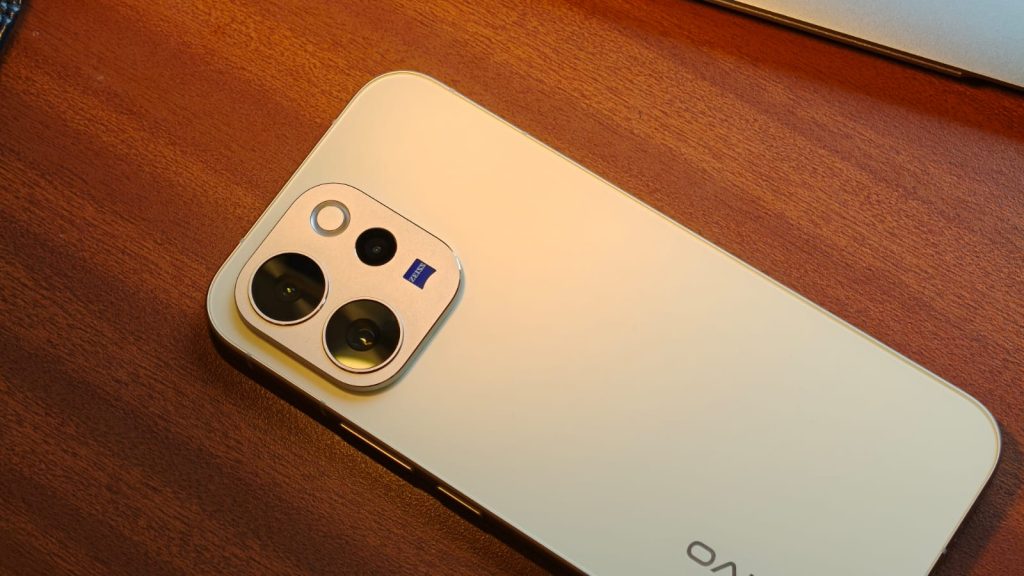
As my previous reviews will attest, vivo has always made some handsome-looking phones, and I even crowned the X300 Pro my favourite smartphone design. Well, I was lying, as the V70 easily surpasses the flagship’s design by a mile or two. There’s something about flat edges and a brushed aluminium frame that just hits different. The phone combines all that with a Lemon yellow finish, which is the most beautiful thing I’ve seen. Don’t bother with the red color, take my word and get the yellow, you won’t regret it. The back is lined with matte glass, which feels super good to touch and prevents the phone from slipping.
The camera module is another highlight. Unlike the one on the X-series, which is just a massive glass island, the V70’s module has some character. The silver metal finish around the individual lenses matches the color perfectly, and the Zeiss branding adds a touch of class and sophistication. When I took the phone out to a family function, people asked, “Oh, what phone is it that you’re using? It looks pretty.” And my answer was, “Sorry, cannot say under embargo, but yes, super pretty indeed.” So, if you do indeed like turning heads with your tech, V70 could be for you.
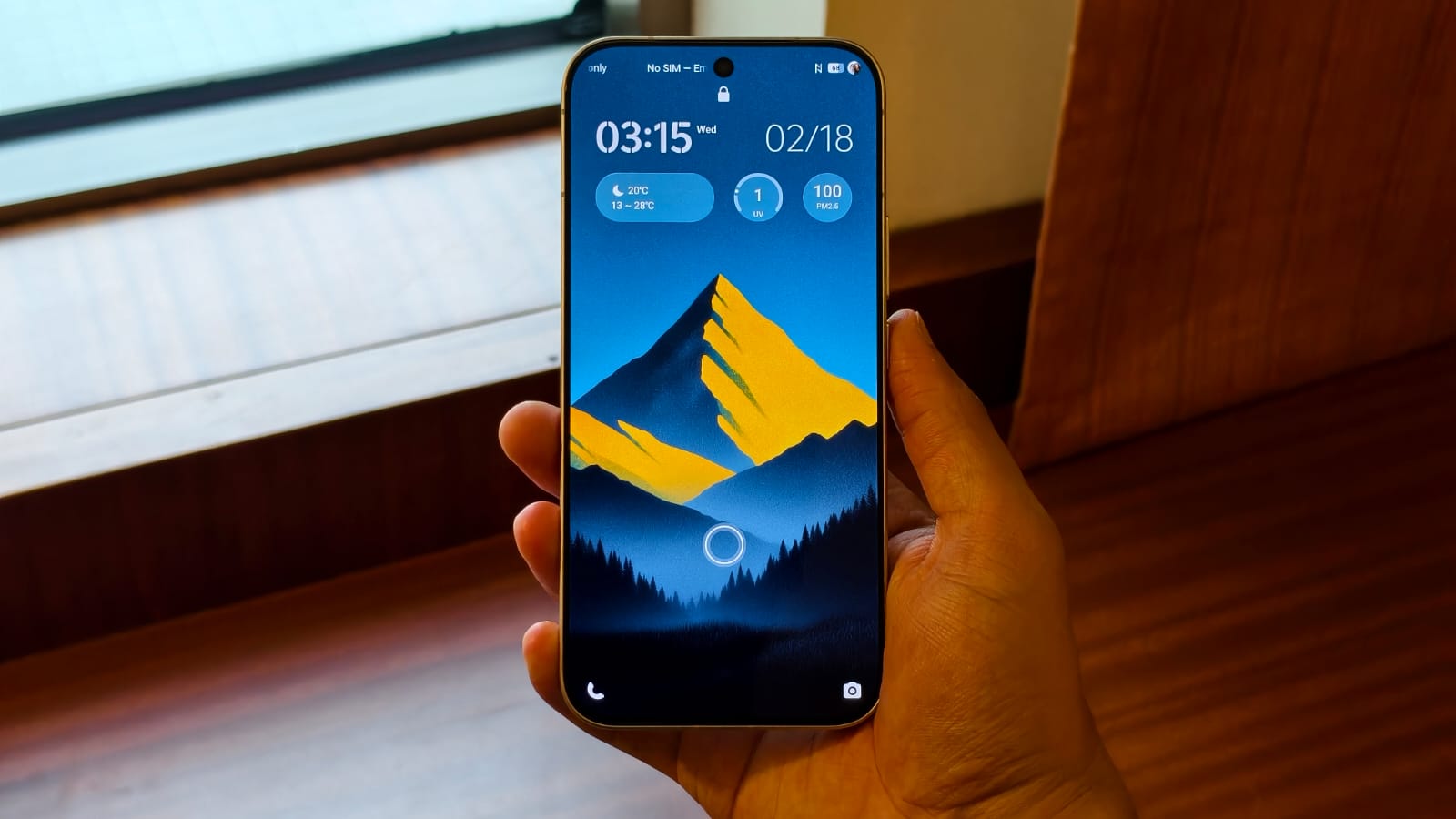
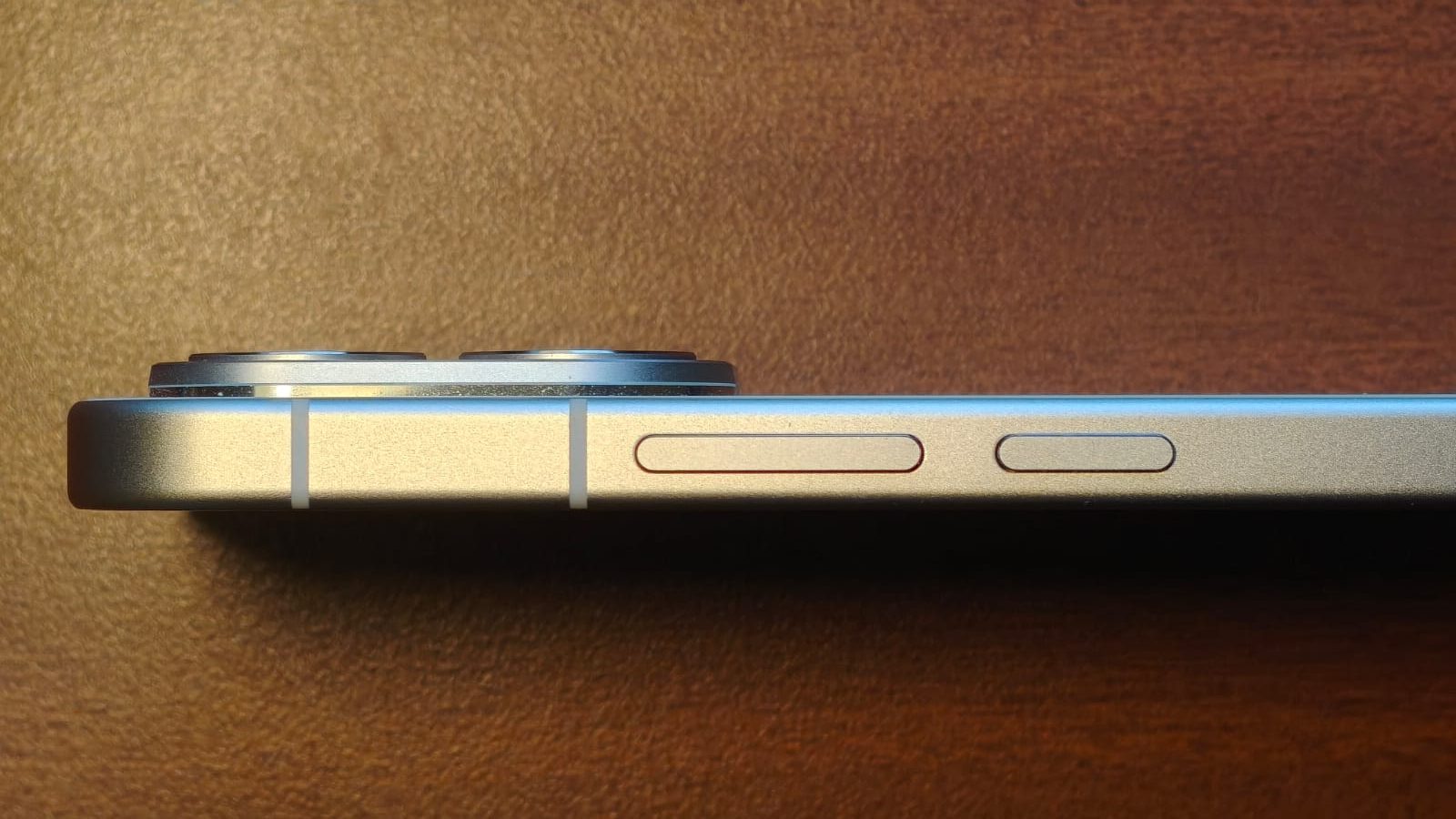
Another thing I love is the in-hand feel. The V70 is neither too small nor too large, making it perfect to hold if you have average-sized hands like me. The sides don’t dig into the palms at all, and the 7.59 mm thickness means your pockets won’t have that big bulge when carrying the device. While the buttons weren’t really clicky, they are placed exactly where your fingers would naturally rest.
Like every smartphone today, the V70 has both IP68 and IP69 ratings for dust and water resistance, meaning it can be submerged underwater if you so wish. Just don’t do it in the ocean, you’ll have a dead phone. For the very first time, I tested these water-resistance claims intentionally and dipped the V70 in water for a few seconds. The phone escaped without problems. The fingerprint scanner has received a major update. It’s an ultrasonic sensor, which translates to better accuracy with dirty fingerprints and easier setup. vivo has also moved the sensor higher up, which is a very welcome change.
Display

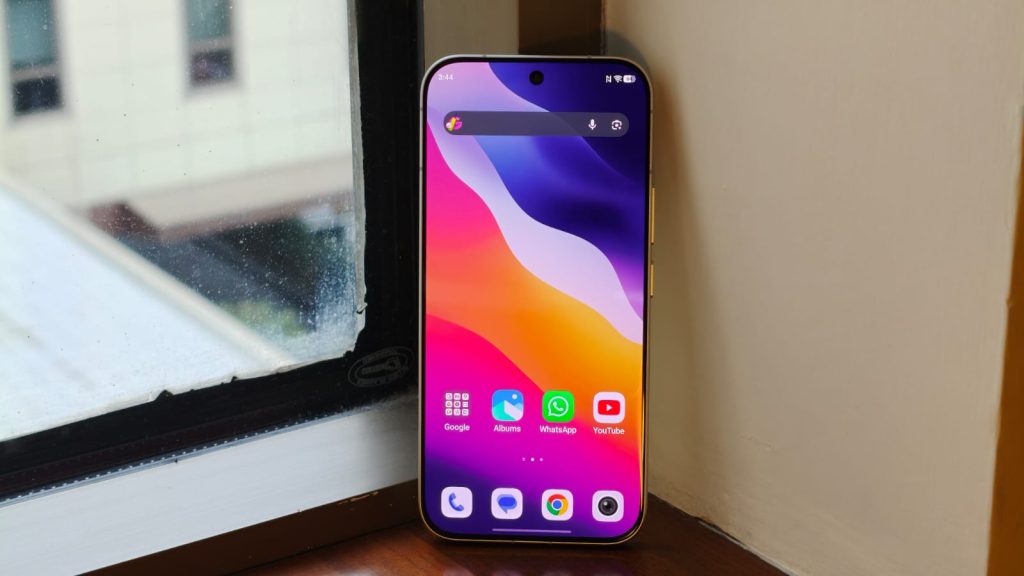
You’ve heard me saying all displays are pretty much the same these days, and that argument holds up with the vivo V70, too. The phone features a 6.59-inch 1.5K AMOLED display with a 120Hz refresh rate. To make it stand out, vivo has trimmed the bezels on the left and right-hand sides to just 0.125 mm, which is just sick and feels super premium. However, the top and bottom bezels are comparatively bigger, though not by much.
Keeping the nags about the bezels aside, the V70’s display is flagship grade. vivo claims a peak brightness of 5,000 nits (HDR). While I don’t have enough money to buy a light meter to verify these claims, what I can tell you is that I was able to capture photos at a function in the bright February sun without having to guess what was on the screen. Moving inside, the 10 billion colors kept everything vibrant, and the HDR 10+ certification made watching episodes of The Pitt a very enjoyable experience. Display protection is handled by the Schott Xensation Alpha glass. It did well to protect my review unit from shattering when I dropped it from my pocket while running to capture the groom at a wedding.
Software & Performance
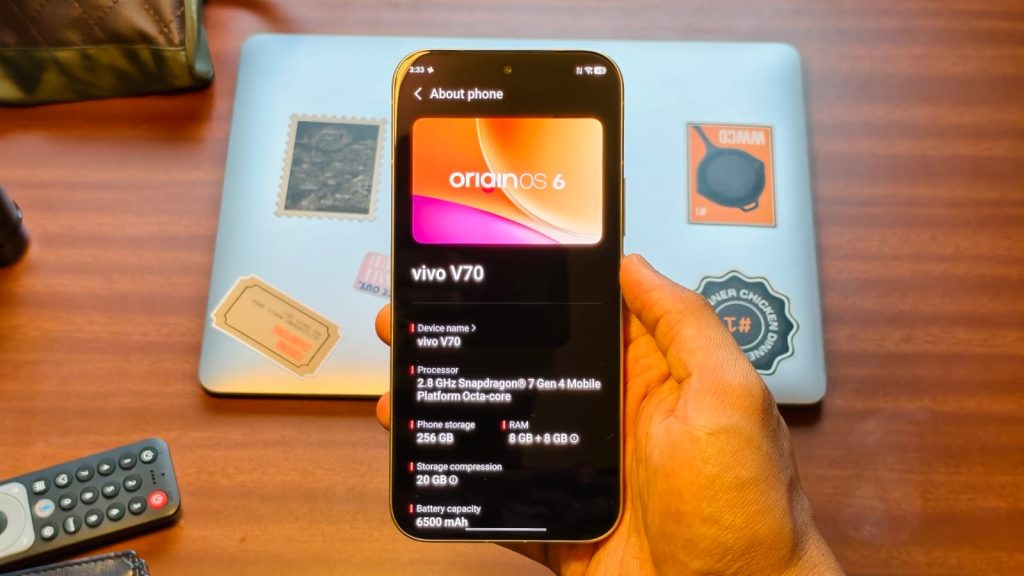
The vivo V70 shares the same heart as its predecessor, the V60: the Qualcomm Snapdragon 7 Gen 4. If you’ve forgotten, the chip houses one Kryo Prime (Cortex-720) core at 2800 MHz, four Kryo Gold (Cortex-720) cores at 2400 MHz, and three Kryo Silver (Cortex-520) cores at 1840 MHz, along with Adreno 722 GPU. vivo has updated the RAM and storage from the V60. The V70 now comes with up to 8GB LPDDR5X RAM and 256GB UFS 4.1 storage.
While enthusiasts among us would be mad not to have a newer processor, the truth is that processors in 2026 don’t really matter. You’ve heard me use the term “breezes past the UI, keeps everything in memory” about fifteen million times, and that’s true here too. The V70 is a capable phone that can handle everything. What matters more, though, is software. Software differentiates the good from the bad, and the bad from the worst. Fortunately, OriginOS belongs in the good category. vivo has done extensive work to revamp its UI to look sophisticated and modern, with really smooth animations, and a feature set that allows extensive customizations without looking ugly. A great example of this is the lock-screen customizations that add a degree of personality in line with each person. It looks sweet, and I’ve had tons of fun trying to get the prettiest look.

The vivo V70 gets access to the same AI features as its flagship brothers. The object eraser works like magic to remove objects and people from any photo you wish. The image expander is my favorite thing when I accidentally capture too close. Beyond that, the Magic Move tool uses gen-AI to move any subject of a photo to your desired place. I’ve tried it, and it’s solid.
What holds back OriginOS from being my favourite Android skin is the lack of convenience, as evidenced by some of the design choices. For example, the back gesture is enabled on the keyboard area, meaning I’ve accidentally closed the keyboard multiple times while hitting backspace. Second, the notification order is reversed, so the newest conversations appear at the top, which takes some time to get used to. If you can ignore these, or have already been using a vivo phone, then the experience should feel right at home. Plus, the company’s promise of four Android updates is a very welcome addition.
Benchmarks & Gaming

As this is a review, I put the Snapdragon 7 Gen 4 through its paces, and the results were pretty expected. The processor put up a respectable 1,274 points in Geekbench’s single-core test and 3,780 in the multi-core test. In AnTuTu, the phone scored 1,014,674 points. While these numbers might not seem very impressive, what is really good is vivo’s thermal management. Never once did I feel the phone heating up, and this statement is backed by the infamous 30-minute 30-thread throttle test, where the vivo V70 only throttled to 89% of its peak performance.
Stepping into gaming, I’m a big BGMI guy. While the days of me grinding to get into eSports are long gone, what isn’t gone is gaming sessions with my bros. vivo has heard my prayers from the V60 review and enabled 90fps support in both BGMI and CODM. It significantly improves the overall experience by keeping everything smooth. I also didn’t notice any frame drops when in combat. Beyond that, the phone has some gaming-centric features like bypass charging, which, instead of charging the battery, uses the power to directly run the games, thus reducing stress on the lithium-ion cell.
Battery
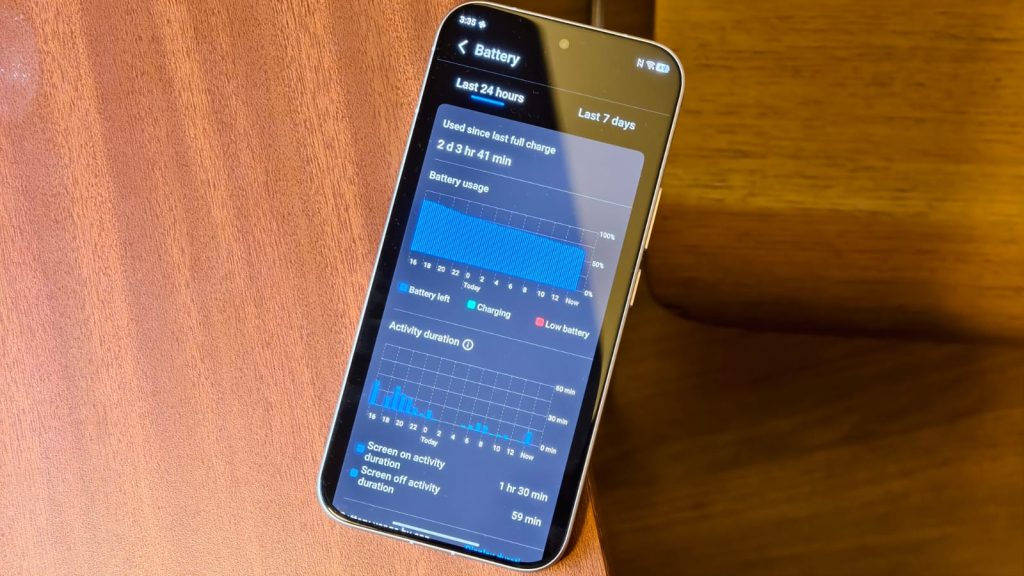
Silicon-carbon is the latest buzz in the battery world, since it promises higher capacity and faster charging. Well, vivo has decided to chuck that thought entirely. Somehow, they’ve managed to pack a massive 6,500 mAh lithium-ion cell in the vivo V70, and it’s fantastic. Coupled with the mid-range processor, the phone runs for an eternity.
To put that in perspective, I charged the phone to 100% on Sunday morning and went to a family function that began at 12 noon. There, I captured around 100 photos in the hot sun, with the brightness manually set to 100%. I then came back home around 3, rested a bit, and went back to my everyday gym struggle, where I had music playing in the background for about 1.5 hours. After that, since it was the weekend, I went out with my family for dinner, where, once again, I was in charge of the photos. After coming back from there at 11 pm, I still had around 40% remaining. Charging is another area where vivo has got us covered. The phone ships with a 90W fast charger, which is plenty capable. It takes the phone from 20% to 80% in around 25 minutes.
Cameras
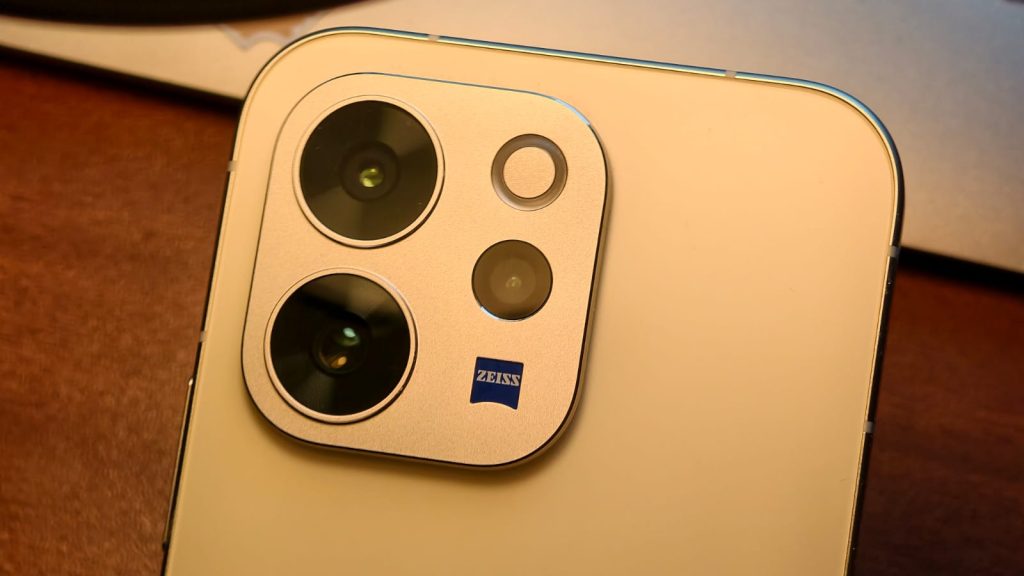
Cameras are vivo’s forte. After all, that’s the biggest reason people buy the V-series. Last year’s V60 proved mighty capable in my testing, and the same can be said of the vivo V70. But before I get ahead of myself, the V70 houses triple cameras, comprising a 50MP primary sensor, another 50MP Sony IMX882 3x telephoto lens, and an 8MP 115-degree UltraWide lens.
Now that the specs are out of the way, the next logical question is, how well does the V70 capture photos? And the answer is pretty good. In daylight, shots from the V70 carry a great amount of detail without being oversharpened. The HDR is mostly spot-on (though it can be affected by the harshest sunlight), and the colors always look aesthetic. Zeiss’s color tuning lends its expertise once again, with a myriad of filters and color modes that add character to a photo.
Low light reveals a similar story. Shots from the main and telephoto lenses are crisp, with low noise and good-looking colors that would fit well on any Instagram story. vivo’s portrait game has been hard to beat recently, with phones like the X300 Pro and the X200T. And I’m glad to say the same about the V70. Its portraits have that natural look that’s really hard to achieve.
Besides, the edge detection is perfect, and the shallow depth of field looks pleasing to anyone’s eye. Once again, there are plenty of Zeiss portrait styles to choose from, and each one plays with the background in a different way. If you ask me, the Biotar look is my favourite. Then again, you’ll need to try them all to find your preference.
The 3x telephoto sensor is pretty solid at its job. The resulting photos are nearly identical to the main camera in terms of color science and sharpness. Since it’s a 50MP sensor, it can zoom in about 10x without losing many details. That said, after the threshold, the images can look processed. What’s also not the best is the UltraWide camera. At just 8MP, it’s fine in daylight, but at night, noise creeps in. Plus, the lack of sharpness makes nighttime samples look muddy.
Nevertheless, what has received a major update is videos. vivo has responded to our feedback and included 4K@60FPS video in the V70. This means you can capture crisp, smooth videos without sacrificing anything. I tried it at the family function, and the results were great, with the HDR performance being a standout. It is important to note that only the primary and telephoto sensors can record at this quality.
Verdict
Starting at ₹45,999, the vivo V70, like many others, has received a price bump. But unlike others, vivo has actually incorporated meaningful updates that make the new vivo V70 the best V-series phone so far. It’s hard to fault. The design is sophisticated yet fun, which is what I love. The super-thin bezels add to the premiumness, and the performance, while not chart-topping, is more than capable for everyday tasks and gaming. The upgraded triple-camera setup can produce pretty images, regardless of the scene or lighting, and the V70’s portrait game is hard to beat. Not to forget, the battery life lasts days on a charge. It gets a big thumbs up from my end.
Source link
#vivo #V70 #Month #VSeries

![This former notorious red-light district is now one of the world’s top AI hubs | TechCrunch
What every U.K. AI startup wants to know these days is, how can I get office space in King’s Cross?
The area is so hot that a VC firm allegedly recently won a deal by promising a founder office space in the neighborhood. “We stop at nothing to win deals [for] and to support” founders, “including helping them source office space when needed,” the firm told me when asked about the rumor, declining to confirm or deny any details.
The neighborhood’s popularity began back in 2016 when DeepMind — then newly acquired by Google — moved in. Soon after, a flood of AI startups followed, wanting to be around the Google DeepMind magic. Today, they hope to take advantage of the cluster of AI talent there.
This has transformed King’s Cross into one of the world’s top AI hubs, rivaled only by San Francisco and Beijing. Around London, it’s known by the sobriquet “Knowledge Quarter,” as it’s home to names like OpenAI, Meta, Isomorphic Labs, Cusp AI, Wayne, Recursive, and, a little farther down the road, Synthesia and Anthropic. The European Technology Network (ETN) just moved into a glossy new office nearby, while University College London sits around the corner.
Mixed in with the new developments are trendy food spots like Hoppers and BAO. Hop a train from King’s Cross, and founders can be in Cambridge in 45 minutes to source talent or can be in Paris in two hours to strike a deal.
Who would have guessed that a little more than 20 years ago, this was one of the seediest areas in London?
“In the ’80s, crack and heroin made the area a major narcotics market,” Hussein Kanji, an investor at Hoxton Ventures, said, recalling syringes in tree trunks and gangs patrolling the streets. “In 1982, the local church was occupied by the English Collective of Prostitutes for 12 straight days.” Then, in the early 2000s, a real estate developer had a dream and, well, “now it is the AI hotbed of the United Kingdom,” Kanji said. “What a change.” Around 18 months ago, his portfolio company BioCorteX moved from the neighborhood Holborn to the Jellicoe building in King’s Cross, hoping to be near the action. “Lots going on in London right now,” Nik Sharma, co-founder of BioCorteX, told me. “Lots of hyperscalers moving in.” That includes, reportedly, Jeff Bezos’ AI company Prometheus, which is also said to be in talks to move into the Jellicoe.
There are around 3,600 AI startups in London, which, together, have raised around .1 billion out of the .8 billion raised in the city since late July, according to Dealroom. Since the start of June, AI-related startups have leased more than 1 million square feet of office space in London, according to the real estate firm Knight Frank. With that, prime rents in King’s Cross have risen 18% over the past three years, Chris Dunn, a commercial insight associate at the firm, told me. That percentage represents only the largest leases encompassing at least 10,000 square feet, like the ones OpenAI and Prometheus are signing. The shorter deals go for even more, he said, and now the vacancy rate for conventional office space is just 0.9%. “Demand has outstripped supply,” he continued.
Today, one of the big topics of the area is sovereignty. It was a wake-up call for many when Anthropic shut off access to Mythos and Fable this summer, leaving some in the ecosystem to conclude: “We’d better look after ourselves,” Saul Klein, co-founder of the VC firm Phoenix Court, told me.
Phoenix Court is located in the King’s Cross area and has three portfolio companies in the vicinity, including Olix (which just announced a .3 billion valuation), Early Health and CoMind. Robin Klein, co-founder of the firm, said the shutdown of Fable and Mythos access was a “small but sharp reminder that Europe can’t simply rent its AI capabilities and capacity; it needs to build and hold some of its own.” King’s Cross, he said, is where much of this building is actually happening.
“The bigger question,” he continued, “is whether the U.K. builds the infrastructure, compute, energy, capital, to make this self-reliance durable, rather than just hosting outposts of U.S. labs.”
Image Credits:Phoenix Court
Top founders want to stay
Simon Kohl, founder of Latent Labs, has offices in King’s Cross and San Francisco. The London office, at the moment, is growing faster, and he’s more bullish than ever on the ecosystem, he said. “The mood right now feels less like London trying to catch up and more like London becoming one of the default places to start a serious AI company,” he said. Look around and you are likely to see Wayve testing its autonomous cars. Founded in 2017 by co-founder Alex Kendall, the unicorn is one of London’s biggest success stories.
“Ten years ago, building a frontier AI company from London felt like an unusual choice,” Kendall told me. “Now it feels like an obvious one.” Wayve moved into King’s Cross in 2018 looking for a space that could double as a garage — “a rare combination in Central London,” Kendall said. He has watched the ecosystem mature around him — and it’s now evident that a startup can stay in London, raise serious capital, hire world-class AI talent, and remain globally competitive, he said. Down the street from Anthropic’s new 158,000-square-foot office is the AI agent builder Sierra and the AI video platform Synthesia.
Laura Gonzalez Florez, Synthesia’s chief of staff and head of people, says the company moved into its glossy new office building a year ago to accommodate its growing team. They were drawn to the area for the same reason as everyone else: “It’s very close to the airport … very close to where a lot of investors are,” she said.
Image Credits:Synthesia
Around two-thirds of Synthesia’s engineers are remote, Gonzalez Florez said, letting the company tap into an affordable, international, and diverse talent pool and helping it scale faster. “From London, we can hire and work, without any problem, people from anywhere, from Slovenia to Portugal,” she said.
Unsurprisingly, London’s AI boom is also causing a talent war.U.K. AI job postings have skyrocketed in the past few years, per data from PwC. When Anthropic announced it moved into town earlier this year, it listed, for example, a salary range of £260,000 to £630,000 for a machine learning research engineer when the average salary in London for the same role is around £102,000. Some founders in the U.K., like those in Silicon Valley, are being forced to raise more and bigger rounds to keep up.
“The real test is whether more globally significant AI companies are founded, funded, and scaled from the U.K., while continuing to attract the world’s best talent to build them here,” Zain Ali, founder of the King’s Cross-based AI legal firm Centuro, told me. “If that continues to happen, King’s Cross won’t just be an AI hub. It’ll become one of the U.K.’s most important strategic assets.”
When you purchase through links in our articles, we may earn a small commission. This doesn’t affect our editorial independence.#Thisformernotorious #redlight #districtis #nowone #worlds #top #hubs #TechCrunchUK](https://techcrunch.com/wp-content/uploads/2026/08/DM9A2852.jpg?w=680 "This former notorious red-light district is now one of the world’s top AI hubs | TechCrunch
What every U.K. AI startup wants to know these days is, how can I get office space in King’s Cross?
The area is so hot that a VC firm allegedly recently won a deal by promising a founder office space in the neighborhood. “We stop at nothing to win deals [for] and to support” founders, “including helping them source office space when needed,” the firm told me when asked about the rumor, declining to confirm or deny any details.
The neighborhood’s popularity began back in 2016 when DeepMind — then newly acquired by Google — moved in. Soon after, a flood of AI startups followed, wanting to be around the Google DeepMind magic. Today, they hope to take advantage of the cluster of AI talent there.
This has transformed King’s Cross into one of the world’s top AI hubs, rivaled only by San Francisco and Beijing. Around London, it’s known by the sobriquet “Knowledge Quarter,” as it’s home to names like OpenAI, Meta, Isomorphic Labs, Cusp AI, Wayne, Recursive, and, a little farther down the road, Synthesia and Anthropic. The European Technology Network (ETN) just moved into a glossy new office nearby, while University College London sits around the corner.
Mixed in with the new developments are trendy food spots like Hoppers and BAO. Hop a train from King’s Cross, and founders can be in Cambridge in 45 minutes to source talent or can be in Paris in two hours to strike a deal.
Who would have guessed that a little more than 20 years ago, this was one of the seediest areas in London?
“In the ’80s, crack and heroin made the area a major narcotics market,” Hussein Kanji, an investor at Hoxton Ventures, said, recalling syringes in tree trunks and gangs patrolling the streets. “In 1982, the local church was occupied by the English Collective of Prostitutes for 12 straight days.” Then, in the early 2000s, a real estate developer had a dream and, well, “now it is the AI hotbed of the United Kingdom,” Kanji said. “What a change.” Around 18 months ago, his portfolio company BioCorteX moved from the neighborhood Holborn to the Jellicoe building in King’s Cross, hoping to be near the action. “Lots going on in London right now,” Nik Sharma, co-founder of BioCorteX, told me. “Lots of hyperscalers moving in.” That includes, reportedly, Jeff Bezos’ AI company Prometheus, which is also said to be in talks to move into the Jellicoe.
There are around 3,600 AI startups in London, which, together, have raised around .1 billion out of the .8 billion raised in the city since late July, according to Dealroom. Since the start of June, AI-related startups have leased more than 1 million square feet of office space in London, according to the real estate firm Knight Frank. With that, prime rents in King’s Cross have risen 18% over the past three years, Chris Dunn, a commercial insight associate at the firm, told me. That percentage represents only the largest leases encompassing at least 10,000 square feet, like the ones OpenAI and Prometheus are signing. The shorter deals go for even more, he said, and now the vacancy rate for conventional office space is just 0.9%. “Demand has outstripped supply,” he continued.
Today, one of the big topics of the area is sovereignty. It was a wake-up call for many when Anthropic shut off access to Mythos and Fable this summer, leaving some in the ecosystem to conclude: “We’d better look after ourselves,” Saul Klein, co-founder of the VC firm Phoenix Court, told me.
Phoenix Court is located in the King’s Cross area and has three portfolio companies in the vicinity, including Olix (which just announced a .3 billion valuation), Early Health and CoMind. Robin Klein, co-founder of the firm, said the shutdown of Fable and Mythos access was a “small but sharp reminder that Europe can’t simply rent its AI capabilities and capacity; it needs to build and hold some of its own.” King’s Cross, he said, is where much of this building is actually happening.
“The bigger question,” he continued, “is whether the U.K. builds the infrastructure, compute, energy, capital, to make this self-reliance durable, rather than just hosting outposts of U.S. labs.”
Image Credits:Phoenix Court
Top founders want to stay
Simon Kohl, founder of Latent Labs, has offices in King’s Cross and San Francisco. The London office, at the moment, is growing faster, and he’s more bullish than ever on the ecosystem, he said. “The mood right now feels less like London trying to catch up and more like London becoming one of the default places to start a serious AI company,” he said. Look around and you are likely to see Wayve testing its autonomous cars. Founded in 2017 by co-founder Alex Kendall, the unicorn is one of London’s biggest success stories.
“Ten years ago, building a frontier AI company from London felt like an unusual choice,” Kendall told me. “Now it feels like an obvious one.” Wayve moved into King’s Cross in 2018 looking for a space that could double as a garage — “a rare combination in Central London,” Kendall said. He has watched the ecosystem mature around him — and it’s now evident that a startup can stay in London, raise serious capital, hire world-class AI talent, and remain globally competitive, he said. Down the street from Anthropic’s new 158,000-square-foot office is the AI agent builder Sierra and the AI video platform Synthesia.
Laura Gonzalez Florez, Synthesia’s chief of staff and head of people, says the company moved into its glossy new office building a year ago to accommodate its growing team. They were drawn to the area for the same reason as everyone else: “It’s very close to the airport … very close to where a lot of investors are,” she said.
Image Credits:Synthesia
Around two-thirds of Synthesia’s engineers are remote, Gonzalez Florez said, letting the company tap into an affordable, international, and diverse talent pool and helping it scale faster. “From London, we can hire and work, without any problem, people from anywhere, from Slovenia to Portugal,” she said.
Unsurprisingly, London’s AI boom is also causing a talent war.U.K. AI job postings have skyrocketed in the past few years, per data from PwC. When Anthropic announced it moved into town earlier this year, it listed, for example, a salary range of £260,000 to £630,000 for a machine learning research engineer when the average salary in London for the same role is around £102,000. Some founders in the U.K., like those in Silicon Valley, are being forced to raise more and bigger rounds to keep up.
“The real test is whether more globally significant AI companies are founded, funded, and scaled from the U.K., while continuing to attract the world’s best talent to build them here,” Zain Ali, founder of the King’s Cross-based AI legal firm Centuro, told me. “If that continues to happen, King’s Cross won’t just be an AI hub. It’ll become one of the U.K.’s most important strategic assets.”
When you purchase through links in our articles, we may earn a small commission. This doesn’t affect our editorial independence.#Thisformernotorious #redlight #districtis #nowone #worlds #top #hubs #TechCrunchUK")

![This former notorious red-light district is now one of the world’s top AI hubs | TechCrunch
What every U.K. AI startup wants to know these days is, how can I get office space in King’s Cross?
The area is so hot that a VC firm allegedly recently won a deal by promising a founder office space in the neighborhood. “We stop at nothing to win deals [for] and to support” founders, “including helping them source office space when needed,” the firm told me when asked about the rumor, declining to confirm or deny any details.
The neighborhood’s popularity began back in 2016 when DeepMind — then newly acquired by Google — moved in. Soon after, a flood of AI startups followed, wanting to be around the Google DeepMind magic. Today, they hope to take advantage of the cluster of AI talent there.
This has transformed King’s Cross into one of the world’s top AI hubs, rivaled only by San Francisco and Beijing. Around London, it’s known by the sobriquet “Knowledge Quarter,” as it’s home to names like OpenAI, Meta, Isomorphic Labs, Cusp AI, Wayne, Recursive, and, a little farther down the road, Synthesia and Anthropic. The European Technology Network (ETN) just moved into a glossy new office nearby, while University College London sits around the corner.
Mixed in with the new developments are trendy food spots like Hoppers and BAO. Hop a train from King’s Cross, and founders can be in Cambridge in 45 minutes to source talent or can be in Paris in two hours to strike a deal.
Who would have guessed that a little more than 20 years ago, this was one of the seediest areas in London?
“In the ’80s, crack and heroin made the area a major narcotics market,” Hussein Kanji, an investor at Hoxton Ventures, said, recalling syringes in tree trunks and gangs patrolling the streets. “In 1982, the local church was occupied by the English Collective of Prostitutes for 12 straight days.” Then, in the early 2000s, a real estate developer had a dream and, well, “now it is the AI hotbed of the United Kingdom,” Kanji said. “What a change.” Around 18 months ago, his portfolio company BioCorteX moved from the neighborhood Holborn to the Jellicoe building in King’s Cross, hoping to be near the action. “Lots going on in London right now,” Nik Sharma, co-founder of BioCorteX, told me. “Lots of hyperscalers moving in.” That includes, reportedly, Jeff Bezos’ AI company Prometheus, which is also said to be in talks to move into the Jellicoe.
There are around 3,600 AI startups in London, which, together, have raised around .1 billion out of the .8 billion raised in the city since late July, according to Dealroom. Since the start of June, AI-related startups have leased more than 1 million square feet of office space in London, according to the real estate firm Knight Frank. With that, prime rents in King’s Cross have risen 18% over the past three years, Chris Dunn, a commercial insight associate at the firm, told me. That percentage represents only the largest leases encompassing at least 10,000 square feet, like the ones OpenAI and Prometheus are signing. The shorter deals go for even more, he said, and now the vacancy rate for conventional office space is just 0.9%. “Demand has outstripped supply,” he continued.
Today, one of the big topics of the area is sovereignty. It was a wake-up call for many when Anthropic shut off access to Mythos and Fable this summer, leaving some in the ecosystem to conclude: “We’d better look after ourselves,” Saul Klein, co-founder of the VC firm Phoenix Court, told me.
Phoenix Court is located in the King’s Cross area and has three portfolio companies in the vicinity, including Olix (which just announced a .3 billion valuation), Early Health and CoMind. Robin Klein, co-founder of the firm, said the shutdown of Fable and Mythos access was a “small but sharp reminder that Europe can’t simply rent its AI capabilities and capacity; it needs to build and hold some of its own.” King’s Cross, he said, is where much of this building is actually happening.
“The bigger question,” he continued, “is whether the U.K. builds the infrastructure, compute, energy, capital, to make this self-reliance durable, rather than just hosting outposts of U.S. labs.”
Image Credits:Phoenix Court
Top founders want to stay
Simon Kohl, founder of Latent Labs, has offices in King’s Cross and San Francisco. The London office, at the moment, is growing faster, and he’s more bullish than ever on the ecosystem, he said. “The mood right now feels less like London trying to catch up and more like London becoming one of the default places to start a serious AI company,” he said. Look around and you are likely to see Wayve testing its autonomous cars. Founded in 2017 by co-founder Alex Kendall, the unicorn is one of London’s biggest success stories.
“Ten years ago, building a frontier AI company from London felt like an unusual choice,” Kendall told me. “Now it feels like an obvious one.” Wayve moved into King’s Cross in 2018 looking for a space that could double as a garage — “a rare combination in Central London,” Kendall said. He has watched the ecosystem mature around him — and it’s now evident that a startup can stay in London, raise serious capital, hire world-class AI talent, and remain globally competitive, he said. Down the street from Anthropic’s new 158,000-square-foot office is the AI agent builder Sierra and the AI video platform Synthesia.
Laura Gonzalez Florez, Synthesia’s chief of staff and head of people, says the company moved into its glossy new office building a year ago to accommodate its growing team. They were drawn to the area for the same reason as everyone else: “It’s very close to the airport … very close to where a lot of investors are,” she said.
Image Credits:Synthesia
Around two-thirds of Synthesia’s engineers are remote, Gonzalez Florez said, letting the company tap into an affordable, international, and diverse talent pool and helping it scale faster. “From London, we can hire and work, without any problem, people from anywhere, from Slovenia to Portugal,” she said.
Unsurprisingly, London’s AI boom is also causing a talent war.U.K. AI job postings have skyrocketed in the past few years, per data from PwC. When Anthropic announced it moved into town earlier this year, it listed, for example, a salary range of £260,000 to £630,000 for a machine learning research engineer when the average salary in London for the same role is around £102,000. Some founders in the U.K., like those in Silicon Valley, are being forced to raise more and bigger rounds to keep up.
“The real test is whether more globally significant AI companies are founded, funded, and scaled from the U.K., while continuing to attract the world’s best talent to build them here,” Zain Ali, founder of the King’s Cross-based AI legal firm Centuro, told me. “If that continues to happen, King’s Cross won’t just be an AI hub. It’ll become one of the U.K.’s most important strategic assets.”
When you purchase through links in our articles, we may earn a small commission. This doesn’t affect our editorial independence.#Thisformernotorious #redlight #districtis #nowone #worlds #top #hubs #TechCrunchUK](https://i0.wp.com/techcrunch.com/wp-content/uploads/2026/08/DM9A2852.jpg?w=680&ssl=1 "This former notorious red-light district is now one of the world’s top AI hubs | TechCrunch
What every U.K. AI startup wants to know these days is, how can I get office space in King’s Cross?
The area is so hot that a VC firm allegedly recently won a deal by promising a founder office space in the neighborhood. “We stop at nothing to win deals [for] and to support” founders, “including helping them source office space when needed,” the firm told me when asked about the rumor, declining to confirm or deny any details.
The neighborhood’s popularity began back in 2016 when DeepMind — then newly acquired by Google — moved in. Soon after, a flood of AI startups followed, wanting to be around the Google DeepMind magic. Today, they hope to take advantage of the cluster of AI talent there.
This has transformed King’s Cross into one of the world’s top AI hubs, rivaled only by San Francisco and Beijing. Around London, it’s known by the sobriquet “Knowledge Quarter,” as it’s home to names like OpenAI, Meta, Isomorphic Labs, Cusp AI, Wayne, Recursive, and, a little farther down the road, Synthesia and Anthropic. The European Technology Network (ETN) just moved into a glossy new office nearby, while University College London sits around the corner.
Mixed in with the new developments are trendy food spots like Hoppers and BAO. Hop a train from King’s Cross, and founders can be in Cambridge in 45 minutes to source talent or can be in Paris in two hours to strike a deal.
Who would have guessed that a little more than 20 years ago, this was one of the seediest areas in London?
“In the ’80s, crack and heroin made the area a major narcotics market,” Hussein Kanji, an investor at Hoxton Ventures, said, recalling syringes in tree trunks and gangs patrolling the streets. “In 1982, the local church was occupied by the English Collective of Prostitutes for 12 straight days.” Then, in the early 2000s, a real estate developer had a dream and, well, “now it is the AI hotbed of the United Kingdom,” Kanji said. “What a change.” Around 18 months ago, his portfolio company BioCorteX moved from the neighborhood Holborn to the Jellicoe building in King’s Cross, hoping to be near the action. “Lots going on in London right now,” Nik Sharma, co-founder of BioCorteX, told me. “Lots of hyperscalers moving in.” That includes, reportedly, Jeff Bezos’ AI company Prometheus, which is also said to be in talks to move into the Jellicoe.
There are around 3,600 AI startups in London, which, together, have raised around .1 billion out of the .8 billion raised in the city since late July, according to Dealroom. Since the start of June, AI-related startups have leased more than 1 million square feet of office space in London, according to the real estate firm Knight Frank. With that, prime rents in King’s Cross have risen 18% over the past three years, Chris Dunn, a commercial insight associate at the firm, told me. That percentage represents only the largest leases encompassing at least 10,000 square feet, like the ones OpenAI and Prometheus are signing. The shorter deals go for even more, he said, and now the vacancy rate for conventional office space is just 0.9%. “Demand has outstripped supply,” he continued.
Today, one of the big topics of the area is sovereignty. It was a wake-up call for many when Anthropic shut off access to Mythos and Fable this summer, leaving some in the ecosystem to conclude: “We’d better look after ourselves,” Saul Klein, co-founder of the VC firm Phoenix Court, told me.
Phoenix Court is located in the King’s Cross area and has three portfolio companies in the vicinity, including Olix (which just announced a .3 billion valuation), Early Health and CoMind. Robin Klein, co-founder of the firm, said the shutdown of Fable and Mythos access was a “small but sharp reminder that Europe can’t simply rent its AI capabilities and capacity; it needs to build and hold some of its own.” King’s Cross, he said, is where much of this building is actually happening.
“The bigger question,” he continued, “is whether the U.K. builds the infrastructure, compute, energy, capital, to make this self-reliance durable, rather than just hosting outposts of U.S. labs.”
Image Credits:Phoenix Court
Top founders want to stay
Simon Kohl, founder of Latent Labs, has offices in King’s Cross and San Francisco. The London office, at the moment, is growing faster, and he’s more bullish than ever on the ecosystem, he said. “The mood right now feels less like London trying to catch up and more like London becoming one of the default places to start a serious AI company,” he said. Look around and you are likely to see Wayve testing its autonomous cars. Founded in 2017 by co-founder Alex Kendall, the unicorn is one of London’s biggest success stories.
“Ten years ago, building a frontier AI company from London felt like an unusual choice,” Kendall told me. “Now it feels like an obvious one.” Wayve moved into King’s Cross in 2018 looking for a space that could double as a garage — “a rare combination in Central London,” Kendall said. He has watched the ecosystem mature around him — and it’s now evident that a startup can stay in London, raise serious capital, hire world-class AI talent, and remain globally competitive, he said. Down the street from Anthropic’s new 158,000-square-foot office is the AI agent builder Sierra and the AI video platform Synthesia.
Laura Gonzalez Florez, Synthesia’s chief of staff and head of people, says the company moved into its glossy new office building a year ago to accommodate its growing team. They were drawn to the area for the same reason as everyone else: “It’s very close to the airport … very close to where a lot of investors are,” she said.
Image Credits:Synthesia
Around two-thirds of Synthesia’s engineers are remote, Gonzalez Florez said, letting the company tap into an affordable, international, and diverse talent pool and helping it scale faster. “From London, we can hire and work, without any problem, people from anywhere, from Slovenia to Portugal,” she said.
Unsurprisingly, London’s AI boom is also causing a talent war.U.K. AI job postings have skyrocketed in the past few years, per data from PwC. When Anthropic announced it moved into town earlier this year, it listed, for example, a salary range of £260,000 to £630,000 for a machine learning research engineer when the average salary in London for the same role is around £102,000. Some founders in the U.K., like those in Silicon Valley, are being forced to raise more and bigger rounds to keep up.
“The real test is whether more globally significant AI companies are founded, funded, and scaled from the U.K., while continuing to attract the world’s best talent to build them here,” Zain Ali, founder of the King’s Cross-based AI legal firm Centuro, told me. “If that continues to happen, King’s Cross won’t just be an AI hub. It’ll become one of the U.K.’s most important strategic assets.”
When you purchase through links in our articles, we may earn a small commission. This doesn’t affect our editorial independence.#Thisformernotorious #redlight #districtis #nowone #worlds #top #hubs #TechCrunchUK")

Post Comment