×
IPL 2026: PowerPlay is the new death overs—Openers are finishing games this season  Marcus Stoinis’ stunning 22-ball 62 (not out) went in vain on Tuesday night as Punjab Kings failed to defend a 222-run total against Rajasthan Royals at the Maharaja Yadavindra Singh International Stadium.Stoinis’ knock came at the back end of the innings and, although it lifted the home side to a competitive total, it wasn’t enough to shut the Royals out as they chased it down with four balls to spare and six wickets in hand.A couple of days earlier, PBKS had done something similar, registering a record T20 chase of 265 against Delhi Capitals.A common factor in this IPL season’s wins has been PowerPlay performances. The Royals scored 84 for one in the first overs in reply to the Kings’ 65 for one. Similarly, DC had managed 68 for one against PBKS, which finished the fielding restrictions after scoring 116 runs without loss. PowerPlay overs have decided 73.68 per cent of matches this season.“Over the years, teams have realised how important the PowerPlay is: only two fielders outside, six overs to maximise. So naturally, there’s more focus on that phase now,” RR fast bowler Sandeep Sharma said.There has been a steady rise in batters targeting the boundaries in the PowerPlay, with run rates climbing from 7.7 in the inaugural season to 8.42 in 2018, and now 9.9 this season.“What we’re seeing is a trend across the tournament – how dominant teams are in the first six overs. It’s very hard to stop sides now with the way they’re playing in the PowerPlay. You’ve also got the replacement player rule, which allows you to stack your batting and go even harder,” PBKS assistant coach Brad Haddin said.A look at the points table also reflects which teams have embraced this approach of setting up, or even finishing, games early. Punjab, Royal Challengers Bengaluru, Sunrisers Hyderabad, and Rajasthan, the current top four, also boast the best returns from their top three batters, especially the openers.For PBKS, Prabhsimran Singh and Priyansh Arya have scored at a strike rate of 205.55, followed by Royals openers Yashasvi Jaiswal and Vaibhav Sooryavanshi at 195.56. SRH’s Abhishek Sharma and Travis Head are at 183.17, while RCB’s Virat Kohli and Phil Salt/Jacob Bethell have struck at 164.42.Winning the PowerPlay isn’t a guarantee, but it gives the batting side a significant advantage for the rest of the innings. DC openers, for instance, have a higher strike rate (172.35) than RCB’s. But with the rest of Bengaluru’s lineup sustaining the pressure, it has translated into results, while the Capitals remain in the bottom half.Is the finisher’s role going extinct?The relentless pressure from ball one has made 200-plus totals par, even if they don’t guarantee wins. Openers are expected to score at a minimum of 10 an over, and the rest of the batting order must maintain a similar tempo.Teams are no longer building towards a late surge. The first six overs are now played with almost the same boundary-hitting intensity (26.11%) as the final four overs (24.12%).“I don’t think there is a thing called finishers anymore. It’s right from ball one – everyone is going at a rate of knots,” Chennai Super Kings coach Stephen Fleming had said earlier this season. “It’s not a build-up to the 16th over and then going harder. Everyone is going hard from ball one. Run rates of 10, 11, 12 throughout are expected. You’re not really getting the big peaks at the end, it’s just a more aggressive approach to get 240.”Table-topper Punjab has been the most successful in executing this approach. While the top three score at over 12 an over, numbers four and five go at 11.1, and the lower middle order (6-8) at 10.81.“If you look at the way we’ve played, our top order has been super dynamic. They’ve set up games and created opportunities,” Haddin said.“But what the rest have done is contribute in roles that win matches. It might not be a 70 or 80 – it could be 15 off six balls to give us momentum. At the moment, they’re doing everything the game requires.”Sandeep, however, believes finishers remain vital, especially over a long tournament.“I don’t think the importance of finishers has reduced at all. Teams with strong finishers still have a great chance. If you look at the past, Chennai had Mahi bhai (MS Dhoni), Mumbai had Hardik Pandya and Kieron Pollard, and KKR had Andre Russell. Teams with strong players at 5, 6, and 7 tend to go far. That’s where the bulk of pressure lies. The top three don’t carry as much pressure – if they get out playing positively, it’s accepted. But 5-6-7 is a crucial phase,” he said.This season has still produced instances of lower-order influence, such as Rinku Singh’s effort in Kolkata Knight Riders’ Super Over win against Lucknow Super Giants, but those moments are becoming rarer in a league where the PowerPlay is fast becoming the new death overs, and openers the new finishers.Published on Apr 29, 2026  #IPL #PowerPlay #death #oversOpeners #finishing #games #season

IPL 2026: PowerPlay is the new death overs—Openers are finishing games this season

Marcus Stoinis’ stunning 22-ball 62 (not out) went in vain on Tuesday night as Punjab Kings failed to defend a 222-run total against Rajasthan Royals at the Maharaja Yadavindra Singh International Stadium.

Stoinis’ knock came at the back end of the innings and, although it lifted the home side to a competitive total, it wasn’t enough to shut the Royals out as they chased it down with four balls to spare and six wickets in hand.

A couple of days earlier, PBKS had done something similar, registering a record T20 chase of 265 against Delhi Capitals.

A common factor in this IPL season’s wins has been PowerPlay performances. The Royals scored 84 for one in the first overs in reply to the Kings’ 65 for one. Similarly, DC had managed 68 for one against PBKS, which finished the fielding restrictions after scoring 116 runs without loss. 

PowerPlay overs have decided 73.68 per cent of matches this season.

“Over the years, teams have realised how important the PowerPlay is: only two fielders outside, six overs to maximise. So naturally, there’s more focus on that phase now,” RR fast bowler Sandeep Sharma said.

There has been a steady rise in batters targeting the boundaries in the PowerPlay, with run rates climbing from 7.7 in the inaugural season to 8.42 in 2018, and now 9.9 this season.

“What we’re seeing is a trend across the tournament – how dominant teams are in the first six overs. It’s very hard to stop sides now with the way they’re playing in the PowerPlay. You’ve also got the replacement player rule, which allows you to stack your batting and go even harder,” PBKS assistant coach Brad Haddin said.

A look at the points table also reflects which teams have embraced this approach of setting up, or even finishing, games early. Punjab, Royal Challengers Bengaluru, Sunrisers Hyderabad, and Rajasthan, the current top four, also boast the best returns from their top three batters, especially the openers.

For PBKS, Prabhsimran Singh and Priyansh Arya have scored at a strike rate of 205.55, followed by Royals openers Yashasvi Jaiswal and Vaibhav Sooryavanshi at 195.56. SRH’s Abhishek Sharma and Travis Head are at 183.17, while RCB’s Virat Kohli and Phil Salt/Jacob Bethell have struck at 164.42.

Winning the PowerPlay isn’t a guarantee, but it gives the batting side a significant advantage for the rest of the innings. DC openers, for instance, have a higher strike rate (172.35) than RCB’s. But with the rest of Bengaluru’s lineup sustaining the pressure, it has translated into results, while the Capitals remain in the bottom half.

Is the finisher’s role going extinct?

The relentless pressure from ball one has made 200-plus totals par, even if they don’t guarantee wins. Openers are expected to score at a minimum of 10 an over, and the rest of the batting order must maintain a similar tempo.

Teams are no longer building towards a late surge. The first six overs are now played with almost the same boundary-hitting intensity (26.11%) as the final four overs (24.12%).

“I don’t think there is a thing called finishers anymore. It’s right from ball one – everyone is going at a rate of knots,” Chennai Super Kings coach Stephen Fleming had said earlier this season. “It’s not a build-up to the 16th over and then going harder. Everyone is going hard from ball one. Run rates of 10, 11, 12 throughout are expected. You’re not really getting the big peaks at the end, it’s just a more aggressive approach to get 240.”

Table-topper Punjab has been the most successful in executing this approach. While the top three score at over 12 an over, numbers four and five go at 11.1, and the lower middle order (6-8) at 10.81.

“If you look at the way we’ve played, our top order has been super dynamic. They’ve set up games and created opportunities,” Haddin said.

“But what the rest have done is contribute in roles that win matches. It might not be a 70 or 80 – it could be 15 off six balls to give us momentum. At the moment, they’re doing everything the game requires.”

Sandeep, however, believes finishers remain vital, especially over a long tournament.

“I don’t think the importance of finishers has reduced at all. Teams with strong finishers still have a great chance. If you look at the past, Chennai had Mahi bhai (MS Dhoni), Mumbai had Hardik Pandya and Kieron Pollard, and KKR had Andre Russell. Teams with strong players at 5, 6, and 7 tend to go far. That’s where the bulk of pressure lies. The top three don’t carry as much pressure – if they get out playing positively, it’s accepted. But 5-6-7 is a crucial phase,” he said.

This season has still produced instances of lower-order influence, such as Rinku Singh’s effort in Kolkata Knight Riders’ Super Over win against Lucknow Super Giants, but those moments are becoming rarer in a league where the PowerPlay is fast becoming the new death overs, and openers the new finishers.

Published on Apr 29, 2026
#IPL #PowerPlay #death #oversOpeners #finishing #games #season

Marcus Stoinis’ stunning 22-ball 62 (not out) went in vain on Tuesday night as Punjab Kings failed to defend a 222-run total against Rajasthan Royals at the Maharaja Yadavindra Singh International Stadium.

Stoinis’ knock came at the back end of the innings and, although it lifted the home side to a competitive total, it wasn’t enough to shut the Royals out as they chased it down with four balls to spare and six wickets in hand.

A couple of days earlier, PBKS had done something similar, registering a record T20 chase of 265 against Delhi Capitals.

A common factor in this IPL season’s wins has been PowerPlay performances. The Royals scored 84 for one in the first overs in reply to the Kings’ 65 for one. Similarly, DC had managed 68 for one against PBKS, which finished the fielding restrictions after scoring 116 runs without loss. 

PowerPlay overs have decided 73.68 per cent of matches this season.

“Over the years, teams have realised how important the PowerPlay is: only two fielders outside, six overs to maximise. So naturally, there’s more focus on that phase now,” RR fast bowler Sandeep Sharma said.

There has been a steady rise in batters targeting the boundaries in the PowerPlay, with run rates climbing from 7.7 in the inaugural season to 8.42 in 2018, and now 9.9 this season.

“What we’re seeing is a trend across the tournament – how dominant teams are in the first six overs. It’s very hard to stop sides now with the way they’re playing in the PowerPlay. You’ve also got the replacement player rule, which allows you to stack your batting and go even harder,” PBKS assistant coach Brad Haddin said.

A look at the points table also reflects which teams have embraced this approach of setting up, or even finishing, games early. Punjab, Royal Challengers Bengaluru, Sunrisers Hyderabad, and Rajasthan, the current top four, also boast the best returns from their top three batters, especially the openers.

For PBKS, Prabhsimran Singh and Priyansh Arya have scored at a strike rate of 205.55, followed by Royals openers Yashasvi Jaiswal and Vaibhav Sooryavanshi at 195.56. SRH’s Abhishek Sharma and Travis Head are at 183.17, while RCB’s Virat Kohli and Phil Salt/Jacob Bethell have struck at 164.42.

Winning the PowerPlay isn’t a guarantee, but it gives the batting side a significant advantage for the rest of the innings. DC openers, for instance, have a higher strike rate (172.35) than RCB’s. But with the rest of Bengaluru’s lineup sustaining the pressure, it has translated into results, while the Capitals remain in the bottom half.

Is the finisher’s role going extinct?

The relentless pressure from ball one has made 200-plus totals par, even if they don’t guarantee wins. Openers are expected to score at a minimum of 10 an over, and the rest of the batting order must maintain a similar tempo.

Teams are no longer building towards a late surge. The first six overs are now played with almost the same boundary-hitting intensity (26.11%) as the final four overs (24.12%).

“I don’t think there is a thing called finishers anymore. It’s right from ball one – everyone is going at a rate of knots,” Chennai Super Kings coach Stephen Fleming had said earlier this season. “It’s not a build-up to the 16th over and then going harder. Everyone is going hard from ball one. Run rates of 10, 11, 12 throughout are expected. You’re not really getting the big peaks at the end, it’s just a more aggressive approach to get 240.”

Table-topper Punjab has been the most successful in executing this approach. While the top three score at over 12 an over, numbers four and five go at 11.1, and the lower middle order (6-8) at 10.81.

“If you look at the way we’ve played, our top order has been super dynamic. They’ve set up games and created opportunities,” Haddin said.

“But what the rest have done is contribute in roles that win matches. It might not be a 70 or 80 – it could be 15 off six balls to give us momentum. At the moment, they’re doing everything the game requires.”

Sandeep, however, believes finishers remain vital, especially over a long tournament.

“I don’t think the importance of finishers has reduced at all. Teams with strong finishers still have a great chance. If you look at the past, Chennai had Mahi bhai (MS Dhoni), Mumbai had Hardik Pandya and Kieron Pollard, and KKR had Andre Russell. Teams with strong players at 5, 6, and 7 tend to go far. That’s where the bulk of pressure lies. The top three don’t carry as much pressure – if they get out playing positively, it’s accepted. But 5-6-7 is a crucial phase,” he said.

This season has still produced instances of lower-order influence, such as Rinku Singh’s effort in Kolkata Knight Riders’ Super Over win against Lucknow Super Giants, but those moments are becoming rarer in a league where the PowerPlay is fast becoming the new death overs, and openers the new finishers.

Published on Apr 29, 2026

Source link
#IPL #PowerPlay #death #oversOpeners #finishing #games #season

Previous post

‘White Lotus’ Season 4 Cast: Meet the Main Actors From Chris Messina to Laura Dern

Next post

Deadspin | Drew Romo switch-hits 2 home runs as White Sox bash Angels <div id=""><section id="0" class=" w-full"><div class="xl:container mx-0 !px-4 py-0 pb-4 !mx-0 !px-0"><img src="https://images.deadspin.com/tr:w-900/28834279.jpg" srcset="https://images.deadspin.com/tr:w-900/28834279.jpg" alt="MLB: Los Angeles Angels at Chicago White Sox" class="w-full" fetchpriority="high" loading="eager"/><span class="text-0.8 leading-tight">Apr 28, 2026; Chicago, Illinois, USA; Chicago White Sox designated hitter Colson Montgomery (12) hits a single against the Los Angeles Angels during the fifth inning at Rate Field. Mandatory Credit: Patrick Gorski-Imagn Images<!-- --> <!-- --> </span></div></section><section id="section-1"> <p>Drew Romo homered from both sides of the plate, Colson Montgomery also went deep and Davis Martin pitched effectively into the sixth inning as the host Chicago White Sox defeated the Los Angeles Angels 5-2 on Tuesday.</p> </section><section id="section-2"> <p>Chicago has won the first two games of the series against skidding Los Angeles, which has lost five in a row and nine of 10.</p> </section><section id="section-3"> <p>Solving resurgent Angels right-hander Jose Soriano was the key on Tuesday.</p> </section><section id="section-4"> <p>Soriano entered the game with a 0.24 ERA — the lowest figure in a pitcher’s first six starts with a minimum 30 innings pitched since earned runs became official in both leagues in 1913, per MLB research.</p> </section><section id="section-5"> <p>Chicago hit the veteran right-hander more than any other club this season — after Soriano (5-1) struck out the side in the first inning, that is.</p> </section><section id="section-6"> <p>Montgomery led off the second with a solo home run to right field to give the White Sox an early 1-0 lead. Jo Adell grounded an RBI single to center against Martin to tie the game in the fourth before Chicago responded with another long ball in the bottom half.</p> </section><section id="section-7"> <p>Romo belted an 0-2 fastball over the fence in right field for a two-run blast that marked his first career home run and first hit of any kind in the majors since 2024. Chicago selected Romo’s contract from Triple-A Charlotte on Saturday while designating fellow catcher Reese McGuire for assignment.</p> </section><br/><section id="section-8"> <p>Romo added a solo home run against Brent Suter in the sixth while batting right-handed. He hit from the left side against Soriano.</p> </section> <section id="section-9"> <p>Martin improved to 4-1 by limiting the Angels with runners on base. Sebastian Rivero and Nolan Schanuel both collected two hits against Martin, who yielded seven in his 5 2/3 innings, but Schanuel’s double was the only one that went for extra bases.</p> </section><section id="section-10"> <p>Chicago’s Sam Antonacci was hit by a pitch to force in a run in the seventh. The Angels’ Josh Lowe hit a solo homer in the eighth to cap the scoring.</p> </section><section id="section-11"> <p>Seranthony Dominguez earned his seventh save in nine chances.</p> </section><section id="section-12"> <p>Martin allowed one run. He walked one and struck out seven.</p> </section><section id="section-13"> <p>Soriano scattered three runs and six hits in five innings with three walks and six strikeouts.</p> </section><section id="section-14"> <p>Chicago’s Everson Pereiera left the game with right shoulder soreness and is day-to-day. Austin Hays replaced him in right field.</p> </section><section id="section-15"> <p>–Field Level Media</p> </section></div> #Deadspin #Drew #Romo #switchhits #home #runs #White #Sox #bash #Angels

When I arrived to cover the Minnesota Vikings for the St. Paul Pioneer Press in 2000, it was clear I was dealing with a star-studded roster.

The team boasted future Pro Football Hall of Famers; wide receivers Cris Carter and Randy Moss and defensive tackle John Randle. Plus, there were a ton of other stars including quarterback Daunte Culpepper, center Matt Birk and running back Robert Smith. The Vikings were loaded with star power.

The talent around the team wasn’t relegated simply to the roster, however.

That summer I first laid my eyes on a 16-year-old high school junior named Larry Fitzgerald Jr. The son of a local media member and close friend of Vikings’ head coach Dennis Green, Little Fitzy was a ball boy during training camp and on game days. It turns out, Larry Fitzgerald Jr. is very likely the most famous former NFL ball boy in history.

On reporting date, fellow reporter Kevin Seifert pointed out Fitzgerald to me and said “that’s a bad man.” Seifert didn’t say that about any of the actual Vikings that day.

Fitzgerald was already known as the best Minnesota high school prospect in years and he was considered one of the best high school players in the country. Seifert told me the buzz was that the kid was, no doubt, headed to the NFL in a half decade or so. Seifert was on the money. I’m not sure the Hall of Fame was mentioned or not.

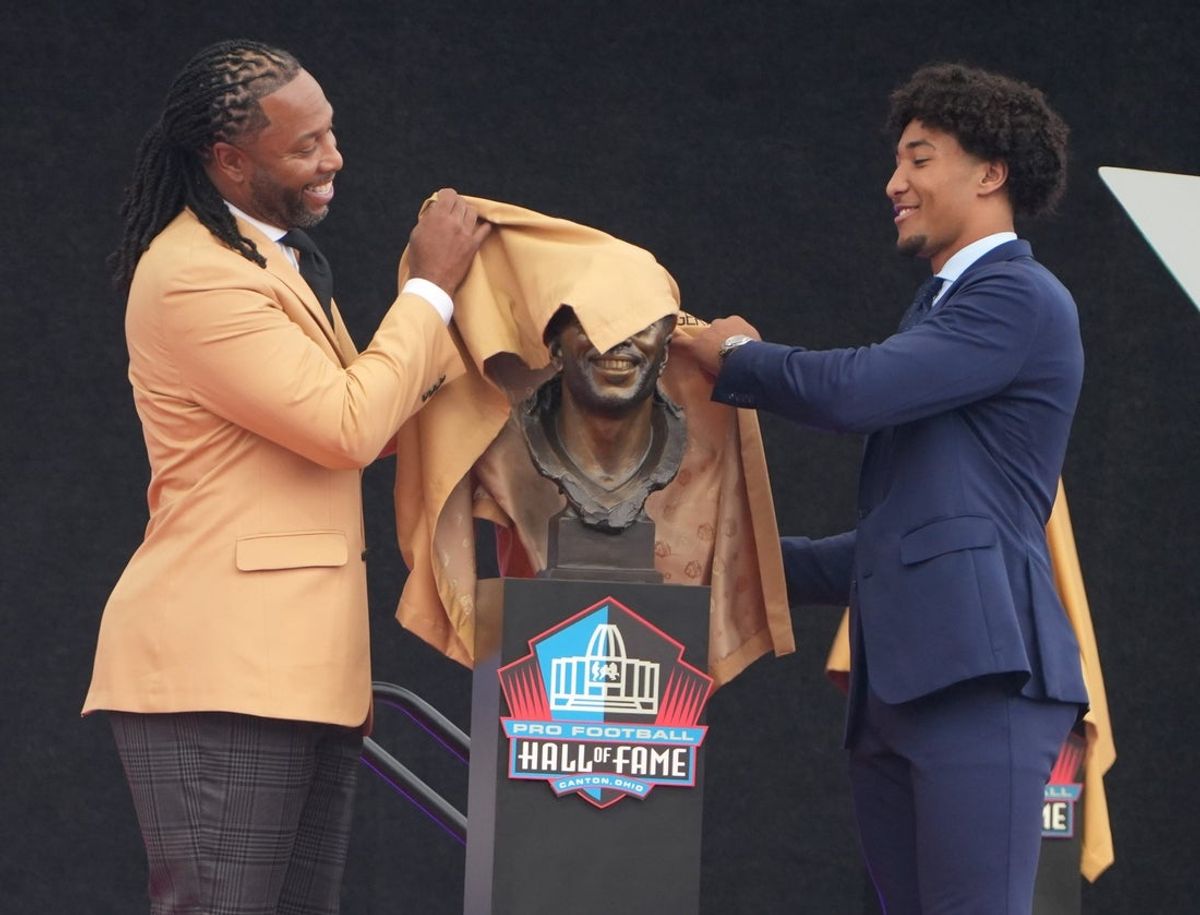
But this weekend of course, that’s exactly where Little Fitzy is headed. He will be enshrined into the Pro Football Hall of Fame in Canton, Ohio, on Saturday as a first-ballot Hall of Famer.

Fitzgerald will be remembered as one of the best and most productive wide receivers in league history after an incredible 17-season career with the Arizona Cardinals.

I have a ton of memories of being around Fitzgerald, but there’s one that stands out among them all.

One day after training camp, a nameless Vikings’ wide receiver camp body was getting extra work on a JUGS machine, catching balls. He was being tutored by Fitzgerald, who was showing this player how to properly approach the incoming ball. This was a child instructing a grown man an NFL team deemed good enough to attend training camp.

Larry Fitzgerald Jr. was special even back then.

In addition to his incredible natural football ability, Larry Fitzgerald Jr. stood out for his politeness and good nature. You could tell he was a good kid from the first time you met him.

There was no I’m-going-to-be-a-star attitude. He was genuine and he worked his tail off with the rest of the ball boys. There was no entitlement. It was as if he was using his time around an NFL camp as an internship for his future. He passed with flying colors.

I’ve always cherished following his career from his days at Pittsburgh in college to his days of dominating the NFL and I’ve enjoyed running into him over the years now and again.

Enjoy Canton, Little Fitzy, you’ve earned it.

#Larry #Fitzgeralds #Hall #Fame #induction #years #making">Larry Fitzgerald’s Hall of Fame induction is 25 years in the making  When I arrived to cover the Minnesota Vikings for the St. Paul Pioneer Press in 2000, it was clear I was dealing with a star-studded roster.The team boasted future Pro Football Hall of Famers; wide receivers Cris Carter and Randy Moss and defensive tackle John Randle. Plus, there were a ton of other stars including quarterback Daunte Culpepper, center Matt Birk and running back Robert Smith. The Vikings were loaded with star power.The talent around the team wasn’t relegated simply to the roster, however.That summer I first laid my eyes on a 16-year-old high school junior named Larry Fitzgerald Jr. The son of a local media member and close friend of Vikings’ head coach Dennis Green, Little Fitzy was a ball boy during training camp and on game days. It turns out, Larry Fitzgerald Jr. is very likely the most famous former NFL ball boy in history.On reporting date, fellow reporter Kevin Seifert pointed out Fitzgerald to me and said “that’s a bad man.” Seifert didn’t say that about any of the actual Vikings that day.Fitzgerald was already known as the best Minnesota high school prospect in years and he was considered one of the best high school players in the country. Seifert told me the buzz was that the kid was, no doubt, headed to the NFL in a half decade or so. Seifert was on the money. I’m not sure the Hall of Fame was mentioned or not.But this weekend of course, that’s exactly where Little Fitzy is headed. He will be enshrined into the Pro Football Hall of Fame in Canton, Ohio, on Saturday as a first-ballot Hall of Famer.Fitzgerald will be remembered as one of the best and most productive wide receivers in league history after an incredible 17-season career with the Arizona Cardinals.I have a ton of memories of being around Fitzgerald, but there’s one that stands out among them all.One day after training camp, a nameless Vikings’ wide receiver camp body was getting extra work on a JUGS machine, catching balls. He was being tutored by Fitzgerald, who was showing this player how to properly approach the incoming ball. This was a child instructing a grown man an NFL team deemed good enough to attend training camp.Larry Fitzgerald Jr. was special even back then.In addition to his incredible natural football ability, Larry Fitzgerald Jr. stood out for his politeness and good nature. You could tell he was a good kid from the first time you met him.There was no I’m-going-to-be-a-star attitude. He was genuine and he worked his tail off with the rest of the ball boys. There was no entitlement. It was as if he was using his time around an NFL camp as an internship for his future. He passed with flying colors.I’ve always cherished following his career from his days at Pittsburgh in college to his days of dominating the NFL and I’ve enjoyed running into him over the years now and again.Enjoy Canton, Little Fitzy, you’ve earned it.  #Larry #Fitzgeralds #Hall #Fame #induction #years #making

Follow Sportstar for extensive coverage of the tenth edition of the TNPL, from live scores and match reports to exclusive analysis and features.

TOSS

Tiruppur Tamizhans won the toss and chose to bowl first.

PLAYING XIs

Nellai Royal Kings: Athish SR(w), D Santhosh Kumar, Ajitesh Guruswamy, U Mukilesh, Rithik Easwaran, Sonu Yadav(c), Muhammed Adnan Khan, Ramalingam Rohit, Emmanuel Cherian, NS Harish, Rocky Bhasker

Tiruppur Tamizhans: Tushar Raheja(w), Amit Sathvik, Pradosh Ranjan Paul, Mohamed Ali, Uthirasamy Sasidev, Ravisrinivasan Sai Kishore(c), M Mathivannan, S Mohan Prasath, R Silambarasan, Esakkimuthu A, T Natarajan

Published on Aug 09, 2026

#TNPL #Live #Allround #batting #display #propels #Nellai #Royal #Kings">TNPL 2026 Live: All-round batting display propels Nellai Royal Kings to 206/8  Follow Sportstar for extensive coverage of the tenth edition of the TNPL, from live scores and match reports to exclusive analysis and features.TOSSTiruppur Tamizhans won the toss and chose to bowl first.PLAYING XIsNellai Royal Kings: Athish SR(w), D Santhosh Kumar, Ajitesh Guruswamy, U Mukilesh, Rithik Easwaran, Sonu Yadav(c), Muhammed Adnan Khan, Ramalingam Rohit, Emmanuel Cherian, NS Harish, Rocky BhaskerTiruppur Tamizhans: Tushar Raheja(w), Amit Sathvik, Pradosh Ranjan Paul, Mohamed Ali, Uthirasamy Sasidev, Ravisrinivasan Sai Kishore(c), M Mathivannan, S Mohan Prasath, R Silambarasan, Esakkimuthu A, T NatarajanPublished on Aug 09, 2026  #TNPL #Live #Allround #batting #display #propels #Nellai #Royal #Kings

Post Comment