NFL Defensive Rookie of the Year odds with 2 favorites and appealing long-shot options
TAMPA, FL – April 24: Tampa Bay Buccaneers 2026 first round pick Edge Rusher Rueben Bain Jr. holds up a jersey as General Manager Jason Licht and Head Coach Todd Bowles stand on each side of Bain during the Tampa Bay Buccaneers First Round Pick Press Conference on April 24, 2026 at the AdventHealth Training Center at One Buccaneer Place in Tampa, Florida. (Photo by Cliff Welch/Icon Sportswire via Getty Images) | Icon Sportswire via Getty Images
With the NFL Draft in the rearview, fans can start speculating on how well players will fit into their new landing spots. The NFL Draft is an inexact alchemy, and every prospect’s impact will be determined as much by their own skills and traits as their ability to adapt and gel with their new organization’s structures and schemes. Taking a look at the odds on NFL Defensive Player of the Year award, via FanDuel, is a chance to project which players found the perfect landing spot to make an immediate impact in the league.
David Bailey (+500), EDGE – New York Jets
Many expect David Bailey to contribute right away after the Jets invested their No. 2 overall pick in the EDGE prospect’s steady production and projectable traits instead of searching for more upside with less polished prospects. Bailey posted 14.5 sacks last season with Texas Tech. If Aaron Glenn’s defense starts playing at an above-average level, Bailey could earn a lot of attention for helping turn things around.
Rueben Bain Jr. (+500), EDGE – Tampa Bay Buccaneers
Rueben Bain Jr. showed off his ability to move the line of scrimmage and take over football games during Miami’s run to the CFB Championship. The defensive lineman is joining a Buccaneers team that’s struggled to find consistency in closing out games, and they’re watching their NFC South conference rivals stock up on offensive firepower. Bain will start right away for a Todd Bowles defense that can create unique passrushing looks around DT Vita Vea.
Arvell Reese (+750) will start immediately alongside friendly company in New York Giants linebackers Brian Burns, Tremaine Edmunds, and Kayvon Thibodeaux. If offenses key on all of these other stars, Reese could produce eye-popping stats.
Mansoor Delane (+850) will be tested early and often as the primary CB after the Kansas City Chiefs traded away both of last year’s starters. The Chiefs traded up to secure the draft’s top CB, and the former Virginia Tech and LSU standout will be playing in a big TV market that will create buzz if he starts making plays.
Sonny Styles (+900) will get the chance to play the Bobby Wagner role in the middle of Dan Quinn’s Washington Commanders defense. The converted safety led the Buckeyes in tackles last season, and he’ll benefit from playing alongside disruptive linebacker Frankie Luvu.
Caleb Downs (+900) will be a focal point of Dallas Cowboys’ new Defensive Coordinator Christian Parker’s 3-4 scheme. Parker brings familiarity with the division as former passing game coordinator and DBs coach for the Eagles, and he could put Downs in position to clean up a lot of broken plays behind a revamped defensive front
TAMPA, FL – April 24: Tampa Bay Buccaneers 2026 first round pick Edge Rusher Rueben Bain Jr. holds up a jersey as General Manager Jason Licht and Head Coach Todd Bowles stand on each side of Bain during the Tampa Bay Buccaneers First Round Pick Press Conference on April 24, 2026 at the AdventHealth Training Center at One Buccaneer Place in Tampa, Florida. (Photo by Cliff Welch/Icon Sportswire via Getty Images) | Icon Sportswire via Getty Images
With the NFL Draft in the rearview, fans can start speculating on how well players will fit into their new landing spots. The NFL Draft is an inexact alchemy, and every prospect’s impact will be determined as much by their own skills and traits as their ability to adapt and gel with their new organization’s structures and schemes. Taking a look at the odds on NFL Defensive Player of the Year award, via FanDuel, is a chance to project which players found the perfect landing spot to make an immediate impact in the league.
David Bailey (+500), EDGE – New York Jets
Many expect David Bailey to contribute right away after the Jets invested their No. 2 overall pick in the EDGE prospect’s steady production and projectable traits instead of searching for more upside with less polished prospects. Bailey posted 14.5 sacks last season with Texas Tech. If Aaron Glenn’s defense starts playing at an above-average level, Bailey could earn a lot of attention for helping turn things around.
Rueben Bain Jr. (+500), EDGE – Tampa Bay Buccaneers
Rueben Bain Jr. showed off his ability to move the line of scrimmage and take over football games during Miami’s run to the CFB Championship. The defensive lineman is joining a Buccaneers team that’s struggled to find consistency in closing out games, and they’re watching their NFC South conference rivals stock up on offensive firepower. Bain will start right away for a Todd Bowles defense that can create unique passrushing looks around DT Vita Vea.
Arvell Reese (+750) will start immediately alongside friendly company in New York Giants linebackers Brian Burns, Tremaine Edmunds, and Kayvon Thibodeaux. If offenses key on all of these other stars, Reese could produce eye-popping stats.
Mansoor Delane (+850) will be tested early and often as the primary CB after the Kansas City Chiefs traded away both of last year’s starters. The Chiefs traded up to secure the draft’s top CB, and the former Virginia Tech and LSU standout will be playing in a big TV market that will create buzz if he starts making plays.
Sonny Styles (+900) will get the chance to play the Bobby Wagner role in the middle of Dan Quinn’s Washington Commanders defense. The converted safety led the Buckeyes in tackles last season, and he’ll benefit from playing alongside disruptive linebacker Frankie Luvu.
Caleb Downs (+900) will be a focal point of Dallas Cowboys’ new Defensive Coordinator Christian Parker’s 3-4 scheme. Parker brings familiarity with the division as former passing game coordinator and DBs coach for the Eagles, and he could put Downs in position to clean up a lot of broken plays behind a revamped defensive front
#Deadspin #Larry #Fitzgerald #Arizona #gave #home">Deadspin | Larry Fitzgerald thanks all of Arizona: ‘You gave me a home’
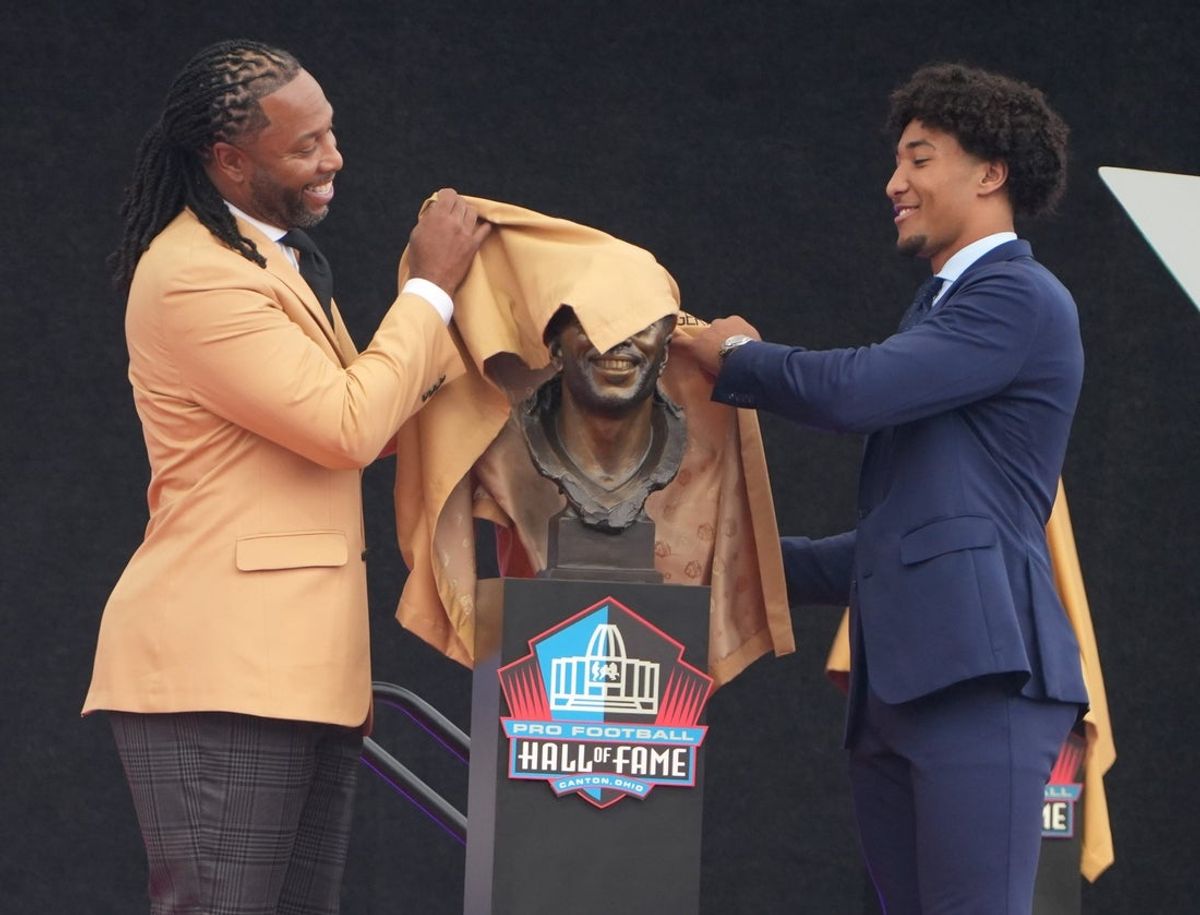
Pro Football Hall of Fame enshrinee Larry Fitzgerald and his son Devin Fitzgerald unveil his bust during the Class of 2026 enshrinement ceremony at Tom Benson Hall of Fame Stadium in Canton, Ohio, on Aug. 8, 2026.
One day after being inducted into the Pro Football Hall of Fame, longtime Arizona Cardinals wide receiver Larry Fitzgerald paid for a full-page ad in the Arizona Republic to thank everyone who made a Minnesota native feel welcome in the state he calls home.
After being selected by the Cardinals with the third overall pick in the 2004 NFL Draft, Fitzgerald spent all 17 years of his NFL career in Arizona. He caught 1,432 passes for 17,492 yards and 121 touchdowns while earning 11 trips to the Pro Bowl.
Fitzgerald ranks second to Jerry Rice on the NFL’s all-time lists for receptions and receiving yards. He stands sixth in touchdown catches, trailing Rice, Randy Moss, Terrell Owens, Chris Carter and Marvin Harrison.
Here’s the message Fitzgerald penned for his Arizona Republic ad:
People have asked me countless times what it felt like to be inducted into the Pro Football Hall of Fame.
The truth is, it was one of the greatest honors of my life.
But this really isn’t a Hall of Fame story.
It’s a thank-you letter.
I arrived in Arizona as a 20-year-old kid who didn’t know a single person. I had no idea this desert would become the place that would shape me into the man I am today.
The day I landed was the same day the nation learned Pat Tillman had lost his life. Pat is one of America’s great heroes.
I stepped off the plane into a state where its people were carrying real grief, and something inside me grew quiet. I started paying attention.
You learn quickly what loyalty looks like when it isn’t just a word.
For the next 17 seasons, I quietly measured myself against the standard Pat Tillman set. I’m still not sure I ever lived up to it.
Somewhere along the way, Arizona stopped being the place where I lived and became the place I was from.
It happened through a thousand ordinary moments until one day, I realized this was simply home. Not because I was a Hall of Famer. Not because I was a wide receiver. Just because the people of this state allowed me to be Larry.
You don’t fall in love with a place because of its stadiums. You fall in love on quiet mornings hiking Camelback Mountain.
On crisp fall afternoons walking a golf course. During summers in Flagstaff and standing among the red rocks of Sedona that remind you just how small you are in the best possible way.
When I stopped playing football, I walked away quietly. I’m known for my Irish goodbyes. Arizona even gave me that. Yet you kept showing up for me anyway, especially through the work of my foundation. Your support was never conditional. You never asked me to be anything other than myself, and somehow that was always enough.
Arizona gave a kid from Minneapolis something he didn’t even know he was searching for.
Belonging.
And that sense of belonging changed me.
After a while, you weren’t cheering for a wide receiver anymore, you were cheering for one of your own.
So this isn’t really a story about 17 years in a Cardinals uniform or a bronze bust in Canton.
It’s the story of a young man who was welcomed by a state that owed him nothing and gave him everything.
Thank you, Arizona.
Thank you for letting a kid from somewhere else become one of your own.
Thank you for embracing not just the player, but the man.
You gave me far more than a career. You gave me friendships that will last a lifetime. You gave me purpose beyond football.
You gave me a place where my children will always know they belong.
#Larry #Fitzgeralds #Hall #Fame #induction #years #making">Larry Fitzgerald’s Hall of Fame induction is 25 years in the making
When I arrived to cover the Minnesota Vikings for the St. Paul Pioneer Press in 2000, it was clear I was dealing with a star-studded roster.
The team boasted future Pro Football Hall of Famers; wide receivers Cris Carter and Randy Moss and defensive tackle John Randle. Plus, there were a ton of other stars including quarterback Daunte Culpepper, center Matt Birk and running back Robert Smith. The Vikings were loaded with star power.
The talent around the team wasn’t relegated simply to the roster, however.
That summer I first laid my eyes on a 16-year-old high school junior named Larry Fitzgerald Jr. The son of a local media member and close friend of Vikings’ head coach Dennis Green, Little Fitzy was a ball boy during training camp and on game days. It turns out, Larry Fitzgerald Jr. is very likely the most famous former NFL ball boy in history.
On reporting date, fellow reporter Kevin Seifert pointed out Fitzgerald to me and said “that’s a bad man.” Seifert didn’t say that about any of the actual Vikings that day.
Fitzgerald was already known as the best Minnesota high school prospect in years and he was considered one of the best high school players in the country. Seifert told me the buzz was that the kid was, no doubt, headed to the NFL in a half decade or so. Seifert was on the money. I’m not sure the Hall of Fame was mentioned or not.
But this weekend of course, that’s exactly where Little Fitzy is headed. He will be enshrined into the Pro Football Hall of Fame in Canton, Ohio, on Saturday as a first-ballot Hall of Famer.
Fitzgerald will be remembered as one of the best and most productive wide receivers in league history after an incredible 17-season career with the Arizona Cardinals.
I have a ton of memories of being around Fitzgerald, but there’s one that stands out among them all.
One day after training camp, a nameless Vikings’ wide receiver camp body was getting extra work on a JUGS machine, catching balls. He was being tutored by Fitzgerald, who was showing this player how to properly approach the incoming ball. This was a child instructing a grown man an NFL team deemed good enough to attend training camp.
Larry Fitzgerald Jr. was special even back then.
In addition to his incredible natural football ability, Larry Fitzgerald Jr. stood out for his politeness and good nature. You could tell he was a good kid from the first time you met him.
There was no I’m-going-to-be-a-star attitude. He was genuine and he worked his tail off with the rest of the ball boys. There was no entitlement. It was as if he was using his time around an NFL camp as an internship for his future. He passed with flying colors.
I’ve always cherished following his career from his days at Pittsburgh in college to his days of dominating the NFL and I’ve enjoyed running into him over the years now and again.
#TNPL #Live #Allround #batting #display #propels #Nellai #Royal #Kings">TNPL 2026 Live: All-round batting display propels Nellai Royal Kings to 206/8
Follow Sportstar for extensive coverage of the tenth edition of the TNPL, from live scores and match reports to exclusive analysis and features.
TOSS
Tiruppur Tamizhans won the toss and chose to bowl first.
PLAYING XIs
Nellai Royal Kings: Athish SR(w), D Santhosh Kumar, Ajitesh Guruswamy, U Mukilesh, Rithik Easwaran, Sonu Yadav(c), Muhammed Adnan Khan, Ramalingam Rohit, Emmanuel Cherian, NS Harish, Rocky Bhasker
Tiruppur Tamizhans: Tushar Raheja(w), Amit Sathvik, Pradosh Ranjan Paul, Mohamed Ali, Uthirasamy Sasidev, Ravisrinivasan Sai Kishore(c), M Mathivannan, S Mohan Prasath, R Silambarasan, Esakkimuthu A, T Natarajan




Post Comment