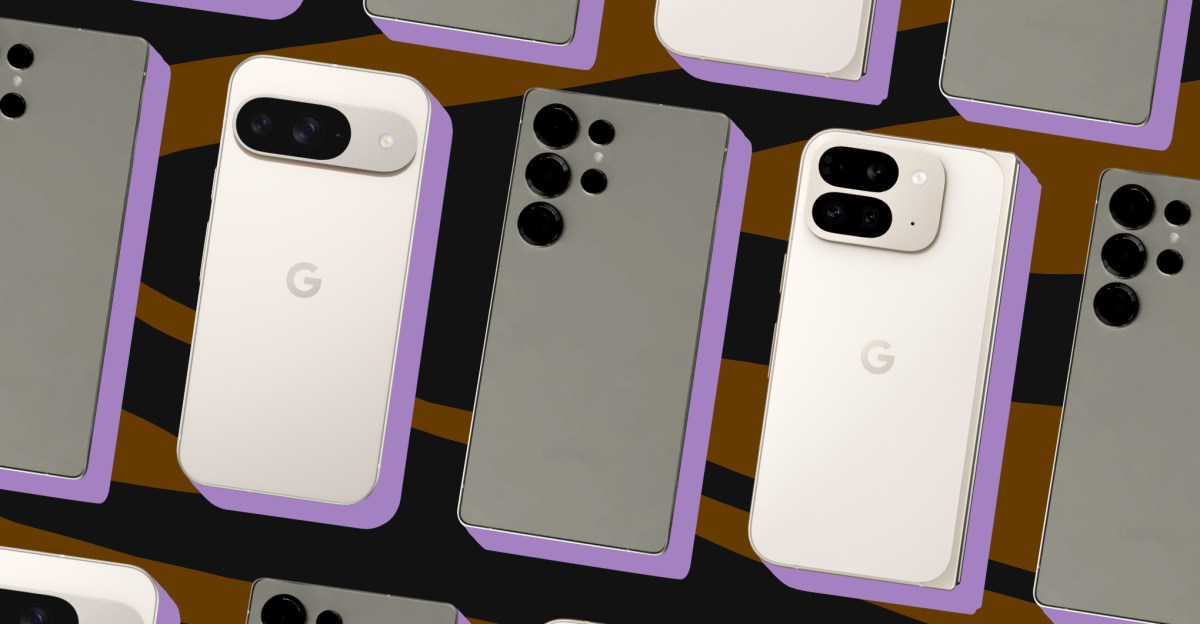
The Android ecosystem is all about choice. While iPhone owners have a smaller pool of new devices to pick from when it’s time to upgrade, there’s a wider range of choices on Android. Some Android phones even fold in half! Imagine.
On the flip side, all that choice can make for some hard decisions. Here’s where I’d like to help; I’ve tested a whole boatload of recent Android phones, and I think there are some real winners in the current batch. It’s all a matter of what you’re looking for, what you’re comfortable spending, and what your definition of a “reasonably sized phone” is. (I have my own, personally.)
As you sift through the options, you’ll almost certainly come across tech’s favorite buzzphrase of the moment: AI. Generally speaking, AI has yet to really impress me on a phone. The Pixel 9 series has some potentially useful features, like a Screenshots app that uses AI to tag relevant info in metadata, and Galaxy devices can translate a phone call for you in real time. These things are nothing to sneeze at! But none of it feels like the platform shift that the big tech companies keep promising. Best not to put too much stock in any company’s AI claims just yet.
What I’m looking for
There’s no shortcut to properly testing a phone; I put my personal SIM card (physical or otherwise) in each phone I review and live with it for a minimum of one full week. I set up each phone from scratch, load it up with my apps, and go about living my life — stress testing the battery, using GPS navigation on my bike while streaming radio, taking rapid-fire portrait mode photos of my kid — everything I can throw at it. Starting over with a new phone every week either sounds like a dream or your personal hell, depending on how Into Phones you are. For me, switching has become so routine that it’s mostly painless.
A great Android phone will go the distance. I look for signs that the hardware and software will keep up for many years to come, including a strong IP rating for dust and water resistance (IP68 is preferred), durable glass panels on the front and back, and a sturdy aluminum frame rather than plastic. Samsung and Google flagships now offer seven years of OS and security updates, which as awesome. As a bare minimum three years of Android OS version upgrades is preferred, along with a total of four or five years of security updates.
The best Android phones have plenty of resolution to cover their large display area, which means 1440p, ideally. A fast refresh rate of at least 120Hz is preferred — animations and scrolling look super smooth at that rate — and even better if it’s variable down to 1Hz to save on battery life.
Any phone can take a decent photo in good lighting, but the best phone cameras can handle low light and high-contrast scenes well, too. I look for optical (most common) or sensor-shift (rare) image stabilization, which helps compensate for hand shake and enable slower shutter speeds in low light to gather more light. A telephoto lens is great to have too, though high-res sensors are starting to offer better lossless crop modes that mimic short zoom lenses well.
Most phones on this list offer wireless charging, though not all do. Lack of wireless charging isn’t a complete deal-breaker, but it’s becoming an essential feature for a lot of people since it’s convenient for charging many different kinds of devices.
If you live in the US, I have some bad news about the Android market, though. For complicated reasons having to do with “capitalism” and “geopolitics,” we don’t get nearly as many of the options as you’ll find in Asia and Europe — brands like Huawei, Xiaomi, Honor, and Oppo just aren’t available here. I’ve limited this guide to the devices I’ve personally tested in depth; thus, it is a fairly US-centric set of recommendations.
With that in mind, it’s also worth acknowledging that most people in the US get their phones “for free” from their wireless carrier. If you can manage it, buying a phone unlocked will give you the most flexibility and freedom if you end up wanting to change carriers in the near future. Phone manufacturers also offer financing and trade-in deals to make payment more manageable. But if you’re happy with your carrier and the free phone on offer is the one you really want, by all means, take the free phone. Just make sure you understand the terms, especially if you need to change plans to cash in on the deal.
However you go about it, you have some fantastic options for your next Android phone.
The best Android phone overall

$599
The Good
- Updated design feels more secure in hand
- Fast fingerprint sensor
- Seven years of software and OS updates
The Bad
- No telephoto camera
- AI features are inconsistent
- What is a photo?
Screen: 6.3-inch 1080p 120Hz OLED / Processor: Tensor G4 / Cameras: 50-megapixel f/1.7 main with OIS, 48-megapixel ultrawide, 10.5-megapixel selfie / Battery: 4,700mAh / Charging: 27W wired, 15W wireless (with Pixel Stand 2) / Weather resistance: IP68
Google’s hardware is better than ever, and the whole Pixel 9 lineup feels just as polished as anything you’d get from Samsung or Apple. But at $799 (and often less than that), the basic Pixel 9 is in a particularly appealing position, and if you don’t need a telephoto camera or the biggest screen, then this is the Android phone to get.
The Pixel 9 comes with some significant quality-of-life improvements like a faster fingerprint scanner for unlocking the phone. The camera is as reliable as ever, and if you’re into AI photo editing tricks, boy does this phone have ‘em. There’s a new Screenshots app that acts as a place to store all of the information that would otherwise be lost at sea in your camera roll, and it uses AI to parse information out and make it searchable. Kinda handy.

Even without AI, this is an excellent phone. It’s also designed to go the distance, with seven years of promised OS updates, which very likely means you’ll outgrow the phone before Google stops supporting it. Its potential for long-term value and the quality of the hardware make it an easy recommendation for anyone who just wants a nice Android phone that works.
Read my full Google Pixel 9 review.
The best maximalist phone


$1000
The Good
- Excellent screen
- Improved ultrawide camera
- Rounded corners are comfier
The Bad
- Expensive
- Bulky
- AI is (still) hit or miss
Screen: 6.9-inch 1440p 120Hz OLED / Processor: Qualcomm Snapdragon 8 Elite / Cameras: 200-megapixel main with OIS, 50-megapixel 5x telephoto with OIS, 10-megapixel 3x telephoto with OIS, 50-megapixel ultrawide, 12-megapixel selfie / Battery: 5,000mAh / Charging: 45W wired, 15W wireless (Qi2 Ready) / Weather resistance: IP68
There’s still no phone quite like the Ultra. The Galaxy S25 Ultra is Samsung’s latest answer to the question, “What if your phone had all of the features?” It’s equipped with two telephoto cameras, a built-in stylus, and a big, bright screen. Good luck finding that combination in another phone. Related: this is one of the most expensive slab-style phones you can buy.
The newest edition of the Ultra comes with rounded corners and flat edges, making it more comfortable in your hand. But if you’re looking for significant year-over-year improvements to the Ultra formula outside of that, well, you won’t find much. Samsung’s focus has been on software features, which is to say AI features. But AI on Galaxy phones remains a mixed bag — it’s certainly not the paradigm shift Samsung wants us to think the S25 series represents.

Photo: Allison Johnson / The Verge
All of that puts the Ultra in a place of slightly less distinction than previous versions. The biggest updates are software features available to the rest of the S25 series. The Ultra looks and feels more like other Galaxy phones this time around, too. More than ever, it’s hard to understand what Samsung means when it calls this phone “Ultra.” Still, it’s your best choice for a feature-packed Android phone — even if it’s not quite as ultra as it once was.
Read my full Samsung Galaxy S25 Ultra review.
The best Android phone that isn’t huge


$625
The Good
- The last reasonably sized Android phone
- Seven years of OS upgrades
- Very good camera
The Bad
- Samsung software is as cluttered as usual
- AI is still a mixed bag
Screen: 6.2-inch 2340 x 1080 120hz OLED / Processor: Qualcomm Snapdragon 8 Elite Cameras: 50-megapixel main with OIS, 12-megapixel ultrawide, 10-megapixel 3x telephoto with OIS, 12-megapixel selfie Battery: 4000mAh / Charging: 25W wired, 15W wireless (Qi2 Ready) / Weather-resistance rating: IP68
Most people like a big phone, and I get that. I do. If you want a big Android phone, you have plenty of options in front of you. But some of us like a smaller phone — something that (kind of) fits in your pocket, or feels more comfortable in your hand. For us, there is but one option on Android: the Samsung Galaxy S25.
That’s the regular S25, not the Plus, which is a fine big phone. But the standard S25 is basically the last of its kind: a full-featured phone with a 6.2-inch screen. It’s not small, but it’s not huge, and we’ll have to take what we can get. And it’s a darn good phone that keeps up with the bigger devices in all the important ways: the battery goes all day, it comes with plenty of RAM, and it even has a real telephoto lens — not something you get on a basic, 6.1-inch phone on, say, iOS.

Photo: Allison Johnson / The Verge
The Galaxy S25 isn’t just a good, small-ish phone by default. It’s reliable, durable, and comes with the promise of seven years of OS updates. It’s not my pick for the overall best Android phone because Samsung software can be a bit much, but if you’re comfortable in the Samsung ecosystem and you just want a phone that fits in your dang pocket, then this is the one to go with.
The best phone if you hate waiting for your phone to charge


$850
The Good
- Excellent battery life
- Six years of security updates
- Strong IP rating for dust and water resistance
The Bad
- Big phone is big
- Not as many OS updates as Google and Samsung offer
Screen: 6.82-inch 1440p 120Hz LTPO OLED / Processor: Snapdragon 8 Elite / Cameras: 50-megapixel f/1.6 main with OIS, 50-megapixel 3x telephoto with OIS, 50-megapixel f/2.0 ultrawide, 32-megapixel selfie / Battery: 6,000mAh / Charging: 80W wired, 50W wireless / Weather-resistance rating: IP68 and IP69
There are plenty of good reasons to consider the OnePlus 13. It has a big, beautiful screen, and costs a hundred bucks less than the Galaxy S25 Plus. Its dust and water resistance is so strong you could practically use the phone in a hurricane without consequences. And its camera system is much improved year over year, particularly when it comes to low-light portraiture. But there’s one standout reason to consider the 13: impatience.

The OnePlus 13 offers enough battery stamina to get through two days of moderate use on a single charge — and that’s with plenty of power-draining features enabled, including the always-on display. If you’re thriftier with your charge, it could even go beyond that. Forgot to charge overnight? No big deal; you can probably just charge it up on night two. Charging is also relatively fast, and in the US, the phone comes with an 80W wired charger in the box. So even if you do need a midday top-off, you’ll be able to get hours of charge in a matter of minutes. No other flagship phone offers that kind of charging (or not charging) flexibility.
Read my full OnePlus 13 review.


$1499
The Good
- Excellent outer screen format
- Inner screen is lovely to use
- Seven years of OS updates
The Bad
- Expensive
- Main camera isn’t as good as slab phones
- Long-term durability?
Screen: 8.0-inch 2076p 120Hz OLED inner screen, 6.3-inch 1080p 120Hz OLED cover screen / Processor: Tensor G4 / Cameras: 48-megapixel f/1.7 main with OIS, 10.8-megapixel 5x telephoto with OIS, 10.5-megapixel ultrawide, 10-megapixel selfie (cover screen), 10-megapixel inner selfie camera / Battery: 4,650mAh / Charging: 21W wired, 7.5W wireless / Weather resistance: IPX8
Does anyone truly need a folding phone? Probably not. But using one is awfully nice, and the Pixel 9 Pro Fold is the nicest book-style foldable I’ve used to date. It’s pricey, it’s still bulkier than a slab-style phone, and its cameras aren’t quite as nice as the other Pixel 9 Pro phones. But it’s a joy to use, both as a regular phone with the cover screen and when you unfold the big inner screen.
The 9 Pro Fold is Google’s second folding phone, following up the passport-shaped Pixel Fold with a format that feels much more familiar. The outer screen measures 6.3 inches on the diagonal, but more importantly, the ratio is the same as Google’s slab phones. By comparison, Samsung’s Z Fold 6 uses a taller, narrower format that feels cramped. Having used them both, I much prefer the 9 Pro Fold’s approach.

That said, the 9 Pro Fold isn’t without compromises. The camera system isn’t quite as good as what you get in the other 9 Pro phones. The outer screen isn’t as sharp or bright as the Pixel 9 Pro’s, either. And it’s not as durable as its slab-style counterparts — there’s no dust resistance, and you can’t get it repaired just anywhere. For $1,800, that’s an awful lot to swallow. For the adventurous early adopter, though, the 9 Pro Fold will be very rewarding.
Read my full Google Pixel 9 Pro Fold review.
Other Android phones worth considering
There are many more great Android devices that weren’t covered here, and a few are worth calling out that didn’t quite make the cut for a recommendation.
- First off, there’s the Galaxy Z Flip 6, Samsung’s excellent clamshell-style foldable. It’s not as much fun to use as the 2025 Razr Ultra — which facilitates using apps on the cover screen more easily — but Motorola’s track record for software updates isn’t great, so the Z Flip 6 is a safer bet for a flip phone. Read our review.
- The OnePlus Open is also another good book-style foldable option. It’s thin and light, and the software includes some thoughtful approaches to multitasking — a crucial part of the folding phone experience. But it won’t be supported with software updates for as long as the Pixel 9 Pro Fold or the Galaxy Z Fold 6. Read our review.
- Speaking of OnePlus, the company also recently launched the OnePlus 13R, a midrange phone with a big 6.78-inch OLED display and enough battery life to carry you through two full days on a single charge. That said, the $599 handset lacks wireless charging and full water resistance, both of which can be found on other budget-friendly phones for less. Read our review.
- We’re currently in the midst of testing Samsung’s new Galaxy S25 Edge, which essentially serves as a sleeker S25 Plus that trades battery life and a telephoto lens for sheer compactness. It’s still got a 6.7-inch OLED display and a Snapdragon 8 Elite for Galaxy chipset, but given that it’s 1.5 millimeters thinner and about an ounce lighter than the Plus, it’s more comfortable to tote around. Read our hands-on impressions.
- Last but not least, there’s the Google Pixel 9A. It comes with some small but important updates over the 8A, including more robust water resistance and a slightly bigger, brighter screen. Better yet, those improvements don’t come with a price bump. With seven years of OS updates included, that’s a strong ROI. Read our review.
- Google’s Pixel 10 series — which will likely include a regular Pixel 10, a Pro, a Pro XL, and a Pro Fold — will reportedly launch at a Made by Google event on August 13th. Google’s next-gen flagships have been heavily leaked at this point, and the base model is expected to join the Pro options with three cameras (including a telephoto lens). The Pro models, meanwhile, will distinguish themselves with an upgraded Tensor G5 chipset and more advanced AI features while retaining a near-identical design.
Update, June 5th: Updated pricing / availability and added a mention of Samsung’s Galaxy S25 Edge.
Source link
#Android #phones #buy

![This former notorious red-light district is now one of the world’s top AI hubs | TechCrunch
What every U.K. AI startup wants to know these days is, how can I get office space in King’s Cross?
The area is so hot that a VC firm allegedly recently won a deal by promising a founder office space in the neighborhood. “We stop at nothing to win deals [for] and to support” founders, “including helping them source office space when needed,” the firm told me when asked about the rumor, declining to confirm or deny any details.
The neighborhood’s popularity began back in 2016 when DeepMind — then newly acquired by Google — moved in. Soon after, a flood of AI startups followed, wanting to be around the Google DeepMind magic. Today, they hope to take advantage of the cluster of AI talent there.
This has transformed King’s Cross into one of the world’s top AI hubs, rivaled only by San Francisco and Beijing. Around London, it’s known by the sobriquet “Knowledge Quarter,” as it’s home to names like OpenAI, Meta, Isomorphic Labs, Cusp AI, Wayne, Recursive, and, a little farther down the road, Synthesia and Anthropic. The European Technology Network (ETN) just moved into a glossy new office nearby, while University College London sits around the corner.
Mixed in with the new developments are trendy food spots like Hoppers and BAO. Hop a train from King’s Cross, and founders can be in Cambridge in 45 minutes to source talent or can be in Paris in two hours to strike a deal.
Who would have guessed that a little more than 20 years ago, this was one of the seediest areas in London?
“In the ’80s, crack and heroin made the area a major narcotics market,” Hussein Kanji, an investor at Hoxton Ventures, said, recalling syringes in tree trunks and gangs patrolling the streets. “In 1982, the local church was occupied by the English Collective of Prostitutes for 12 straight days.” Then, in the early 2000s, a real estate developer had a dream and, well, “now it is the AI hotbed of the United Kingdom,” Kanji said. “What a change.” Around 18 months ago, his portfolio company BioCorteX moved from the neighborhood Holborn to the Jellicoe building in King’s Cross, hoping to be near the action. “Lots going on in London right now,” Nik Sharma, co-founder of BioCorteX, told me. “Lots of hyperscalers moving in.” That includes, reportedly, Jeff Bezos’ AI company Prometheus, which is also said to be in talks to move into the Jellicoe.
There are around 3,600 AI startups in London, which, together, have raised around .1 billion out of the .8 billion raised in the city since late July, according to Dealroom. Since the start of June, AI-related startups have leased more than 1 million square feet of office space in London, according to the real estate firm Knight Frank. With that, prime rents in King’s Cross have risen 18% over the past three years, Chris Dunn, a commercial insight associate at the firm, told me. That percentage represents only the largest leases encompassing at least 10,000 square feet, like the ones OpenAI and Prometheus are signing. The shorter deals go for even more, he said, and now the vacancy rate for conventional office space is just 0.9%. “Demand has outstripped supply,” he continued.
Today, one of the big topics of the area is sovereignty. It was a wake-up call for many when Anthropic shut off access to Mythos and Fable this summer, leaving some in the ecosystem to conclude: “We’d better look after ourselves,” Saul Klein, co-founder of the VC firm Phoenix Court, told me.
Phoenix Court is located in the King’s Cross area and has three portfolio companies in the vicinity, including Olix (which just announced a .3 billion valuation), Early Health and CoMind. Robin Klein, co-founder of the firm, said the shutdown of Fable and Mythos access was a “small but sharp reminder that Europe can’t simply rent its AI capabilities and capacity; it needs to build and hold some of its own.” King’s Cross, he said, is where much of this building is actually happening.
“The bigger question,” he continued, “is whether the U.K. builds the infrastructure, compute, energy, capital, to make this self-reliance durable, rather than just hosting outposts of U.S. labs.”
Image Credits:Phoenix Court
Top founders want to stay
Simon Kohl, founder of Latent Labs, has offices in King’s Cross and San Francisco. The London office, at the moment, is growing faster, and he’s more bullish than ever on the ecosystem, he said. “The mood right now feels less like London trying to catch up and more like London becoming one of the default places to start a serious AI company,” he said. Look around and you are likely to see Wayve testing its autonomous cars. Founded in 2017 by co-founder Alex Kendall, the unicorn is one of London’s biggest success stories.
“Ten years ago, building a frontier AI company from London felt like an unusual choice,” Kendall told me. “Now it feels like an obvious one.” Wayve moved into King’s Cross in 2018 looking for a space that could double as a garage — “a rare combination in Central London,” Kendall said. He has watched the ecosystem mature around him — and it’s now evident that a startup can stay in London, raise serious capital, hire world-class AI talent, and remain globally competitive, he said. Down the street from Anthropic’s new 158,000-square-foot office is the AI agent builder Sierra and the AI video platform Synthesia.
Laura Gonzalez Florez, Synthesia’s chief of staff and head of people, says the company moved into its glossy new office building a year ago to accommodate its growing team. They were drawn to the area for the same reason as everyone else: “It’s very close to the airport … very close to where a lot of investors are,” she said.
Image Credits:Synthesia
Around two-thirds of Synthesia’s engineers are remote, Gonzalez Florez said, letting the company tap into an affordable, international, and diverse talent pool and helping it scale faster. “From London, we can hire and work, without any problem, people from anywhere, from Slovenia to Portugal,” she said.
Unsurprisingly, London’s AI boom is also causing a talent war.U.K. AI job postings have skyrocketed in the past few years, per data from PwC. When Anthropic announced it moved into town earlier this year, it listed, for example, a salary range of £260,000 to £630,000 for a machine learning research engineer when the average salary in London for the same role is around £102,000. Some founders in the U.K., like those in Silicon Valley, are being forced to raise more and bigger rounds to keep up.
“The real test is whether more globally significant AI companies are founded, funded, and scaled from the U.K., while continuing to attract the world’s best talent to build them here,” Zain Ali, founder of the King’s Cross-based AI legal firm Centuro, told me. “If that continues to happen, King’s Cross won’t just be an AI hub. It’ll become one of the U.K.’s most important strategic assets.”
When you purchase through links in our articles, we may earn a small commission. This doesn’t affect our editorial independence.#Thisformernotorious #redlight #districtis #nowone #worlds #top #hubs #TechCrunchUK](https://techcrunch.com/wp-content/uploads/2026/08/DM9A2852.jpg?w=680 "This former notorious red-light district is now one of the world’s top AI hubs | TechCrunch
What every U.K. AI startup wants to know these days is, how can I get office space in King’s Cross?
The area is so hot that a VC firm allegedly recently won a deal by promising a founder office space in the neighborhood. “We stop at nothing to win deals [for] and to support” founders, “including helping them source office space when needed,” the firm told me when asked about the rumor, declining to confirm or deny any details.
The neighborhood’s popularity began back in 2016 when DeepMind — then newly acquired by Google — moved in. Soon after, a flood of AI startups followed, wanting to be around the Google DeepMind magic. Today, they hope to take advantage of the cluster of AI talent there.
This has transformed King’s Cross into one of the world’s top AI hubs, rivaled only by San Francisco and Beijing. Around London, it’s known by the sobriquet “Knowledge Quarter,” as it’s home to names like OpenAI, Meta, Isomorphic Labs, Cusp AI, Wayne, Recursive, and, a little farther down the road, Synthesia and Anthropic. The European Technology Network (ETN) just moved into a glossy new office nearby, while University College London sits around the corner.
Mixed in with the new developments are trendy food spots like Hoppers and BAO. Hop a train from King’s Cross, and founders can be in Cambridge in 45 minutes to source talent or can be in Paris in two hours to strike a deal.
Who would have guessed that a little more than 20 years ago, this was one of the seediest areas in London?
“In the ’80s, crack and heroin made the area a major narcotics market,” Hussein Kanji, an investor at Hoxton Ventures, said, recalling syringes in tree trunks and gangs patrolling the streets. “In 1982, the local church was occupied by the English Collective of Prostitutes for 12 straight days.” Then, in the early 2000s, a real estate developer had a dream and, well, “now it is the AI hotbed of the United Kingdom,” Kanji said. “What a change.” Around 18 months ago, his portfolio company BioCorteX moved from the neighborhood Holborn to the Jellicoe building in King’s Cross, hoping to be near the action. “Lots going on in London right now,” Nik Sharma, co-founder of BioCorteX, told me. “Lots of hyperscalers moving in.” That includes, reportedly, Jeff Bezos’ AI company Prometheus, which is also said to be in talks to move into the Jellicoe.
There are around 3,600 AI startups in London, which, together, have raised around .1 billion out of the .8 billion raised in the city since late July, according to Dealroom. Since the start of June, AI-related startups have leased more than 1 million square feet of office space in London, according to the real estate firm Knight Frank. With that, prime rents in King’s Cross have risen 18% over the past three years, Chris Dunn, a commercial insight associate at the firm, told me. That percentage represents only the largest leases encompassing at least 10,000 square feet, like the ones OpenAI and Prometheus are signing. The shorter deals go for even more, he said, and now the vacancy rate for conventional office space is just 0.9%. “Demand has outstripped supply,” he continued.
Today, one of the big topics of the area is sovereignty. It was a wake-up call for many when Anthropic shut off access to Mythos and Fable this summer, leaving some in the ecosystem to conclude: “We’d better look after ourselves,” Saul Klein, co-founder of the VC firm Phoenix Court, told me.
Phoenix Court is located in the King’s Cross area and has three portfolio companies in the vicinity, including Olix (which just announced a .3 billion valuation), Early Health and CoMind. Robin Klein, co-founder of the firm, said the shutdown of Fable and Mythos access was a “small but sharp reminder that Europe can’t simply rent its AI capabilities and capacity; it needs to build and hold some of its own.” King’s Cross, he said, is where much of this building is actually happening.
“The bigger question,” he continued, “is whether the U.K. builds the infrastructure, compute, energy, capital, to make this self-reliance durable, rather than just hosting outposts of U.S. labs.”
Image Credits:Phoenix Court
Top founders want to stay
Simon Kohl, founder of Latent Labs, has offices in King’s Cross and San Francisco. The London office, at the moment, is growing faster, and he’s more bullish than ever on the ecosystem, he said. “The mood right now feels less like London trying to catch up and more like London becoming one of the default places to start a serious AI company,” he said. Look around and you are likely to see Wayve testing its autonomous cars. Founded in 2017 by co-founder Alex Kendall, the unicorn is one of London’s biggest success stories.
“Ten years ago, building a frontier AI company from London felt like an unusual choice,” Kendall told me. “Now it feels like an obvious one.” Wayve moved into King’s Cross in 2018 looking for a space that could double as a garage — “a rare combination in Central London,” Kendall said. He has watched the ecosystem mature around him — and it’s now evident that a startup can stay in London, raise serious capital, hire world-class AI talent, and remain globally competitive, he said. Down the street from Anthropic’s new 158,000-square-foot office is the AI agent builder Sierra and the AI video platform Synthesia.
Laura Gonzalez Florez, Synthesia’s chief of staff and head of people, says the company moved into its glossy new office building a year ago to accommodate its growing team. They were drawn to the area for the same reason as everyone else: “It’s very close to the airport … very close to where a lot of investors are,” she said.
Image Credits:Synthesia
Around two-thirds of Synthesia’s engineers are remote, Gonzalez Florez said, letting the company tap into an affordable, international, and diverse talent pool and helping it scale faster. “From London, we can hire and work, without any problem, people from anywhere, from Slovenia to Portugal,” she said.
Unsurprisingly, London’s AI boom is also causing a talent war.U.K. AI job postings have skyrocketed in the past few years, per data from PwC. When Anthropic announced it moved into town earlier this year, it listed, for example, a salary range of £260,000 to £630,000 for a machine learning research engineer when the average salary in London for the same role is around £102,000. Some founders in the U.K., like those in Silicon Valley, are being forced to raise more and bigger rounds to keep up.
“The real test is whether more globally significant AI companies are founded, funded, and scaled from the U.K., while continuing to attract the world’s best talent to build them here,” Zain Ali, founder of the King’s Cross-based AI legal firm Centuro, told me. “If that continues to happen, King’s Cross won’t just be an AI hub. It’ll become one of the U.K.’s most important strategic assets.”
When you purchase through links in our articles, we may earn a small commission. This doesn’t affect our editorial independence.#Thisformernotorious #redlight #districtis #nowone #worlds #top #hubs #TechCrunchUK")

![This former notorious red-light district is now one of the world’s top AI hubs | TechCrunch
What every U.K. AI startup wants to know these days is, how can I get office space in King’s Cross?
The area is so hot that a VC firm allegedly recently won a deal by promising a founder office space in the neighborhood. “We stop at nothing to win deals [for] and to support” founders, “including helping them source office space when needed,” the firm told me when asked about the rumor, declining to confirm or deny any details.
The neighborhood’s popularity began back in 2016 when DeepMind — then newly acquired by Google — moved in. Soon after, a flood of AI startups followed, wanting to be around the Google DeepMind magic. Today, they hope to take advantage of the cluster of AI talent there.
This has transformed King’s Cross into one of the world’s top AI hubs, rivaled only by San Francisco and Beijing. Around London, it’s known by the sobriquet “Knowledge Quarter,” as it’s home to names like OpenAI, Meta, Isomorphic Labs, Cusp AI, Wayne, Recursive, and, a little farther down the road, Synthesia and Anthropic. The European Technology Network (ETN) just moved into a glossy new office nearby, while University College London sits around the corner.
Mixed in with the new developments are trendy food spots like Hoppers and BAO. Hop a train from King’s Cross, and founders can be in Cambridge in 45 minutes to source talent or can be in Paris in two hours to strike a deal.
Who would have guessed that a little more than 20 years ago, this was one of the seediest areas in London?
“In the ’80s, crack and heroin made the area a major narcotics market,” Hussein Kanji, an investor at Hoxton Ventures, said, recalling syringes in tree trunks and gangs patrolling the streets. “In 1982, the local church was occupied by the English Collective of Prostitutes for 12 straight days.” Then, in the early 2000s, a real estate developer had a dream and, well, “now it is the AI hotbed of the United Kingdom,” Kanji said. “What a change.” Around 18 months ago, his portfolio company BioCorteX moved from the neighborhood Holborn to the Jellicoe building in King’s Cross, hoping to be near the action. “Lots going on in London right now,” Nik Sharma, co-founder of BioCorteX, told me. “Lots of hyperscalers moving in.” That includes, reportedly, Jeff Bezos’ AI company Prometheus, which is also said to be in talks to move into the Jellicoe.
There are around 3,600 AI startups in London, which, together, have raised around .1 billion out of the .8 billion raised in the city since late July, according to Dealroom. Since the start of June, AI-related startups have leased more than 1 million square feet of office space in London, according to the real estate firm Knight Frank. With that, prime rents in King’s Cross have risen 18% over the past three years, Chris Dunn, a commercial insight associate at the firm, told me. That percentage represents only the largest leases encompassing at least 10,000 square feet, like the ones OpenAI and Prometheus are signing. The shorter deals go for even more, he said, and now the vacancy rate for conventional office space is just 0.9%. “Demand has outstripped supply,” he continued.
Today, one of the big topics of the area is sovereignty. It was a wake-up call for many when Anthropic shut off access to Mythos and Fable this summer, leaving some in the ecosystem to conclude: “We’d better look after ourselves,” Saul Klein, co-founder of the VC firm Phoenix Court, told me.
Phoenix Court is located in the King’s Cross area and has three portfolio companies in the vicinity, including Olix (which just announced a .3 billion valuation), Early Health and CoMind. Robin Klein, co-founder of the firm, said the shutdown of Fable and Mythos access was a “small but sharp reminder that Europe can’t simply rent its AI capabilities and capacity; it needs to build and hold some of its own.” King’s Cross, he said, is where much of this building is actually happening.
“The bigger question,” he continued, “is whether the U.K. builds the infrastructure, compute, energy, capital, to make this self-reliance durable, rather than just hosting outposts of U.S. labs.”
Image Credits:Phoenix Court
Top founders want to stay
Simon Kohl, founder of Latent Labs, has offices in King’s Cross and San Francisco. The London office, at the moment, is growing faster, and he’s more bullish than ever on the ecosystem, he said. “The mood right now feels less like London trying to catch up and more like London becoming one of the default places to start a serious AI company,” he said. Look around and you are likely to see Wayve testing its autonomous cars. Founded in 2017 by co-founder Alex Kendall, the unicorn is one of London’s biggest success stories.
“Ten years ago, building a frontier AI company from London felt like an unusual choice,” Kendall told me. “Now it feels like an obvious one.” Wayve moved into King’s Cross in 2018 looking for a space that could double as a garage — “a rare combination in Central London,” Kendall said. He has watched the ecosystem mature around him — and it’s now evident that a startup can stay in London, raise serious capital, hire world-class AI talent, and remain globally competitive, he said. Down the street from Anthropic’s new 158,000-square-foot office is the AI agent builder Sierra and the AI video platform Synthesia.
Laura Gonzalez Florez, Synthesia’s chief of staff and head of people, says the company moved into its glossy new office building a year ago to accommodate its growing team. They were drawn to the area for the same reason as everyone else: “It’s very close to the airport … very close to where a lot of investors are,” she said.
Image Credits:Synthesia
Around two-thirds of Synthesia’s engineers are remote, Gonzalez Florez said, letting the company tap into an affordable, international, and diverse talent pool and helping it scale faster. “From London, we can hire and work, without any problem, people from anywhere, from Slovenia to Portugal,” she said.
Unsurprisingly, London’s AI boom is also causing a talent war.U.K. AI job postings have skyrocketed in the past few years, per data from PwC. When Anthropic announced it moved into town earlier this year, it listed, for example, a salary range of £260,000 to £630,000 for a machine learning research engineer when the average salary in London for the same role is around £102,000. Some founders in the U.K., like those in Silicon Valley, are being forced to raise more and bigger rounds to keep up.
“The real test is whether more globally significant AI companies are founded, funded, and scaled from the U.K., while continuing to attract the world’s best talent to build them here,” Zain Ali, founder of the King’s Cross-based AI legal firm Centuro, told me. “If that continues to happen, King’s Cross won’t just be an AI hub. It’ll become one of the U.K.’s most important strategic assets.”
When you purchase through links in our articles, we may earn a small commission. This doesn’t affect our editorial independence.#Thisformernotorious #redlight #districtis #nowone #worlds #top #hubs #TechCrunchUK](https://i0.wp.com/techcrunch.com/wp-content/uploads/2026/08/DM9A2852.jpg?w=680&ssl=1 "This former notorious red-light district is now one of the world’s top AI hubs | TechCrunch
What every U.K. AI startup wants to know these days is, how can I get office space in King’s Cross?
The area is so hot that a VC firm allegedly recently won a deal by promising a founder office space in the neighborhood. “We stop at nothing to win deals [for] and to support” founders, “including helping them source office space when needed,” the firm told me when asked about the rumor, declining to confirm or deny any details.
The neighborhood’s popularity began back in 2016 when DeepMind — then newly acquired by Google — moved in. Soon after, a flood of AI startups followed, wanting to be around the Google DeepMind magic. Today, they hope to take advantage of the cluster of AI talent there.
This has transformed King’s Cross into one of the world’s top AI hubs, rivaled only by San Francisco and Beijing. Around London, it’s known by the sobriquet “Knowledge Quarter,” as it’s home to names like OpenAI, Meta, Isomorphic Labs, Cusp AI, Wayne, Recursive, and, a little farther down the road, Synthesia and Anthropic. The European Technology Network (ETN) just moved into a glossy new office nearby, while University College London sits around the corner.
Mixed in with the new developments are trendy food spots like Hoppers and BAO. Hop a train from King’s Cross, and founders can be in Cambridge in 45 minutes to source talent or can be in Paris in two hours to strike a deal.
Who would have guessed that a little more than 20 years ago, this was one of the seediest areas in London?
“In the ’80s, crack and heroin made the area a major narcotics market,” Hussein Kanji, an investor at Hoxton Ventures, said, recalling syringes in tree trunks and gangs patrolling the streets. “In 1982, the local church was occupied by the English Collective of Prostitutes for 12 straight days.” Then, in the early 2000s, a real estate developer had a dream and, well, “now it is the AI hotbed of the United Kingdom,” Kanji said. “What a change.” Around 18 months ago, his portfolio company BioCorteX moved from the neighborhood Holborn to the Jellicoe building in King’s Cross, hoping to be near the action. “Lots going on in London right now,” Nik Sharma, co-founder of BioCorteX, told me. “Lots of hyperscalers moving in.” That includes, reportedly, Jeff Bezos’ AI company Prometheus, which is also said to be in talks to move into the Jellicoe.
There are around 3,600 AI startups in London, which, together, have raised around .1 billion out of the .8 billion raised in the city since late July, according to Dealroom. Since the start of June, AI-related startups have leased more than 1 million square feet of office space in London, according to the real estate firm Knight Frank. With that, prime rents in King’s Cross have risen 18% over the past three years, Chris Dunn, a commercial insight associate at the firm, told me. That percentage represents only the largest leases encompassing at least 10,000 square feet, like the ones OpenAI and Prometheus are signing. The shorter deals go for even more, he said, and now the vacancy rate for conventional office space is just 0.9%. “Demand has outstripped supply,” he continued.
Today, one of the big topics of the area is sovereignty. It was a wake-up call for many when Anthropic shut off access to Mythos and Fable this summer, leaving some in the ecosystem to conclude: “We’d better look after ourselves,” Saul Klein, co-founder of the VC firm Phoenix Court, told me.
Phoenix Court is located in the King’s Cross area and has three portfolio companies in the vicinity, including Olix (which just announced a .3 billion valuation), Early Health and CoMind. Robin Klein, co-founder of the firm, said the shutdown of Fable and Mythos access was a “small but sharp reminder that Europe can’t simply rent its AI capabilities and capacity; it needs to build and hold some of its own.” King’s Cross, he said, is where much of this building is actually happening.
“The bigger question,” he continued, “is whether the U.K. builds the infrastructure, compute, energy, capital, to make this self-reliance durable, rather than just hosting outposts of U.S. labs.”
Image Credits:Phoenix Court
Top founders want to stay
Simon Kohl, founder of Latent Labs, has offices in King’s Cross and San Francisco. The London office, at the moment, is growing faster, and he’s more bullish than ever on the ecosystem, he said. “The mood right now feels less like London trying to catch up and more like London becoming one of the default places to start a serious AI company,” he said. Look around and you are likely to see Wayve testing its autonomous cars. Founded in 2017 by co-founder Alex Kendall, the unicorn is one of London’s biggest success stories.
“Ten years ago, building a frontier AI company from London felt like an unusual choice,” Kendall told me. “Now it feels like an obvious one.” Wayve moved into King’s Cross in 2018 looking for a space that could double as a garage — “a rare combination in Central London,” Kendall said. He has watched the ecosystem mature around him — and it’s now evident that a startup can stay in London, raise serious capital, hire world-class AI talent, and remain globally competitive, he said. Down the street from Anthropic’s new 158,000-square-foot office is the AI agent builder Sierra and the AI video platform Synthesia.
Laura Gonzalez Florez, Synthesia’s chief of staff and head of people, says the company moved into its glossy new office building a year ago to accommodate its growing team. They were drawn to the area for the same reason as everyone else: “It’s very close to the airport … very close to where a lot of investors are,” she said.
Image Credits:Synthesia
Around two-thirds of Synthesia’s engineers are remote, Gonzalez Florez said, letting the company tap into an affordable, international, and diverse talent pool and helping it scale faster. “From London, we can hire and work, without any problem, people from anywhere, from Slovenia to Portugal,” she said.
Unsurprisingly, London’s AI boom is also causing a talent war.U.K. AI job postings have skyrocketed in the past few years, per data from PwC. When Anthropic announced it moved into town earlier this year, it listed, for example, a salary range of £260,000 to £630,000 for a machine learning research engineer when the average salary in London for the same role is around £102,000. Some founders in the U.K., like those in Silicon Valley, are being forced to raise more and bigger rounds to keep up.
“The real test is whether more globally significant AI companies are founded, funded, and scaled from the U.K., while continuing to attract the world’s best talent to build them here,” Zain Ali, founder of the King’s Cross-based AI legal firm Centuro, told me. “If that continues to happen, King’s Cross won’t just be an AI hub. It’ll become one of the U.K.’s most important strategic assets.”
When you purchase through links in our articles, we may earn a small commission. This doesn’t affect our editorial independence.#Thisformernotorious #redlight #districtis #nowone #worlds #top #hubs #TechCrunchUK")

Post Comment