HP Introduces Next-Generation AI PCs With NVIDIA RTX Spark
HP has announced a new line of Windows PCs equipped with NVIDIA RTX Spark, designed to enhance AI computing experiences. They’re targeting creators, gamers, and developers who need to run intense apps and use new AI workflows. HP wants these PCs to be super capable, ultra-responsive, and ready for what’s ahead.
The new lineup includes the OmniBook Ultra 16 and OmniBook X 14. Both come with NVIDIA RTX Spark tech, which blends AI and superior graphics while boosting battery efficiency. So, HP is all about amazing performance without sacrificing battery life or mobility. The company claims these laptops will rank among the world’s thinnest models without compromising battery life.
Built For Creators, Gamers, And AI Developers
The platform gives us the computing power for video production, digital design, and content creation. Plus, gamers get better graphics and a more responsive experience. AI developers can make and test AI models right on their computers, too. This mix of AI and graphics tech makes advanced computing easier for a lot more people to use.
Along with its new AI laptops, HP is expanding into desktops, workstations, and enterprise systems. The company is preparing a compact RTX Spark-powered desktop that combines strong AI performance with a space-saving design. HP is also building advanced systems using NVIDIA GB300 technology for demanding business tasks. Furthermore, for those needing more security, there’s the ZGX Nano. It provides a safe space to develop and deploy AI without worries.
Expected Price and Availability
HP plans to launch the OmniBook Ultra 16 and OmniBook X 14 later in 2026. The company has not revealed pricing details for either laptop yet. More details about the devices are expected closer to release. HP also plans to launch the OmniDesk Mini Desktop PC in August 2026. Buyers can expect further information about features and pricing before the products reach the market.
HP has announced a new line of Windows PCs equipped with NVIDIA RTX Spark, designed to enhance AI computing experiences. They’re targeting creators, gamers, and developers who need to run intense apps and use new AI workflows. HP wants these PCs to be super capable, ultra-responsive, and ready for what’s ahead.
The new lineup includes the OmniBook Ultra 16 and OmniBook X 14. Both come with NVIDIA RTX Spark tech, which blends AI and superior graphics while boosting battery efficiency. So, HP is all about amazing performance without sacrificing battery life or mobility. The company claims these laptops will rank among the world’s thinnest models without compromising battery life.
Built For Creators, Gamers, And AI Developers
The platform gives us the computing power for video production, digital design, and content creation. Plus, gamers get better graphics and a more responsive experience. AI developers can make and test AI models right on their computers, too. This mix of AI and graphics tech makes advanced computing easier for a lot more people to use.
Along with its new AI laptops, HP is expanding into desktops, workstations, and enterprise systems. The company is preparing a compact RTX Spark-powered desktop that combines strong AI performance with a space-saving design. HP is also building advanced systems using NVIDIA GB300 technology for demanding business tasks. Furthermore, for those needing more security, there’s the ZGX Nano. It provides a safe space to develop and deploy AI without worries.
Expected Price and Availability
HP plans to launch the OmniBook Ultra 16 and OmniBook X 14 later in 2026. The company has not revealed pricing details for either laptop yet. More details about the devices are expected closer to release. HP also plans to launch the OmniDesk Mini Desktop PC in August 2026. Buyers can expect further information about features and pricing before the products reach the market.
Source link
#Introduces #NextGeneration #PCs #NVIDIA #RTX #Spark
S2 follows the same formula. It features a camera visor-inspired design, with fun colors, a Sony IMX852 camera sensor, and the MediaTek Dimensity 7360 Turbo processor.
All this at a price of ₹39,999 seems like a decent deal given the great AI price surge of 2026. But is it worth your money? To find out, I got the S2 for review and took it with me on a trip to Vietnam. It served as my primary phone in the country, thanks to the eSIM support, and I took about 300 photos in the brutal summer heat on the beaches of Nha Trang.
vivo S2 Review
Hisan Kidwai
Summary
The vivo S2’s design is simply lovely. It’s practical while still managing to turn heads. Beyond that, there’s a big 6.8-inch AMOLED panel that’s great for watching movies, while the Dimensity 7360 Turbo proved capable of handling everyday tasks and games like “CODM” without much trouble. The cameras, or should I say the camera, are good enough for daytime photos, but struggle with sharpness at night, so keep that in mind.
Design & Hardware
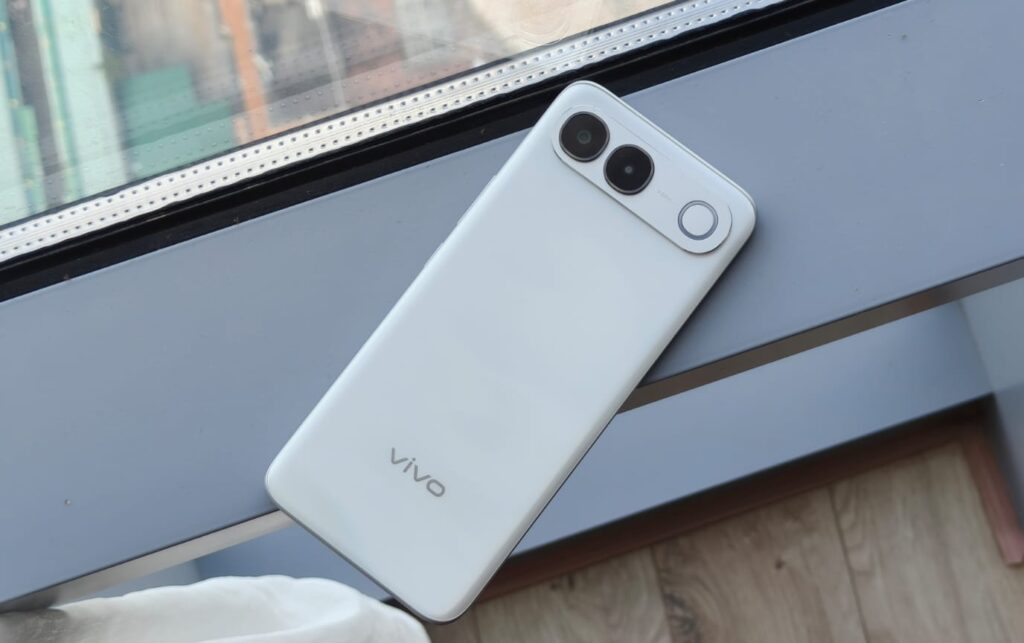
Design is where the vivo S2 gets full marks, simply because it’s beautiful to look at. I’ll say this straight: the horizontal visor is the best implementation of the camera module. It not only doesn’t get in the way but also keeps the phone from wobbling on a table. The same benefits apply here. There are two cutouts for the camera setup, with the flash sitting on the right. Color options, of which there are three, comprise Silk White, Regal Bronze, and Sapphire Blue. I received the Silk White model for review, and it’s a looker. The back has a silk-like finish that shines in different ways as the light hits. There’s also a wave-like pattern that adds to the overall appeal and makes it more premium. Thankfully, the finish is matte, so you don’t need to worry about greasy fingers.
To confirm it wasn’t just me liking the design, I also gave the phone to my friends and family, all of whom had similar reactions. I could also see a few people looking at what phone I was using at the airport. Another thing you’ll notice with the S2 immediately is its build. Instead of the flat sides we’ve all gotten used to, the S2 has a curved aesthetic. The frame and rear glass curve toward each other, and it really does feel good. Sometimes I miss the old curved aesthetic, and it’s nice that vivo is keeping the trend alive. The corners don’t dig into your palms, and people with smaller hands shouldn’t have much trouble using it one-handed.
The sides are obviously plastic, and that’s not necessarily a bad thing. While I was fiddling around at the airport looking for my passport, I dropped the phone on the moving walkway, and it landed directly on one corner. The S2 survived unscathed, and after that, I just kept it inside the pre-bundled case. Since it was rainy season in Vietnam, the S2’s IP68 and IP69 ratings were quickly put to the test. The phone can survive being submerged in water, so all your pool photos should be fine. That said, please don’t take your phone into the ocean since saltwater can still cause damage. There’s also the fingerprint sensor on the front, and it’s pretty standard. It’s an optical unit, so dirty fingers could be a problem, and it’s a bit slow.
Display
Good smartphone displays have become pretty common, especially on flagships. And even though the S2 isn’t a flagship phone, its display is up to the mark. For some context, the 6.8-inch AMOLED panel has a 1.5K resolution and a 120Hz refresh rate. All this, as expected, translates to a great multimedia experience. Colors look vibrant, blacks are inky deep, and skin tones look natural while I binge-watched “Ted Lasso” at the airport.
vivo claims a peak brightness of 3,000 nits, and while I don’t carry a light meter on vacations, I can tell you that it’s plenty bright. The S2’s display was legible even in direct sunlight when I tried to read the cab number, and I wasn’t squinting much. A few other nice additions include an SGS-certified eye protection filter and Low Flicker Certification. Both are designed to make the display easier on the eyes, particularly at night. vivo hasn’t specified the exact type of glass it uses on the S2. Since I didn’t drop the phone after the first fall, I can’t comment much on how it’ll survive drops. But as a general rule of thumb, curved panels are less resistant than flat ones, so I’d recommend keeping the pre-applied screen protector.
Performance & Software
You can have all the fancy design and display in the world, but none of it is of any use if the phone can’t open Instagram quickly for a little doom scroll session. Fortunately, that’s not the case with the vivo S2. It’s powered by MediaTek’s Dimensity 7360 Turbo processor, paired with up to 8GB of LPDDR4X RAM and 256GB of UFS 3.1 storage. I’ll say this straight: DDR4X RAM should not be inside a sub-40K phone. Sadly, that’s the consequence of AI, and we can’t really blame vivo for that.
Everyday performance on the S2 is quite good. It opens and closes regular apps without a hitch or stutter, keeping the experience smooth. Heavy apps open quickly, and vivo’s new OriginOS is a great version of Android. Animations are fluid and clean, and the UI is full of customization options for you to change the phone’s vibe. It’s not overwhelming, and I got used to the interface in just a couple of days.
Since this is 2026, vivo has bundled a few AI features, including transcription tools and Smart Call Assistant, along with the vivo Office Kit. Sadly, except for AI erase, you don’t get many AI editing features, which was a bummer. I also noticed some stutters when flicking through different applications, but nothing major. What was more annoying, though, was the bloatware. I counted roughly 20 pre-installed applications even after saying no to installing anything in the first place. Thankfully, vivo vivo allows users to remove all apps.
I also ran a series of benchmarks to test the raw performance of the Dimensity 7360 Turbo. In Geekbench, scored 1,017 in the single-core test and 2,987 in the multi-core test. In AnTuTu, the S2 went just shy of the million mark with a score of 990,781. For context, those numbers are similar to the Snapdragon 7 Gen 3. vivo has also incorporated a big vapor chamber inside the S2, which I put to the test in CODM. Even on Very High graphics settings and Ultra frame rate, it held up pretty well. There was no noticeable lag or jitter during intense combat, and the phone only got warm after a 30-minute session. To help protect battery health, there’s bypass charging as well.
Battery Life & Charging
Given the slim profile of the S2, I expected the battery life to be nothing to write home about. The truth is, however, way different. With a capacity of 7,050 mAh, the S2 is a battery champ, capable of lasting multiple days on a single charge. I used the phone for navigation while walking around Nha Trang looking for a lunch spot. I then headed to the beach in the evening to capture some photos, and ended the day by taking a few more photos and watching some YouTube videos. I ended that day with about 40% charge remaining, which is pretty impressive.
When it was finally time to recharge, the 44W fast charger came in handy. It took the phone from 20% to 80% in around 50 minutes, which should be enough for any demanding day. vivo also says the cell should be good for over 1200 charging cycles without losing much health.
Cameras
Given that the vivo S2 targets younger, style-conscious buyers, photography is understandably a big part of the pitch. The vivo S2 houses the 50MP Sony IMX852 sensor, and that’s it. There is a secondary camera, but it’s a 2MP sensor and no ultrawide action. That said, the photos from the main sensor are really good. With enough light, the S2 captured rather pleasing photos of Nha Trang’s cityscapes. The shots had plenty of detail, while colors leaned toward the vibrant side, which I personally like. Contrast was mostly spot on as well. The camera sometimes overexposed the sun, but nothing major.
Since there’s no telephoto sensor, the S2’s main camera also doubles as the portrait lens. The same generally held true for portrait shots, with skin tones being true to their color, and a nice shallow depth of field. As far as nighttime photos are concerned, the images do benefit from vivo’s processing, which tries to retain colors and balance everything. However, I did notice a lack of sharpness in photos here, which was further exaggerated by the long shutter times. Moving subjects can be a problem. Video recording tops out at 4K 30 FPS, and they are fine. The resulting shots are clear and very usable in daytime. Selfies are another highlight, with rather good sharpness and colors. Plus, you can also record 4K videos from the front.
Verdict
Starting at ₹39,999, the vivo S2 is an interesting phone, marking vivo’s return to a segment it hasn’t explored in a while. And I must admit, I love this design. It’s practical while still managing to turn heads. If you like your tech to make a statement, then there aren’t many choices in the market. Beyond the design, there’s a big 6.8-inch AMOLED panel that’s great for watching movies, while the Dimensity 7360 Turbo proved capable of handling everyday tasks and games like “CODM” without much trouble. The cameras, or should I say the camera, are good enough for daytime photos, but struggle with sharpness at night, so keep that in mind.
S2 follows the same formula. It features a camera visor-inspired design, with fun colors, a Sony IMX852 camera sensor, and the MediaTek Dimensity 7360 Turbo processor.
All this at a price of ₹39,999 seems like a decent deal given the great AI price surge of 2026. But is it worth your money? To find out, I got the S2 for review and took it with me on a trip to Vietnam. It served as my primary phone in the country, thanks to the eSIM support, and I took about 300 photos in the brutal summer heat on the beaches of Nha Trang.
vivo S2 Review
Hisan Kidwai
Summary
The vivo S2’s design is simply lovely. It’s practical while still managing to turn heads. Beyond that, there’s a big 6.8-inch AMOLED panel that’s great for watching movies, while the Dimensity 7360 Turbo proved capable of handling everyday tasks and games like “CODM” without much trouble. The cameras, or should I say the camera, are good enough for daytime photos, but struggle with sharpness at night, so keep that in mind.
Design & Hardware
Design is where the vivo S2 gets full marks, simply because it’s beautiful to look at. I’ll say this straight: the horizontal visor is the best implementation of the camera module. It not only doesn’t get in the way but also keeps the phone from wobbling on a table. The same benefits apply here. There are two cutouts for the camera setup, with the flash sitting on the right. Color options, of which there are three, comprise Silk White, Regal Bronze, and Sapphire Blue. I received the Silk White model for review, and it’s a looker. The back has a silk-like finish that shines in different ways as the light hits. There’s also a wave-like pattern that adds to the overall appeal and makes it more premium. Thankfully, the finish is matte, so you don’t need to worry about greasy fingers.
To confirm it wasn’t just me liking the design, I also gave the phone to my friends and family, all of whom had similar reactions. I could also see a few people looking at what phone I was using at the airport. Another thing you’ll notice with the S2 immediately is its build. Instead of the flat sides we’ve all gotten used to, the S2 has a curved aesthetic. The frame and rear glass curve toward each other, and it really does feel good. Sometimes I miss the old curved aesthetic, and it’s nice that vivo is keeping the trend alive. The corners don’t dig into your palms, and people with smaller hands shouldn’t have much trouble using it one-handed.
The sides are obviously plastic, and that’s not necessarily a bad thing. While I was fiddling around at the airport looking for my passport, I dropped the phone on the moving walkway, and it landed directly on one corner. The S2 survived unscathed, and after that, I just kept it inside the pre-bundled case. Since it was rainy season in Vietnam, the S2’s IP68 and IP69 ratings were quickly put to the test. The phone can survive being submerged in water, so all your pool photos should be fine. That said, please don’t take your phone into the ocean since saltwater can still cause damage. There’s also the fingerprint sensor on the front, and it’s pretty standard. It’s an optical unit, so dirty fingers could be a problem, and it’s a bit slow.
Display
Good smartphone displays have become pretty common, especially on flagships. And even though the S2 isn’t a flagship phone, its display is up to the mark. For some context, the 6.8-inch AMOLED panel has a 1.5K resolution and a 120Hz refresh rate. All this, as expected, translates to a great multimedia experience. Colors look vibrant, blacks are inky deep, and skin tones look natural while I binge-watched “Ted Lasso” at the airport.
vivo claims a peak brightness of 3,000 nits, and while I don’t carry a light meter on vacations, I can tell you that it’s plenty bright. The S2’s display was legible even in direct sunlight when I tried to read the cab number, and I wasn’t squinting much. A few other nice additions include an SGS-certified eye protection filter and Low Flicker Certification. Both are designed to make the display easier on the eyes, particularly at night. vivo hasn’t specified the exact type of glass it uses on the S2. Since I didn’t drop the phone after the first fall, I can’t comment much on how it’ll survive drops. But as a general rule of thumb, curved panels are less resistant than flat ones, so I’d recommend keeping the pre-applied screen protector.
Performance & Software
You can have all the fancy design and display in the world, but none of it is of any use if the phone can’t open Instagram quickly for a little doom scroll session. Fortunately, that’s not the case with the vivo S2. It’s powered by MediaTek’s Dimensity 7360 Turbo processor, paired with up to 8GB of LPDDR4X RAM and 256GB of UFS 3.1 storage. I’ll say this straight: DDR4X RAM should not be inside a sub-40K phone. Sadly, that’s the consequence of AI, and we can’t really blame vivo for that.
Everyday performance on the S2 is quite good. It opens and closes regular apps without a hitch or stutter, keeping the experience smooth. Heavy apps open quickly, and vivo’s new OriginOS is a great version of Android. Animations are fluid and clean, and the UI is full of customization options for you to change the phone’s vibe. It’s not overwhelming, and I got used to the interface in just a couple of days.
Since this is 2026, vivo has bundled a few AI features, including transcription tools and Smart Call Assistant, along with the vivo Office Kit. Sadly, except for AI erase, you don’t get many AI editing features, which was a bummer. I also noticed some stutters when flicking through different applications, but nothing major. What was more annoying, though, was the bloatware. I counted roughly 20 pre-installed applications even after saying no to installing anything in the first place. Thankfully, vivo vivo allows users to remove all apps.
I also ran a series of benchmarks to test the raw performance of the Dimensity 7360 Turbo. In Geekbench, scored 1,017 in the single-core test and 2,987 in the multi-core test. In AnTuTu, the S2 went just shy of the million mark with a score of 990,781. For context, those numbers are similar to the Snapdragon 7 Gen 3. vivo has also incorporated a big vapor chamber inside the S2, which I put to the test in CODM. Even on Very High graphics settings and Ultra frame rate, it held up pretty well. There was no noticeable lag or jitter during intense combat, and the phone only got warm after a 30-minute session. To help protect battery health, there’s bypass charging as well.
Battery Life & Charging
Given the slim profile of the S2, I expected the battery life to be nothing to write home about. The truth is, however, way different. With a capacity of 7,050 mAh, the S2 is a battery champ, capable of lasting multiple days on a single charge. I used the phone for navigation while walking around Nha Trang looking for a lunch spot. I then headed to the beach in the evening to capture some photos, and ended the day by taking a few more photos and watching some YouTube videos. I ended that day with about 40% charge remaining, which is pretty impressive.
When it was finally time to recharge, the 44W fast charger came in handy. It took the phone from 20% to 80% in around 50 minutes, which should be enough for any demanding day. vivo also says the cell should be good for over 1200 charging cycles without losing much health.
Cameras
Given that the vivo S2 targets younger, style-conscious buyers, photography is understandably a big part of the pitch. The vivo S2 houses the 50MP Sony IMX852 sensor, and that’s it. There is a secondary camera, but it’s a 2MP sensor and no ultrawide action. That said, the photos from the main sensor are really good. With enough light, the S2 captured rather pleasing photos of Nha Trang’s cityscapes. The shots had plenty of detail, while colors leaned toward the vibrant side, which I personally like. Contrast was mostly spot on as well. The camera sometimes overexposed the sun, but nothing major.
Since there’s no telephoto sensor, the S2’s main camera also doubles as the portrait lens. The same generally held true for portrait shots, with skin tones being true to their color, and a nice shallow depth of field. As far as nighttime photos are concerned, the images do benefit from vivo’s processing, which tries to retain colors and balance everything. However, I did notice a lack of sharpness in photos here, which was further exaggerated by the long shutter times. Moving subjects can be a problem. Video recording tops out at 4K 30 FPS, and they are fine. The resulting shots are clear and very usable in daytime. Selfies are another highlight, with rather good sharpness and colors. Plus, you can also record 4K videos from the front.
Verdict
Starting at ₹39,999, the vivo S2 is an interesting phone, marking vivo’s return to a segment it hasn’t explored in a while. And I must admit, I love this design. It’s practical while still managing to turn heads. If you like your tech to make a statement, then there aren’t many choices in the market. Beyond the design, there’s a big 6.8-inch AMOLED panel that’s great for watching movies, while the Dimensity 7360 Turbo proved capable of handling everyday tasks and games like “CODM” without much trouble. The cameras, or should I say the camera, are good enough for daytime photos, but struggle with sharpness at night, so keep that in mind.
#vivo #Review #Stylish #MidRanger #Battery #Life #SpareVivo">vivo S2 Review: A Stylish Mid-Ranger With Battery Life to Spare
The 2026 smartphone market has been a bit difficult to deal with. Buying a phone has always been about choosing what matters most to you. Some need their phone to run demanding games for hours, while others love to show off a fancy design and a camera that takes pictures worthy of an Instagram story. If you’re the latter, vivo has just resurrected the S-lineup. For the uninitiated, the first S1 targeted style-conscious, younger consumers, and the new S2 follows the same formula. It features a camera visor-inspired design, with fun colors, a Sony IMX852 camera sensor, and the MediaTek Dimensity 7360 Turbo processor.
All this at a price of ₹39,999 seems like a decent deal given the great AI price surge of 2026. But is it worth your money? To find out, I got the S2 for review and took it with me on a trip to Vietnam. It served as my primary phone in the country, thanks to the eSIM support, and I took about 300 photos in the brutal summer heat on the beaches of Nha Trang.
vivo S2 Review
Hisan Kidwai
Summary
The vivo S2’s design is simply lovely. It’s practical while still managing to turn heads. Beyond that, there’s a big 6.8-inch AMOLED panel that’s great for watching movies, while the Dimensity 7360 Turbo proved capable of handling everyday tasks and games like “CODM” without much trouble. The cameras, or should I say the camera, are good enough for daytime photos, but struggle with sharpness at night, so keep that in mind.
Design & Hardware
Design is where the vivo S2 gets full marks, simply because it’s beautiful to look at. I’ll say this straight: the horizontal visor is the best implementation of the camera module. It not only doesn’t get in the way but also keeps the phone from wobbling on a table. The same benefits apply here. There are two cutouts for the camera setup, with the flash sitting on the right. Color options, of which there are three, comprise Silk White, Regal Bronze, and Sapphire Blue. I received the Silk White model for review, and it’s a looker. The back has a silk-like finish that shines in different ways as the light hits. There’s also a wave-like pattern that adds to the overall appeal and makes it more premium. Thankfully, the finish is matte, so you don’t need to worry about greasy fingers.
To confirm it wasn’t just me liking the design, I also gave the phone to my friends and family, all of whom had similar reactions. I could also see a few people looking at what phone I was using at the airport. Another thing you’ll notice with the S2 immediately is its build. Instead of the flat sides we’ve all gotten used to, the S2 has a curved aesthetic. The frame and rear glass curve toward each other, and it really does feel good. Sometimes I miss the old curved aesthetic, and it’s nice that vivo is keeping the trend alive. The corners don’t dig into your palms, and people with smaller hands shouldn’t have much trouble using it one-handed.
The sides are obviously plastic, and that’s not necessarily a bad thing. While I was fiddling around at the airport looking for my passport, I dropped the phone on the moving walkway, and it landed directly on one corner. The S2 survived unscathed, and after that, I just kept it inside the pre-bundled case. Since it was rainy season in Vietnam, the S2’s IP68 and IP69 ratings were quickly put to the test. The phone can survive being submerged in water, so all your pool photos should be fine. That said, please don’t take your phone into the ocean since saltwater can still cause damage. There’s also the fingerprint sensor on the front, and it’s pretty standard. It’s an optical unit, so dirty fingers could be a problem, and it’s a bit slow.
Display
Good smartphone displays have become pretty common, especially on flagships. And even though the S2 isn’t a flagship phone, its display is up to the mark. For some context, the 6.8-inch AMOLED panel has a 1.5K resolution and a 120Hz refresh rate. All this, as expected, translates to a great multimedia experience. Colors look vibrant, blacks are inky deep, and skin tones look natural while I binge-watched “Ted Lasso” at the airport.
vivo claims a peak brightness of 3,000 nits, and while I don’t carry a light meter on vacations, I can tell you that it’s plenty bright. The S2’s display was legible even in direct sunlight when I tried to read the cab number, and I wasn’t squinting much. A few other nice additions include an SGS-certified eye protection filter and Low Flicker Certification. Both are designed to make the display easier on the eyes, particularly at night. vivo hasn’t specified the exact type of glass it uses on the S2. Since I didn’t drop the phone after the first fall, I can’t comment much on how it’ll survive drops. But as a general rule of thumb, curved panels are less resistant than flat ones, so I’d recommend keeping the pre-applied screen protector.
Performance & Software
You can have all the fancy design and display in the world, but none of it is of any use if the phone can’t open Instagram quickly for a little doom scroll session. Fortunately, that’s not the case with the vivo S2. It’s powered by MediaTek’s Dimensity 7360 Turbo processor, paired with up to 8GB of LPDDR4X RAM and 256GB of UFS 3.1 storage. I’ll say this straight: DDR4X RAM should not be inside a sub-40K phone. Sadly, that’s the consequence of AI, and we can’t really blame vivo for that.
Everyday performance on the S2 is quite good. It opens and closes regular apps without a hitch or stutter, keeping the experience smooth. Heavy apps open quickly, and vivo’s new OriginOS is a great version of Android. Animations are fluid and clean, and the UI is full of customization options for you to change the phone’s vibe. It’s not overwhelming, and I got used to the interface in just a couple of days.
Since this is 2026, vivo has bundled a few AI features, including transcription tools and Smart Call Assistant, along with the vivo Office Kit. Sadly, except for AI erase, you don’t get many AI editing features, which was a bummer. I also noticed some stutters when flicking through different applications, but nothing major. What was more annoying, though, was the bloatware. I counted roughly 20 pre-installed applications even after saying no to installing anything in the first place. Thankfully, vivo vivo allows users to remove all apps.
I also ran a series of benchmarks to test the raw performance of the Dimensity 7360 Turbo. In Geekbench, scored 1,017 in the single-core test and 2,987 in the multi-core test. In AnTuTu, the S2 went just shy of the million mark with a score of 990,781. For context, those numbers are similar to the Snapdragon 7 Gen 3. vivo has also incorporated a big vapor chamber inside the S2, which I put to the test in CODM. Even on Very High graphics settings and Ultra frame rate, it held up pretty well. There was no noticeable lag or jitter during intense combat, and the phone only got warm after a 30-minute session. To help protect battery health, there’s bypass charging as well.
Battery Life & Charging
Given the slim profile of the S2, I expected the battery life to be nothing to write home about. The truth is, however, way different. With a capacity of 7,050 mAh, the S2 is a battery champ, capable of lasting multiple days on a single charge. I used the phone for navigation while walking around Nha Trang looking for a lunch spot. I then headed to the beach in the evening to capture some photos, and ended the day by taking a few more photos and watching some YouTube videos. I ended that day with about 40% charge remaining, which is pretty impressive.
When it was finally time to recharge, the 44W fast charger came in handy. It took the phone from 20% to 80% in around 50 minutes, which should be enough for any demanding day. vivo also says the cell should be good for over 1200 charging cycles without losing much health.
Cameras
Given that the vivo S2 targets younger, style-conscious buyers, photography is understandably a big part of the pitch. The vivo S2 houses the 50MP Sony IMX852 sensor, and that’s it. There is a secondary camera, but it’s a 2MP sensor and no ultrawide action. That said, the photos from the main sensor are really good. With enough light, the S2 captured rather pleasing photos of Nha Trang’s cityscapes. The shots had plenty of detail, while colors leaned toward the vibrant side, which I personally like. Contrast was mostly spot on as well. The camera sometimes overexposed the sun, but nothing major.
Since there’s no telephoto sensor, the S2’s main camera also doubles as the portrait lens. The same generally held true for portrait shots, with skin tones being true to their color, and a nice shallow depth of field. As far as nighttime photos are concerned, the images do benefit from vivo’s processing, which tries to retain colors and balance everything. However, I did notice a lack of sharpness in photos here, which was further exaggerated by the long shutter times. Moving subjects can be a problem. Video recording tops out at 4K 30 FPS, and they are fine. The resulting shots are clear and very usable in daytime. Selfies are another highlight, with rather good sharpness and colors. Plus, you can also record 4K videos from the front.
Verdict
Starting at ₹39,999, the vivo S2 is an interesting phone, marking vivo’s return to a segment it hasn’t explored in a while. And I must admit, I love this design. It’s practical while still managing to turn heads. If you like your tech to make a statement, then there aren’t many choices in the market. Beyond the design, there’s a big 6.8-inch AMOLED panel that’s great for watching movies, while the Dimensity 7360 Turbo proved capable of handling everyday tasks and games like “CODM” without much trouble. The cameras, or should I say the camera, are good enough for daytime photos, but struggle with sharpness at night, so keep that in mind.
Flock Safety’s automatic license plate reader cameras have become targets of public ire and, increasingly, vandalism, with people stealing or destroying them in the dead of night. The company at one point had a plan to keep its eyes open in a way that would be harder to detect, according to 404 Media: by equipping dashcams on rideshare and delivery vehicles with the ability to scan plates while on the road.
In a pitch presentation apparently prepared for the Georgia Office of the Attorney General, Flock reportedly talked up a planned partnership with Nexar, a popular dashcam manufacturer. The theoretical deal would have used Nexar’s network of cameras to scan vehicle plates as drivers went about their business. Flock apparently suggested that it would create a network of more than 350,000 Uber, Lyft, and other delivery service drivers who would all serve as eyes for the company.
Flock’s partnership with Nexar never came to fruition. But the fact that it failed doesn’t really minimize the concern that the company tried to make it happen. Importantly, it’s not clear that drivers would have been made aware of the fact that their camera was serving as a snitch or not—it’s possible the scans would have taken place without any obvious indication that what was being captured on their dashcam was being shared with Flock—and presumably with law enforcement.
Gizmodo reached out to Flock for additional information but did not receive a response at the time of publication.
Nexar is already engaged in a pretty massive project of collecting data from its drivers. The company claims to anonymize data collected from its dashcams and sells it to third parties and publishes a fully user-generated, real-time map called CityStream. Whether drivers are aware of the fact that they are contributing to this or not is unclear—per 404 Media, in some jurisdictions, users are automatically contributing their data to CityStream and have to opt out of sharing.
Flock also isn’t the only company to apparently think up the idea of turning vehicles into mobile surveillance for “safety” purposes. Earlier this year, a company called BusPatrol—which uses cameras on school buses to identify people who blow past the “Stop” sign arm deployed—came under fire when it was revealed that it was planning to let law enforcement use those cameras to scan license plates. Given the abuses that law enforcement across the country have already committed with access to Flock cameras, seems the last thing they need is more camera angles to sift through.
Flock Safety’s automatic license plate reader cameras have become targets of public ire and, increasingly, vandalism, with people stealing or destroying them in the dead of night. The company at one point had a plan to keep its eyes open in a way that would be harder to detect, according to 404 Media: by equipping dashcams on rideshare and delivery vehicles with the ability to scan plates while on the road.
In a pitch presentation apparently prepared for the Georgia Office of the Attorney General, Flock reportedly talked up a planned partnership with Nexar, a popular dashcam manufacturer. The theoretical deal would have used Nexar’s network of cameras to scan vehicle plates as drivers went about their business. Flock apparently suggested that it would create a network of more than 350,000 Uber, Lyft, and other delivery service drivers who would all serve as eyes for the company.
Flock’s partnership with Nexar never came to fruition. But the fact that it failed doesn’t really minimize the concern that the company tried to make it happen. Importantly, it’s not clear that drivers would have been made aware of the fact that their camera was serving as a snitch or not—it’s possible the scans would have taken place without any obvious indication that what was being captured on their dashcam was being shared with Flock—and presumably with law enforcement.
Gizmodo reached out to Flock for additional information but did not receive a response at the time of publication.
Nexar is already engaged in a pretty massive project of collecting data from its drivers. The company claims to anonymize data collected from its dashcams and sells it to third parties and publishes a fully user-generated, real-time map called CityStream. Whether drivers are aware of the fact that they are contributing to this or not is unclear—per 404 Media, in some jurisdictions, users are automatically contributing their data to CityStream and have to opt out of sharing.
Flock also isn’t the only company to apparently think up the idea of turning vehicles into mobile surveillance for “safety” purposes. Earlier this year, a company called BusPatrol—which uses cameras on school buses to identify people who blow past the “Stop” sign arm deployed—came under fire when it was revealed that it was planning to let law enforcement use those cameras to scan license plates. Given the abuses that law enforcement across the country have already committed with access to Flock cameras, seems the last thing they need is more camera angles to sift through.
#Flock #Reportedly #Turn #Uber #Drivers #Mobile #Snitchesartifical intelligence,Dashcams,flock,Flock Safety,license plate readers,Lyft,Uber">Flock Reportedly Tried to Turn Uber Drivers Into Mobile Snitches
Flock Safety’s automatic license plate reader cameras have become targets of public ire and, increasingly, vandalism, with people stealing or destroying them in the dead of night. The company at one point had a plan to keep its eyes open in a way that would be harder to detect, according to 404 Media: by equipping dashcams on rideshare and delivery vehicles with the ability to scan plates while on the road.
In a pitch presentation apparently prepared for the Georgia Office of the Attorney General, Flock reportedly talked up a planned partnership with Nexar, a popular dashcam manufacturer. The theoretical deal would have used Nexar’s network of cameras to scan vehicle plates as drivers went about their business. Flock apparently suggested that it would create a network of more than 350,000 Uber, Lyft, and other delivery service drivers who would all serve as eyes for the company.
Flock’s partnership with Nexar never came to fruition. But the fact that it failed doesn’t really minimize the concern that the company tried to make it happen. Importantly, it’s not clear that drivers would have been made aware of the fact that their camera was serving as a snitch or not—it’s possible the scans would have taken place without any obvious indication that what was being captured on their dashcam was being shared with Flock—and presumably with law enforcement.
Gizmodo reached out to Flock for additional information but did not receive a response at the time of publication.
Nexar is already engaged in a pretty massive project of collecting data from its drivers. The company claims to anonymize data collected from its dashcams and sells it to third parties and publishes a fully user-generated, real-time map called CityStream. Whether drivers are aware of the fact that they are contributing to this or not is unclear—per 404 Media, in some jurisdictions, users are automatically contributing their data to CityStream and have to opt out of sharing.
Flock also isn’t the only company to apparently think up the idea of turning vehicles into mobile surveillance for “safety” purposes. Earlier this year, a company called BusPatrol—which uses cameras on school buses to identify people who blow past the “Stop” sign arm deployed—came under fire when it was revealed that it was planning to let law enforcement use those cameras to scan license plates. Given the abuses that law enforcement across the country have already committed with access to Flock cameras, seems the last thing they need is more camera angles to sift through.
Late last month, Zhuge, who is in her late twenties, interviewed Christopher Nolan, one of the most influential directors in Hollywood, who was in Beijing promoting The Odyssey. Rather than asking about celebrities or Hollywood, Zhuge posed a series of deeply philosophical questions to Nolan about the Christianization of Greek philosophy and how to portray heroes in films. The first thing she asked: “Are you a bard for a civilization at dusk?”
Nolan was visibly impressed by Zhuge. After the interview was published in China, Geoff Keighley, a video game journalist and the son of Nolan’s longtime friend David Keighley, shared the interview on X, calling it “a great listen.” Keighley’s video has been watched over 18 million times, and when Zhuge later posted the interview on her own X account, it racked up another 6.9 million views.
For the first time, Zhuge had become the main character of the English-speaking internet. She was being praised, mocked, criticized, and defended all at the same time. Many people said it was the best interview Nolan has done for The Odyssey, while the National Review called it a “CCP hostage video.” But everyone ultimately wanted to know the same thing: Who was this young Chinese woman with a bob haircut talking about the decline of civilizations?
While almost no one in the West knows her name, Zhuge is already one of the most prominent young intellectuals in China and has been interviewed by many of the country’s cultural elite. She was featured in Vogue China as an example of a successful woman in her twenties and frequently shares yoga and fitness tips to her 360,000 fans on the Chinese social media platform Xiaohongshu.
When I spoke to Zhuge this week, she framed her success as being born out of personal tragedy. “I was going through an adulterous divorce in which my ex-husband sued me and I accumulated a lot of legal debt,” she says. “I felt discouraged in the English-speaking academia because of certain personal experiences related to that personal tragedy, so I turned my attention back to the Chinese-speaking world to build a career there and pay off my debt.”
When I started digging into Zhuge’s career, I was shocked by her level of productivity. Aside from publishing philosophy translations and writing articles for Chinese media outlets, she has recorded more than 360 episodes of her podcast Monologues of a Committed Observer in just the last three years. That’s an average of one new episode every three days. Most of the time, she just monologues about political science concepts for a half an hour, seemingly unscripted. On XiaoyuzhouFM, the most popular podcast streaming platform in China, she has over 940,000 subscribers.
But despite her prolific posting, Zhuge claims she isn’t interested in being famous. “I have no attachment to fame and no desire to preserve it for its own sake,” she tells me. “What I want is enough freedom and time to build a life centered on thought. That life requires some money, but not very much.”
View From America
When Zhuge asked Nolan if he saw himself as “a bard for a civilization at dusk,” she says she didn’t have a particular civilization in mind.
She views the question instead as part of the long philosophical tradition of pondering the demise of value systems. “I was not primarily attempting to issue a verdict on the contemporary United States,” she says, but “people are free to interpret the phrase through current debates about American or Western decline.”
#Chinese #Philosopher #Americans #Stop #Fightingmade in china,china,christopher nolan,movies,interviews,hollywood,philosophy">
Late last month, Zhuge, who is in her late twenties, interviewed Christopher Nolan, one of the most influential directors in Hollywood, who was in Beijing promoting The Odyssey. Rather than asking about celebrities or Hollywood, Zhuge posed a series of deeply philosophical questions to Nolan about the Christianization of Greek philosophy and how to portray heroes in films. The first thing she asked: “Are you a bard for a civilization at dusk?”
Nolan was visibly impressed by Zhuge. After the interview was published in China, Geoff Keighley, a video game journalist and the son of Nolan’s longtime friend David Keighley, shared the interview on X, calling it “a great listen.” Keighley’s video has been watched over 18 million times, and when Zhuge later posted the interview on her own X account, it racked up another 6.9 million views.
For the first time, Zhuge had become the main character of the English-speaking internet. She was being praised, mocked, criticized, and defended all at the same time. Many people said it was the best interview Nolan has done for The Odyssey, while the National Review called it a “CCP hostage video.” But everyone ultimately wanted to know the same thing: Who was this young Chinese woman with a bob haircut talking about the decline of civilizations?
While almost no one in the West knows her name, Zhuge is already one of the most prominent young intellectuals in China and has been interviewed by many of the country’s cultural elite. She was featured in Vogue China as an example of a successful woman in her twenties and frequently shares yoga and fitness tips to her 360,000 fans on the Chinese social media platform Xiaohongshu.
When I spoke to Zhuge this week, she framed her success as being born out of personal tragedy. “I was going through an adulterous divorce in which my ex-husband sued me and I accumulated a lot of legal debt,” she says. “I felt discouraged in the English-speaking academia because of certain personal experiences related to that personal tragedy, so I turned my attention back to the Chinese-speaking world to build a career there and pay off my debt.”
When I started digging into Zhuge’s career, I was shocked by her level of productivity. Aside from publishing philosophy translations and writing articles for Chinese media outlets, she has recorded more than 360 episodes of her podcast Monologues of a Committed Observer in just the last three years. That’s an average of one new episode every three days. Most of the time, she just monologues about political science concepts for a half an hour, seemingly unscripted. On XiaoyuzhouFM, the most popular podcast streaming platform in China, she has over 940,000 subscribers.
But despite her prolific posting, Zhuge claims she isn’t interested in being famous. “I have no attachment to fame and no desire to preserve it for its own sake,” she tells me. “What I want is enough freedom and time to build a life centered on thought. That life requires some money, but not very much.”
View From America
When Zhuge asked Nolan if he saw himself as “a bard for a civilization at dusk,” she says she didn’t have a particular civilization in mind.
She views the question instead as part of the long philosophical tradition of pondering the demise of value systems. “I was not primarily attempting to issue a verdict on the contemporary United States,” she says, but “people are free to interpret the phrase through current debates about American or Western decline.”
#Chinese #Philosopher #Americans #Stop #Fightingmade in china,china,christopher nolan,movies,interviews,hollywood,philosophy">The Chinese Philosopher Americans Can’t Stop Fighting About
Yiyang Zhuge learned last week that when you go extremely viral, the people you have been following for years suddenly start following you back. Zhuge logged onto X and found that a string of famous professors and scholars were in her list of new followers. A PhD candidate in political philosophy at Boston College, Zhuge had previously only lurked on X to keep up with the latest debates and gossip in academia. The vast majority of her social media activity happens on the Chinese internet, where she goes by the alias Zhong Shu and hosts a popular podcast with hundreds of thousands of loyal listeners.
Late last month, Zhuge, who is in her late twenties, interviewed Christopher Nolan, one of the most influential directors in Hollywood, who was in Beijing promoting The Odyssey. Rather than asking about celebrities or Hollywood, Zhuge posed a series of deeply philosophical questions to Nolan about the Christianization of Greek philosophy and how to portray heroes in films. The first thing she asked: “Are you a bard for a civilization at dusk?”
Nolan was visibly impressed by Zhuge. After the interview was published in China, Geoff Keighley, a video game journalist and the son of Nolan’s longtime friend David Keighley, shared the interview on X, calling it “a great listen.” Keighley’s video has been watched over 18 million times, and when Zhuge later posted the interview on her own X account, it racked up another 6.9 million views.
For the first time, Zhuge had become the main character of the English-speaking internet. She was being praised, mocked, criticized, and defended all at the same time. Many people said it was the best interview Nolan has done for The Odyssey, while the National Review called it a “CCP hostage video.” But everyone ultimately wanted to know the same thing: Who was this young Chinese woman with a bob haircut talking about the decline of civilizations?
While almost no one in the West knows her name, Zhuge is already one of the most prominent young intellectuals in China and has been interviewed by many of the country’s cultural elite. She was featured in Vogue China as an example of a successful woman in her twenties and frequently shares yoga and fitness tips to her 360,000 fans on the Chinese social media platform Xiaohongshu.
When I spoke to Zhuge this week, she framed her success as being born out of personal tragedy. “I was going through an adulterous divorce in which my ex-husband sued me and I accumulated a lot of legal debt,” she says. “I felt discouraged in the English-speaking academia because of certain personal experiences related to that personal tragedy, so I turned my attention back to the Chinese-speaking world to build a career there and pay off my debt.”
When I started digging into Zhuge’s career, I was shocked by her level of productivity. Aside from publishing philosophy translations and writing articles for Chinese media outlets, she has recorded more than 360 episodes of her podcast Monologues of a Committed Observer in just the last three years. That’s an average of one new episode every three days. Most of the time, she just monologues about political science concepts for a half an hour, seemingly unscripted. On XiaoyuzhouFM, the most popular podcast streaming platform in China, she has over 940,000 subscribers.
But despite her prolific posting, Zhuge claims she isn’t interested in being famous. “I have no attachment to fame and no desire to preserve it for its own sake,” she tells me. “What I want is enough freedom and time to build a life centered on thought. That life requires some money, but not very much.”
View From America
When Zhuge asked Nolan if he saw himself as “a bard for a civilization at dusk,” she says she didn’t have a particular civilization in mind.
She views the question instead as part of the long philosophical tradition of pondering the demise of value systems. “I was not primarily attempting to issue a verdict on the contemporary United States,” she says, but “people are free to interpret the phrase through current debates about American or Western decline.”
#Chinese #Philosopher #Americans #Stop #Fightingmade in china,china,christopher nolan,movies,interviews,hollywood,philosophy





Post Comment