×
  • A gunman who killed at least six people in the streets of Kyiv on Saturday before taking hostages and barricading himself in a nearby supermarket has been shot dead by police, Ukrainian officials said.

    The head of Ukraine’s Interior Ministry, Ihor Klymenko, said in a statement on social media that special tactical police units stormed the store after attempts to contact the gunman with a negotiator failed.

    The attacker was killed while resisting arrest, he said.

    Speaking to reporters at the scene, Klymenko said that the government had killed four bystanders while on the street, before entering the supermarket and killing a fifth person.

    Mayor Vitali Klitschko said that a sixth victim, a young woman, had died from her injuries in the hospital.

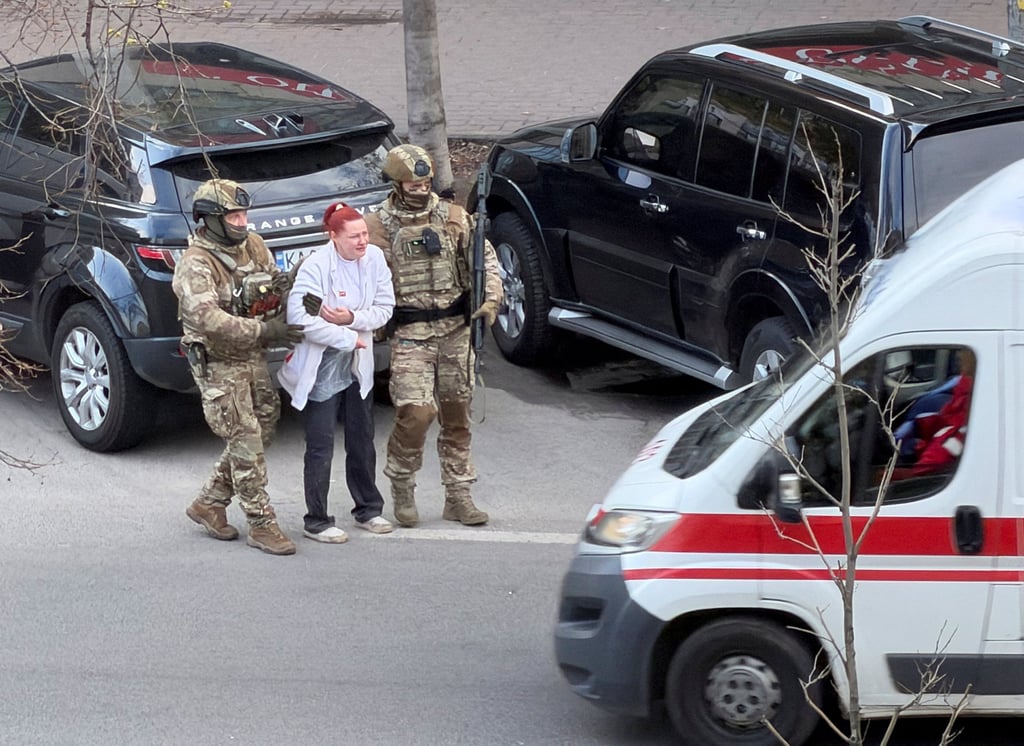
    Special forces officers evacuate a hostage at the site of a shooting incident, in Kyiv, Ukraine, on Saturday. Photo: Reuters
    Special forces officers evacuate a hostage at the site of a shooting incident, in Kyiv, Ukraine, on Saturday. Photo: Reuters

    Klymenko said that police negotiators spoke with the attacker for roughly 40 minutes before storming the building.

    #Kyiv #gunman #kills #takes #hostages #shot #dead #Ukraine #policeUkrainian, Kyiv, President Volodymyr Zelensky, supermarket, Holosiivskyi district, Vitali Klitschko, Ukraine, Ihor Klymenko">Kyiv gunman kills 6, takes hostages before being shot dead by Ukraine police

    A gunman who killed at least six people in the streets of Kyiv on Saturday before taking hostages and barricading himself in a nearby supermarket has been shot dead by police, Ukrainian officials said.

    The head of Ukraine’s Interior Ministry, Ihor Klymenko, said in a statement on social media that special tactical police units stormed the store after attempts to contact the gunman with a negotiator failed.

    The attacker was killed while resisting arrest, he said.

    Speaking to reporters at the scene, Klymenko said that the government had killed four bystanders while on the street, before entering the supermarket and killing a fifth person.

    Mayor Vitali Klitschko said that a sixth victim, a young woman, had died from her injuries in the hospital.

    Special forces officers evacuate a hostage at the site of a shooting incident, in Kyiv, Ukraine, on Saturday. Photo: Reuters
    Special forces officers evacuate a hostage at the site of a shooting incident, in Kyiv, Ukraine, on Saturday. Photo: Reuters

    Klymenko said that police negotiators spoke with the attacker for roughly 40 minutes before storming the building.

    #Kyiv #gunman #kills #takes #hostages #shot #dead #Ukraine #policeUkrainian, Kyiv, President Volodymyr Zelensky, supermarket, Holosiivskyi district, Vitali Klitschko, Ukraine, Ihor Klymenko
  • #Oppo #Find #Ultra #Find #X9s #Series #Global #Launch #Rumoured #AprilOppo">Oppo Find X9 Ultra and Find X9s Series Global Launch Rumoured for April 21

    Oppo is gearing up to expand its flagship range with new models soon. It looks like the Oppo Find X9 Ultra will launch alongside the Find X9s. Along with these phones, the company may also introduce other products, such as the Oppo Watch X3 and Enco Clip 2, at the same event.

    Rumored Specifications of Oppo Find X9 Ultra

    Oppo Find X9 Ultra and Find X9s Series Global Launch Rumoured for April 21
	
Oppo is gearing up to expand its flagship range with new models soon. It looks like the Oppo Find X9 Ultra will launch alongside the Find X9s. Along with these phones, the company may also introduce other products, such as the Oppo Watch X3 and Enco Clip 2, at the same event.


Rumored Specifications of Oppo Find X9 Ultra 


The Oppo Find X9s is expected to feature a flat display design, which many users prefer for everyday use. The bezels are quite slim at 1.15mm, adding to its premium look. On the front, a hole-punch cutout will house the selfie camera. Moreover, the phone stands out for its button placement: the power and volume buttons are on the left, while another button is on the right.


For photography, Oppo is adding a Hasselblad-tuned triple camera system to the Find X9s. It will feature a 50MP main camera designed to capture clear and sharp images. The camera setup sits inside a square module, and an LED flash is also included.


Another important feature of the phone is its battery, which comes with an impressive capacity of 7,025 mAh. The device will easily handle any task thanks to its powerful battery, whether it’s gaming or video streaming. However, details about the phone’s chipset and performance features remain unknown.


What to Expect from the Find X9s Pro


As of now, it appears the Oppo Find X9s Pro will be released only in China. Among other things, the smartphone will reportedly feature a quadruple-camera module with two 200MP lenses. In addition, it could integrate Oppo’s LUMO image-sensing tech to deliver high-quality shots. As for the display panel, it is expected to be 6.3 inches.


#Oppo #Find #Ultra #Find #X9s #Series #Global #Launch #Rumoured #AprilOppo

    The Oppo Find X9s is expected to feature a flat display design, which many users prefer for everyday use. The bezels are quite slim at 1.15mm, adding to its premium look. On the front, a hole-punch cutout will house the selfie camera. Moreover, the phone stands out for its button placement: the power and volume buttons are on the left, while another button is on the right.

    For photography, Oppo is adding a Hasselblad-tuned triple camera system to the Find X9s. It will feature a 50MP main camera designed to capture clear and sharp images. The camera setup sits inside a square module, and an LED flash is also included.

    Another important feature of the phone is its battery, which comes with an impressive capacity of 7,025 mAh. The device will easily handle any task thanks to its powerful battery, whether it’s gaming or video streaming. However, details about the phone’s chipset and performance features remain unknown.

    What to Expect from the Find X9s Pro

    As of now, it appears the Oppo Find X9s Pro will be released only in China. Among other things, the smartphone will reportedly feature a quadruple-camera module with two 200MP lenses. In addition, it could integrate Oppo’s LUMO image-sensing tech to deliver high-quality shots. As for the display panel, it is expected to be 6.3 inches.

    #Oppo #Find #Ultra #Find #X9s #Series #Global #Launch #Rumoured #AprilOppo
  • WR Jordyn Tyson, Arizona State

    Some of Tyson’s shine has seemed to dull over the last number of weeks due to medical read flags, but when healthy, he has been one of the most dynamic pass-catchers in the country.

    For the Steelers, they need to load up on as much offensive talent as possible in order to both win now and prepare for the future. Think back to 2004 when they drafted Ben Roethlisberger. They had three good receivers, a pair of good running backs in Duce Staley and Jerome Bettis (and then Willie Parker in 2005), a good offensive line, and a good defense. By adding Tyson, the Steelers can recreate that formula, as just about every other aspect is in place.

    They can focus on both winning now when Aaron Rodgers inevitably emerges into the South Side, but also make it much easier to figure out who their future quarterback is by surrounding whomever they put under center in 2027 with as much talent as possible.

  • #Jordyn #Tyson #Steelers #pick #Nations #community #mock #draft">Jordyn Tyson goes to Steelers at pick No. 21 in SB Nation’s community mock draft

    WR Jordyn Tyson, Arizona State

    Some of Tyson’s shine has seemed to dull over the last number of weeks due to medical read flags, but when healthy, he has been one of the most dynamic pass-catchers in the country.

    For the Steelers, they need to load up on as much offensive talent as possible in order to both win now and prepare for the future. Think back to 2004 when they drafted Ben Roethlisberger. They had three good receivers, a pair of good running backs in Duce Staley and Jerome Bettis (and then Willie Parker in 2005), a good offensive line, and a good defense. By adding Tyson, the Steelers can recreate that formula, as just about every other aspect is in place.

    They can focus on both winning now when Aaron Rodgers inevitably emerges into the South Side, but also make it much easier to figure out who their future quarterback is by surrounding whomever they put under center in 2027 with as much talent as possible.

    #Jordyn #Tyson #Steelers #pick #Nations #community #mock #draft
    Displaced by Iran war: out of Lebanon, into Syrian crisisIt was the shelling that drove Syrian man Imad Omar Qashit from his home again. Fourteen years ago, he fled from Syria to Lebanon. This time, it was the other way round.

“When Israeli missiles destroyed entire homes in my neighborhood in southern Lebanon’s city of Tyre, we decided it was time to save our lives again,” the 52-year-old told DW.

In early March, Lebanon was drawn into the wider Middle East war after local group Hezbollah, which is backed by Iran, fired rockets into Israel, ostensibly in retaliation for the Israeli killing of Iran’s leader.

On Thursday, a 10-day ceasefire between Israel and Lebanon was brokered by the US but before that, more than 227,549 people had crossed the three official border points from Lebanon into Syria, according to the latest numbers from the United Nation’s International Organization for Migration (IOM). The vast majority, 95%, were Syrians, while 5% were Lebanese nationals.

Lebanon’s health authorities say the death toll from Israel’s attacks on the Hezbollah militia is around 2,196. The ministry does not provide a breakdown by nationality and estimates of how many Syrians are among the killed and injured range widely, from 39 to 315. According to the UN refugee agency UNHCR, more than 1 million Syrian refugees are still registered in Lebanon, with hundreds of thousands more believed to be in the country without registration.More than 270,000 Syrians returned from Lebanon since March even though observers warn the country is not ready to host them Image: Izz Aldien Alqasem/Anadolu Agency/IMAGO

Protracted crisis

Once Qashit and his family arrived back in their home town Maarat al-Numan near Aleppo, they found their house completely destroyed as a result of Syria’s civil war, which only ended in December 2024 after a coalition of rebel groups ousted Syria’s longtime dictator, Bashar Assad.

“There are no houses for rent as the whole city is destroyed,” Qashit told DW. For the time being, they are staying with his sister. 

Another Syrian, Mohammad Jassem al-Brouk, fled Israeli strikes in Lebanon two weeks ago. “It was extremely crowded at the border crossing and it took an entire day to get through,” he told DW.

When he eventually arrived at his family home in the city of Qusair near Homs, he only found remnants of the house. With no other option, he unpacked his tent from the refugee camp in Lebanon, set it up, and is now living in it. Despite his lack of housing, he has no intention of returning to Lebanon. 

Earlier in April, a survey by the UN’s refugee agency, the UNHCR, found that around half of the Syrians they had interviewed also said that they intend to remain permanently in Syria despite economic challenges and limited state services.

“Syrians are returning because Lebanon has become unlivable, rather than Syria being ready to receive them,” Nanar Hawach, senior Syria analyst at the International Crisis Group, confirms. “The government can manage the border but it has no answer for what happens after that,” he said. In his view, the hundreds of thousands of returnees should not be read as a sign that conditions inside Syria have improved.Areas that were contested during the Syrian civil war are often contaminated with unexploded devices that pose a danger to returning SyriansImage: Arif Hudaverdi Yaman/Anadolu/picture alliance

Legacy of war

Syria continues to struggle with the legacy of more than a decade of conflict. Despite sanctions being lifted and Syria’s return to the international fold, sectarian clashes and political instability still compound the country’s problems.

The World Bank’s damage assessment estimates total reconstruction costs at about 6 billion (€200 billion). Basic services, including education, health care and infrastructure, remain limited and the humanitarian situation for the around 26 million people is  dire.

According to the UN, around 15.6 million Syrians require humanitarian assistance and 13.3 million Syrians are food-insecure. A severe drought in 2025 devastated 95% of rainfed crops, the UN 2025 food security assessment report notes.

“Syria was already in a protracted humanitarian crisis before this new wave of returns,” Hiba Zayadin, senior researcher in the Middle East and North Africa division at Human Rights Watch, told DW. “The infrastructure simply isn’t there to absorb large numbers of people, many of whom left with nothing and are returning to the same.”  Before the US-brokered ceasefire, Israel demolished large parts of southern Lebanon and Tyre, prompting Syrian refugees to pack up and leaveImage: Louisa Gouliamaki/REUTERS

Risk of unexploded devices

These are not the only issues. Syria is also one of the most contaminated countries in the world when it comes to explosive remnants. “Years of aerial bombardment, ground fighting and the use of cluster munitions across multiple governorates have left vast areas littered with unexploded ordnance, or UXO, landmines and improvised explosive devices,” Zayadin continued.

“The danger is very real,” Iain Overton confirmed. He’s the executive director of the UK-based organization, Action on Armed Violence (AOAV) which records evidence of armed violence against civilians worldwide.

He also warned that UXO contamination remains particularly acute in areas that have seen sustained fighting and shifting frontlines, including parts of Raqqa, Deir el-Zour, Aleppo, Idlib and rural Homs and Hama. “These are precisely the areas to which many refugees are returning,” he told DW, adding that children and returnees unfamiliar with contaminated environments are especially vulnerable.

“Even in the absence of active hostilities, the legacy of explosive violence continues to kill and injure,” Overton said, adding that the trend is worsening. In 2024, AOAV recorded 238 UXO incidents causing 508 casualties. Of these, 479 were civilians. By 2025, this had risen sharply to 794 incidents and 1,537 casualties, including 1,424 civilians.

For Qashit and his family, recently returned from Lebanon, these is just one more thing to worry about. “My children would not recognize unexploded mines when they are playing outside,” he said, concerned. 

Back to Yarmouk: A Syrian family rebuilds and seeks justice To view this video please enable JavaScript, and consider upgrading to a web browser that supports HTML5 video

Edited by: C. Schaer
#Displaced #Iran #war #Lebanon #Syrian #crisis

    It was the shelling that drove Syrian man Imad Omar Qashit from his home again. Fourteen years ago, he fled from Syria to Lebanon. This time, it was the other way round.

    “When Israeli missiles destroyed entire homes in my neighborhood in southern Lebanon’s city of Tyre, we decided it was time to save our lives again,” the 52-year-old told DW.

    In early March, Lebanon was drawn into the wider Middle East war after local group Hezbollah, which is backed by Iran, fired rockets into Israel, ostensibly in retaliation for the Israeli killing of Iran’s leader.

    On Thursday, a 10-day ceasefire between Israel and Lebanon was brokered by the US but before that, more than 227,549 people had crossed the three official border points from Lebanon into Syria, according to the latest numbers from the United Nation’s International Organization for Migration (IOM). The vast majority, 95%, were Syrians, while 5% were Lebanese nationals.

    Lebanon’s health authorities say the death toll from Israel’s attacks on the Hezbollah militia is around 2,196. The ministry does not provide a breakdown by nationality and estimates of how many Syrians are among the killed and injured range widely, from 39 to 315. According to the UN refugee agency UNHCR, more than 1 million Syrian refugees are still registered in Lebanon, with hundreds of thousands more believed to be in the country without registration.

    Syrians wait at a border crossing as refugees
    More than 270,000 Syrians returned from Lebanon since March even though observers warn the country is not ready to host them Image: Izz Aldien Alqasem/Anadolu Agency/IMAGO

    Protracted crisis

    Once Qashit and his family arrived back in their home town Maarat al-Numan near Aleppo, they found their house completely destroyed as a result of Syria’s civil war, which only ended in December 2024 after a coalition of rebel groups ousted Syria’s longtime dictator, Bashar Assad.

    “There are no houses for rent as the whole city is destroyed,” Qashit told DW. For the time being, they are staying with his sister. 

    Another Syrian, Mohammad Jassem al-Brouk, fled Israeli strikes in Lebanon two weeks ago. “It was extremely crowded at the border crossing and it took an entire day to get through,” he told DW.

    When he eventually arrived at his family home in the city of Qusair near Homs, he only found remnants of the house. With no other option, he unpacked his tent from the refugee camp in Lebanon, set it up, and is now living in it. Despite his lack of housing, he has no intention of returning to Lebanon. 

    Earlier in April, a survey by the UN’s refugee agency, the UNHCR, found that around half of the Syrians they had interviewed also said that they intend to remain permanently in Syria despite economic challenges and limited state services.

    “Syrians are returning because Lebanon has become unlivable, rather than Syria being ready to receive them,” Nanar Hawach, senior Syria analyst at the International Crisis Group, confirms. “The government can manage the border but it has no answer for what happens after that,” he said. In his view, the hundreds of thousands of returnees should not be read as a sign that conditions inside Syria have improved.

    A boy jumps off the back of the rusted and charred remains of abandoned military vehicles
    Areas that were contested during the Syrian civil war are often contaminated with unexploded devices that pose a danger to returning SyriansImage: Arif Hudaverdi Yaman/Anadolu/picture alliance

    Legacy of war

    Syria continues to struggle with the legacy of more than a decade of conflict. Despite sanctions being lifted and Syria’s return to the international fold, sectarian clashes and political instability still compound the country’s problems.

    The World Bank’s damage assessment estimates total reconstruction costs at about $216 billion (€200 billion). Basic services, including education, health care and infrastructure, remain limited and the humanitarian situation for the around 26 million people is  dire.

    According to the UN, around 15.6 million Syrians require humanitarian assistance and 13.3 million Syrians are food-insecure. A severe drought in 2025 devastated 95% of rainfed crops, the UN 2025 food security assessment report notes.

    “Syria was already in a protracted humanitarian crisis before this new wave of returns,” Hiba Zayadin, senior researcher in the Middle East and North Africa division at Human Rights Watch, told DW. “The infrastructure simply isn’t there to absorb large numbers of people, many of whom left with nothing and are returning to the same.” 

    A woman walks next to an ambulance
    Before the US-brokered ceasefire, Israel demolished large parts of southern Lebanon and Tyre, prompting Syrian refugees to pack up and leaveImage: Louisa Gouliamaki/REUTERS

    Risk of unexploded devices

    These are not the only issues. Syria is also one of the most contaminated countries in the world when it comes to explosive remnants. “Years of aerial bombardment, ground fighting and the use of cluster munitions across multiple governorates have left vast areas littered with unexploded ordnance, or UXO, landmines and improvised explosive devices,” Zayadin continued.

    “The danger is very real,” Iain Overton confirmed. He’s the executive director of the UK-based organization, Action on Armed Violence (AOAV) which records evidence of armed violence against civilians worldwide.

    He also warned that UXO contamination remains particularly acute in areas that have seen sustained fighting and shifting frontlines, including parts of Raqqa, Deir el-Zour, Aleppo, Idlib and rural Homs and Hama. “These are precisely the areas to which many refugees are returning,” he told DW, adding that children and returnees unfamiliar with contaminated environments are especially vulnerable.

    “Even in the absence of active hostilities, the legacy of explosive violence continues to kill and injure,” Overton said, adding that the trend is worsening. In 2024, AOAV recorded 238 UXO incidents causing 508 casualties. Of these, 479 were civilians. By 2025, this had risen sharply to 794 incidents and 1,537 casualties, including 1,424 civilians.

    For Qashit and his family, recently returned from Lebanon, these is just one more thing to worry about. “My children would not recognize unexploded mines when they are playing outside,” he said, concerned. 

    Back to Yarmouk: A Syrian family rebuilds and seeks justice

    Edited by: C. Schaer

    #Displaced #Iran #war #Lebanon #Syrian #crisis">Displaced by Iran war: out of Lebanon, into Syrian crisis

    It was the shelling that drove Syrian man Imad Omar Qashit from his home again. Fourteen years ago, he fled from Syria to Lebanon. This time, it was the other way round.

    “When Israeli missiles destroyed entire homes in my neighborhood in southern Lebanon’s city of Tyre, we decided it was time to save our lives again,” the 52-year-old told DW.

    In early March, Lebanon was drawn into the wider Middle East war after local group Hezbollah, which is backed by Iran, fired rockets into Israel, ostensibly in retaliation for the Israeli killing of Iran’s leader.

    On Thursday, a 10-day ceasefire between Israel and Lebanon was brokered by the US but before that, more than 227,549 people had crossed the three official border points from Lebanon into Syria, according to the latest numbers from the United Nation’s International Organization for Migration (IOM). The vast majority, 95%, were Syrians, while 5% were Lebanese nationals.

    Lebanon’s health authorities say the death toll from Israel’s attacks on the Hezbollah militia is around 2,196. The ministry does not provide a breakdown by nationality and estimates of how many Syrians are among the killed and injured range widely, from 39 to 315. According to the UN refugee agency UNHCR, more than 1 million Syrian refugees are still registered in Lebanon, with hundreds of thousands more believed to be in the country without registration.

    Syrians wait at a border crossing as refugees
    More than 270,000 Syrians returned from Lebanon since March even though observers warn the country is not ready to host them Image: Izz Aldien Alqasem/Anadolu Agency/IMAGO

    Protracted crisis

    Once Qashit and his family arrived back in their home town Maarat al-Numan near Aleppo, they found their house completely destroyed as a result of Syria’s civil war, which only ended in December 2024 after a coalition of rebel groups ousted Syria’s longtime dictator, Bashar Assad.

    “There are no houses for rent as the whole city is destroyed,” Qashit told DW. For the time being, they are staying with his sister. 

    Another Syrian, Mohammad Jassem al-Brouk, fled Israeli strikes in Lebanon two weeks ago. “It was extremely crowded at the border crossing and it took an entire day to get through,” he told DW.

    When he eventually arrived at his family home in the city of Qusair near Homs, he only found remnants of the house. With no other option, he unpacked his tent from the refugee camp in Lebanon, set it up, and is now living in it. Despite his lack of housing, he has no intention of returning to Lebanon. 

    Earlier in April, a survey by the UN’s refugee agency, the UNHCR, found that around half of the Syrians they had interviewed also said that they intend to remain permanently in Syria despite economic challenges and limited state services.

    “Syrians are returning because Lebanon has become unlivable, rather than Syria being ready to receive them,” Nanar Hawach, senior Syria analyst at the International Crisis Group, confirms. “The government can manage the border but it has no answer for what happens after that,” he said. In his view, the hundreds of thousands of returnees should not be read as a sign that conditions inside Syria have improved.

    A boy jumps off the back of the rusted and charred remains of abandoned military vehicles
    Areas that were contested during the Syrian civil war are often contaminated with unexploded devices that pose a danger to returning SyriansImage: Arif Hudaverdi Yaman/Anadolu/picture alliance

    Legacy of war

    Syria continues to struggle with the legacy of more than a decade of conflict. Despite sanctions being lifted and Syria’s return to the international fold, sectarian clashes and political instability still compound the country’s problems.

    The World Bank’s damage assessment estimates total reconstruction costs at about $216 billion (€200 billion). Basic services, including education, health care and infrastructure, remain limited and the humanitarian situation for the around 26 million people is  dire.

    According to the UN, around 15.6 million Syrians require humanitarian assistance and 13.3 million Syrians are food-insecure. A severe drought in 2025 devastated 95% of rainfed crops, the UN 2025 food security assessment report notes.

    “Syria was already in a protracted humanitarian crisis before this new wave of returns,” Hiba Zayadin, senior researcher in the Middle East and North Africa division at Human Rights Watch, told DW. “The infrastructure simply isn’t there to absorb large numbers of people, many of whom left with nothing and are returning to the same.” 

    A woman walks next to an ambulance
    Before the US-brokered ceasefire, Israel demolished large parts of southern Lebanon and Tyre, prompting Syrian refugees to pack up and leaveImage: Louisa Gouliamaki/REUTERS

    Risk of unexploded devices

    These are not the only issues. Syria is also one of the most contaminated countries in the world when it comes to explosive remnants. “Years of aerial bombardment, ground fighting and the use of cluster munitions across multiple governorates have left vast areas littered with unexploded ordnance, or UXO, landmines and improvised explosive devices,” Zayadin continued.

    “The danger is very real,” Iain Overton confirmed. He’s the executive director of the UK-based organization, Action on Armed Violence (AOAV) which records evidence of armed violence against civilians worldwide.

    He also warned that UXO contamination remains particularly acute in areas that have seen sustained fighting and shifting frontlines, including parts of Raqqa, Deir el-Zour, Aleppo, Idlib and rural Homs and Hama. “These are precisely the areas to which many refugees are returning,” he told DW, adding that children and returnees unfamiliar with contaminated environments are especially vulnerable.

    “Even in the absence of active hostilities, the legacy of explosive violence continues to kill and injure,” Overton said, adding that the trend is worsening. In 2024, AOAV recorded 238 UXO incidents causing 508 casualties. Of these, 479 were civilians. By 2025, this had risen sharply to 794 incidents and 1,537 casualties, including 1,424 civilians.

    For Qashit and his family, recently returned from Lebanon, these is just one more thing to worry about. “My children would not recognize unexploded mines when they are playing outside,” he said, concerned. 

    Back to Yarmouk: A Syrian family rebuilds and seeks justice

    Edited by: C. Schaer

    #Displaced #Iran #war #Lebanon #Syrian #crisis