×
The 23 Best Movies on Amazon Prime Right Now

The 23 Best Movies on Amazon Prime Right Now

In Recent years, Netflix and Apple TV+ have been duking it out to have the most prestigious film offerings, but some of the best movies are on Amazon Prime Video. The streamer was one of the first to go around picking up film festival darlings and other lovable favorites, and those movies are all still there in the library, so if they flew under your radar the first time, now is the perfect time to catch up.

Our picks for the best movies on Amazon Prime are below. All the films in our guide are included in your Prime subscription—no renting here. Once you’ve watched your fill, check out our lists for the best shows on Netflix and best movies on Disney+ if you’re looking for something else to watch. We also have a guide to the best shows on Amazon, if that’s what you’re in the mood for.

If you buy something using links in our stories, we may earn a commission. This helps support our journalism. Learn more.

Die Hard

Is it a Christmas movie, or just a movie set at Christmas? That argument has haunted Die Hard pretty much since its release, but ask yourself this: Have the holidays really begun until Hans Gruber has fallen off Nakatomi Plaza? Debate in the comments, but this action classic remains endlessly entertaining no matter when you watch it. It’s easy to see why Bruce Willis’ turn as reluctant but quippy hero John McClane became his cinematic breakthrough role, single-handedly liberating an entire skyscraper from Alan Rickman’s ruthless terrorist Gruber, but there’s plenty of heart alongside the thrilling set pieces and incredible stunt work. Wherever you stand on the genre question, Die Hard continues to impress, decades on.

Wicked

With Wicked: For Good in cinemas, it’s the perfect time to revisit the first act of the secret history of the witches of Oz. The film—based on the stage musical, in turn based on Gregory Maguire’s novel—follows green-skinned outsider Elphaba (Cynthia Erivo) and perfectly popular pink princess Glinda (Ariana Grande) during their college years, long before society forces them into the roles of the Wicked Witch of the West and Glinda the Good during the events of The Wizard of Oz. It might appear frivolous and fluffy, but it’s also a powerful exploration of how society can be warped by propaganda and authoritarianism—it just happens to be backed up by an absolute belter of a soundtrack.

Merry Little Batman

Jingle bells, Batman smells, Robin … takes over protecting Gotham City solo on a cold Christmas Eve, when the Caped Crusader is away on Justice League business. Focusing on the Damian Wayne incarnation of Robin—here taking on the mantle of “Little Batman”—Merry Little Batman finds Damian taking on the likes of the Penguin, Bane, and Mr. Freeze, desperate to prove he’s ready to join the family business permanently by saving Christmas from the Joker’s evil plans. Proof Batman stories don’t always have to be grim sojourns into Bruce Wayne’s tortured psyche, this festive animated treat is a delight, crammed with loving details for fans of the comics while serving as a fantastic entry point for newcomers. Art director Guillaume Fesquet’s unique approach, based on the style of Ronald Searle, offers one of the most distinctive takes on the Dynamic Duo in their eight decades of existence, too.

Nosferatu

More than a century after F. W. Murnau brought vampires to the silent screen with Nosferatu: A Symphony of Horrors—liberally and infamously “inspired” by Bram Stoker’s Dracula—Robert Eggers reimagines cinema’s first blood-sucker. The story will be familiar to anyone acquainted with Murnau’s or Stoker’s works: Ambitious young estate agent Thomas Hutter (Nicholas Hoult) is sent to Transylvania to finalize a property deal with the enigmatic Count Orlok (Bill Skarsgård), who becomes obsessed with Hutter’s new bride, Ellen (Lily-Rose Depp). But Eggers presents the trail of blood, plague, and terror that follows in a morbidly fascinating new light. Every frame is gorgeously shot, and Skarsgård brings the rapacious Orlok to demonic un-life with an utterly heart-stopping performance.

Knives Out

The debut outing of Benoit Blanc (Daniel Craig) finds the master detective investigating the suspicious death of famed crime novelist Harlan Thrombey (Christopher Plummer). It’s a case complicated by the deceased’s expansive, dysfunctional family, all of whom appear to have a motive for killing their supposedly beloved patriarch. Boasting a murderers’ row of acting talent, including Chris Evans, Jamie Lee Curtis, Toni Collette, LaKeith Stanfield, and Ana de Armas as Thrombey’s attentive nurse Marta—director Rian Johnson’s Knives Out remains a masterful modern updating of the classic whodunit, packed full of meta twists that almost single-handedly reenergized the genre.

Air

Sure, nowadays Michael Jordan is a bona fide sports god, and Nike Air Jordans are still arguably the cool sneaker—but that wasn’t the case back in 1984. Jordan was a rookie, and Nike was about to close down its basketball shoe division. Enter Sonny Vaccaro (Matt Damon), a talent scout for the footwear maker who’s spotted a rising star in North Carolina who could turn everything around—he just needs to convince everyone else that Jordan is worth betting the company on. We all know how that panned out, so thankfully Air is more than a two-hour advert for gym shoes. Damon, Jason Bateman, Chris Tucker, and director Ben Affleck all deliver strong performances—only to be utterly eclipsed by Viola Davis in a magnetic and powerful, if somewhat under-utilized, turn as matriarch Deloris Jordan—while Alex Convery’s script keeps the drama on the people and personalities involved, rather than the boardroom. In an age of franchises and endless blockbusters, Air is the sort of character-focused film that rarely gets made anymore, and is all the more enjoyable for it.

Heads of State

Grumpy British prime minister Sam Clarke (Idris Elba) and action-movie star turned US President Will Derringer (John Cena) can’t stand each other—so teaming up to survive after Air Force One is shot down over the Belarusian wilderness is going to put a real strain on the Special Relationship. Luckily for viewers, though, it also makes for one of the most hilarious and brilliantly choreographed action comedies in years. Priyanka Chopra Jonas is astounding as hard-nosed senior MI6 agent Noel Bisset, out to protect the combative world leaders from each other as much as a mounting terrorist threat, but it’s the spiky chemistry between the leads that really carries the film. Cena is so perfectly obnoxious throughout that you can’t help but feel Elba might actually hate him. A throwback of an action flick in the best way.

Deep Cover

When London police detective Billings (Sean Bean) hits a brick wall infiltrating criminal organizations, he turns to the only people he can trust: struggling improv actors. This ludicrous concept is played for maximum laughs by Bryce Dallas Howard as Kat, a comedian desperate for her big break, and Orlando Bloom as the intractably method-acting Marlon. But it’s Ted Lasso‘s Nick Mohammed who steals every scene as meek and awkward Hugh—an IT nerd who can’t act but “yes, ands … ” every increasingly farcical scenario the trio find themselves in. A bizarre blend of slapstick and Guy Ritchie-esque grit, Deep Cover fully commits.

The Adventures of Buckaroo Banzai Across the 8th Dimension

One of the absolute wildest films you’ve probably never seen, 1984’s The Adventures of Buckaroo Banzai is … almost impossible to describe. Centered on Peter Weller’s Dr. Buckaroo Banzai—a super-genius physicist, skilled neurosurgeon, high-flying test pilot, and beloved rock star—the film follows his battle with the evil Dr. Emilio Lizardo (John Lithgow) over the advanced “oscillation overthruster” that allows travel between dimensions. It’s so much stranger than that though. Expect alien invaders, identical twins of long-lost lovers, Orville Welles, and mid-1980s nuclear war paranoia, and that’s just scratching the surface. The highest of high concept sci-fi flicks, it absolutely bombed on release (despite a phenomenal cast including Jeff Goldblum and Christopher Lloyd) but has since more than earned its standing as a cult favorite. Even Weller himself can’t explain the film, but it is undeniably an experience.

Conclave

Arriving on Prime Video with divine timing, this parable of the election of a new pope makes for powerful viewing. When the pope passes, Cardinal Thomas Lawrence (Ralph Fiennes) starts the process of hosting the papal conclave to choose his successor—but given that the supreme pontiff is one of the most powerful positions on Earth, the election makes for anything but dry Catholic procedure. As the choice narrows to four candidates, and no one is allowed in or out until a new pope is elected, tension mounts while power plays, blackmail, and long-buried secrets rock the Holy See. Based on the novel by Robert Harris and directed by Edward Berger (2022’s All Quiet on the Western Front), Conclave is a meticulously researched and exquisitely shot drama, driven by magnetic performances from a cast including Stanley Tucci, John Lithgow, and Isabella Rossellini.

Evangelion 3.0+1.0: Thrice Upon a Time

Fair warning: As the culmination of 15 years of work for creator and director Hideaki Anno, and serving as a follow-up to his classic 1995 TV anime Neon Genesis Evangelion, this is hardly what you’d call a jumping on point for the notoriously complex mecha franchise. (Thankfully, Prime Video has the whole movie saga available, starting with Evangelion 1.11.) Nevertheless, snagging the international rights for this long-awaited film from Japan’s Studio Khara was a genuine coup for Amazon. Thrice Upon a Time brings to a close the decades-long tale of traumatized teenage robot pilots forced to fight biblically accurate angels—and worse, the twisted machinations of lead character Shinji’s abusive father, Gendo. With bewilderingly beautiful animation, plenty of emotional clout, and an ending that surprised even longtime fans, this is a textbook example of how to send a series out with a bang.

Challengers

Directed by Luca Guadagnino (Call Me by Your Name), Challengers follows the complicated three-way relationship between tennis aces Tashi (Zendaya), Patrick (Josh O’Connor), and Art (Mike Faist). Told nonlinearly, it volleys between the trio’s disaffected present and their more optimistic, exciting past. It’s an energetic and inventively shot sports movie, but the real match tension is in how the promise of Grand Slam glory (and no shortage of raging hormones—it is a Guadagnino film, after all) in the trio’s youth lead to choices that ricochet into the present. Tashi has been forced to abandon the court after a horrific injury, her now-husband Art is stuck in a competitive rut, and Patrick hustles low-stakes games to get by—but none of them have really moved on.

My Old Ass

The unstoppable rise of Aubrey Plaza continues in this smart, modern take on the coming-of-age dramedy. Written and directed by The Fallout’s Megan Park, My Old Ass follows 18-year old Elliott (Maisy Stella) who, on the cusp of college and major life changes, celebrates her birthday by taking mushrooms with her friends. Mid-trip, she meets … Elliott, age 39 (Plaza). It’s when she’s sobered up that things get really trippy, though. Elliott starts receiving text messages from the future—warning her to avoid a boy named Chad. Equal parts hopeful and melancholic, and with powerful performances from both actors playing an Elliott, this film beautifully captures the messy, joyful potential of youth and the nagging, wistful “what ifs?” that come with age. A delight however old you are.

Saltburn

Oxford student Oliver Quick (Barry Keoghan) is having trouble fitting in at the prestigious British university—until he befriends the popular Felix Catton (Jacob Elordi). Handsome, rich, and born to the landed gentry, Felix brings the awkward, socially invisible Oliver into his circle, eventually inviting him to spend summer at the family estate, Saltburn. But as Oliver works his way into the family’s graces, his obsession with Felix takes increasingly dark and deranged turns. Oscillating between black comedy and psychological thriller, writer and director Emerald Fennel (Promising Young Woman) frames the film in 4:3 aspect ratio for a tighter, almost voyeuristic viewing experience that makes its frequently unsettling moments even more uncomfortable. Having attracted plenty of debate since its 2023 release—not least for how it questionably navigates its themes of class and social inclusion—Saltburn was one of the year’s most divisive films, but one that demands your attention.

The Burial

Courtroom dramas are rarely laugh riots, but this tale of funeral home director Jeremiah O’Keefe (Tommy Lee Jones) and his flashy lawyer Willie Gary (Jamie Foxx) taking on a major player in America’s “death care” system brings a dark sense of humor to already grim proceedings. This is no comedy though. Based on true events, director Maggie Betts’ (The Novitiate) latest drama retells a real-life legal case that exposed massive inequality in funereal care and the way Black communities were being regularly overcharged. Foxx and Jones are in top form throughout, but it’s Jurnee Smollett as Mame Downes, Gary’s rival attorney who threatens to outpace him at every turn, whose performance threatens to steal the whole movie. For a film about death, The Burial proves warmly life-affirming.

A Million Miles Away

Charting the life of José Hernández, this biopic—based on Hernández’s own book—mixes the aspirational with the inspirational as it follows its central figure’s rise from, in his own words, migrant farm worker to the first Mexican-American astronaut. Michael Peña is in fine form as Hernández, painting a picture of a man almost myopically driven to reach space, no matter the cost, while Rosa Salazar impresses as his wife Adela, refusing to fade into the background even as she puts her own dreams on pause for José to chase the stars. In lesser hands, this could all be cloying—a twee tale of hard work and achieving the American Dream, with a dash of NASA promo material on the side, but director Alejandra Márquez Abella has her lens as focused on the small beauties of life here on Earth as the splendor and sheer potential of space. A rare delight.

Shin Masked Rider

If you’re sick of cookie-cutter Hollywood superhero movies, then this ground-up reboot of one of Japan’s most beloved heroes deserves your attention. Helmed by Hideaki Anno (Evangelion, Shin Godzilla, Shin Ultraman—“shin” meaning “new” or “true” in Japanese), this revamps the 1971 TV series Kamen Rider. Like that show, it follows motorcyclist Takeshi Hongo (Sosuke Ikematsu). Kidnapped by the terrorist organization S.H.O.C.K.E.R. and forcibly converted into a powerful cyborg, Hongo escapes before being reprogrammed as an agent of the group, instead using his newfound powers to take down its forces. However, unlike the original, Anno’s approach taps into the body horror of the core concept, while also challenging his characters—and audience—to hang onto their intrinsic humanity in the face of a world trying to dehumanize them. It’s more violent than you’d probably expect, often showing the grisly outcome of regular people getting punched by superpowered cyborgs and monsters, but never gratuitous. While those with some understanding of the source material will get more out of Shin Masked Rider, it’s an exciting outing for anyone looking for something a bit fresher from their hero movies.

Nanny

Aisha (Anna Diop) is a Senegalese woman working as a nanny for a rich couple in New York City, hoping to earn enough to bring her son and cousin to join her in America. However, her future is at the mercy of her employers, who seem content to leave Aisha to raise their daughter, Rose, while often withholding her pay. As the stress of the power imbalance weighs on her, Aisha begins having strange dreams of drowning, worsened by her fears of abandoning her own child. The feature debut of director Nikyatu Jusu, Nanny contrasts the horror of the immigrant experience in modern America with something darker, while swapping the expected tropes of hope and opportunity for a palpable sadness for culture and community left behind. Nanny takes a slow-burn, psychological approach to its scares, but Diop is phenomenal throughout, and the meticulous pacing and gorgeous cinematography means every frame lingers.

Coming 2 America

Relying on nostalgia to carry new entries in long-dormant series can be risky business, but Eddie Murphy’s return to the role of Prince—now King—Akeem of Zamunda more than three decades after 1988’s Coming to America shows how to do it right. Drawn back to the US in search of a son he never knew he had, Akeem—and the audience—gets to reunite with familiar faces from the first film, before director Craig Brewer (Hustle and Flow) reverses the formula and tests the American characters with a trip to Zamunda. With a sharper, smarter, and more globally aware script than the original, Coming 2 America defies the odds to be a comedy sequel that stands up to the reputation of its predecessor.

Thirteen Lives

Director Ron Howard’s latest gathers a top-notch cast—including Viggo Mortensen, Colin Farrell, and Joel Edgerton—for a dramatization of the 2018 Tham Luang cave rescue, where a Thai junior soccer team and their assistant coach were trapped in the flooded cave system. As an international effort mounts to save the children, the challenges of navigating miles of underwater caverns become ever more dangerous, and Howard masterfully captures every perilously claustrophobic moment of it. A nail-bitingly tense movie with some ingeniously shot aquatic scenes, Thirteen Lives is a testament to one of the most difficult rescues ever performed.

One Night in Miami …

Based on the play of same name, One Night in Miami follows four icons of culture, music, and sports—Malcolm X, Jim Brown, Sam Cooke, and Muhammad Ali—at the height of the Civil Rights Movement, a converging and pivotal point in their lives and careers. Meeting in a motel room in the wake of Ali’s—then still Cassius Clay—heavyweight victory over Sonny Liston in 1964, the four men discuss their roles in the movement and society as a whole, all while the audience knows the weight of history is bearing down on them. The close confines of much of the film reflect its theatrical roots, but this feature directorial debut from Regina King perfectly portrays the larger-than-life personalities of its cast. Kingsley Ben-Adir is on fire as Malcolm X, with Aldis Hodge, Leslie Odom Jr., and Eli Goree—as Brown, Cooke, and Ali—all utterly magnetic.

The Report

Produced by Amazon, The Report is an engrossing depiction of the US Senate’s investigation into the CIA’s “enhanced interrogation” program—how it came to be, who knew about it, and how the CIA massaged the facts to support its efficacy. Adam Driver stars as Daniel Jones, the lead investigator who plowed an increasingly lonely path to the truth, battling against political resistance and CIA interference all the way. Driver is, as is his habit these days, superb, and the film’s 82 percent “fresh” rating on Rotten Tomatoes is well earned.

Sound of Metal

Punk-rock drummer and recovering addict Ruben starts experiencing hearing loss, and it threatens to upend his entire life. Faced with an impossible choice between giving up his hearing or giving up his career, Ruben begins to spiral, until his girlfriend Lou checks him into a rehab center for the deaf, forcing him to confront his own behavior as much as the future he faces. Riz Ahmed is in spectacular form as the troubled Ruben, while Olivia Cooke’s turn as Lou, who suffers with her own demons, including self-harm, is riveting. Fittingly enough, Sound of Metal also features incredibly nuanced use of sound—and its absence—as director Darius Marder crafts one of the finest dramas in recent years.

Source link
#Movies #Amazon #Prime

Soundboks Mix party speaker, actually a great way to make friends.


Soundboks Mix

The Soundboks Mix is a party speaker that’s loud and portable with decent sound.

  • Loud!
  • Still pretty portable despite its size
  • Sound is pretty good
  • Sound is good but not great
  • No way to get battery readings from the app
  • Underwhelming EQ options
  • Party speakers are pricey and so is the Soundboks Mix

This speaker goes to 11

Party speakers are first and foremost meant for parties, and the $800 Soundbox Mix is no different. Soundboks is known for its Bluetooth speakers and, in particular, for making ones that get ridiculously loud. In case you had any doubt about the loudness, the Soundboks Mix even has a volume dial on the side that goes to 11 instead of 10, Spinal Tap-style.

Soundoks Mix Review: This Loud-Ass Party Speaker Almost Got Me High AF
                Party speakers aren’t really my thing. It’s not that I don’t like to party—I do. Not in a “friends and family surprise you at your house for a serious talk” kind of way, but in a “mid-30s, I have sh*t to do in the morning” kind of way. Really, I just don’t like to annoy people more than I have to.

 New York City isn’t known for its serenity, but it takes a certain level of decorum to get along, and party speakers, with their inherent obnoxiousness, break a very tenuous code. They’re big (not great for small living spaces), loud (not great for proximate neighbors), and expensive (not great for paying rent on time). They’re, in many ways, antithetical to what most New Yorkers (and other urban-dwelling people) look for in personal audio. They’re also, as I learned in my experience using the 21-pound Soundboks Mix party speaker, actually a great way to make friends.                        Soundboks Mix           The Soundboks Mix is a party speaker that’s loud and portable with decent sound.                                                                                                                                                                                              Loud!                                                                                   Still pretty portable despite its size                                                                                   Sound is pretty good                                                                                                                                                                                                                                                    Sound is good but not great                                                                                   No way to get battery readings from the app                                                                                   Underwhelming EQ options                                                                                   Party speakers are pricey and so is the Soundboks Mix                                                                                                                                      This speaker goes to 11 Party speakers are first and foremost meant for parties, and the 0 Soundbox Mix is no different. Soundboks is known for its Bluetooth speakers and, in particular, for making ones that get ridiculously loud. In case you had any doubt about the loudness, the Soundboks Mix even has a volume dial on the side that goes to 11 instead of 10, Spinal Tap-style.

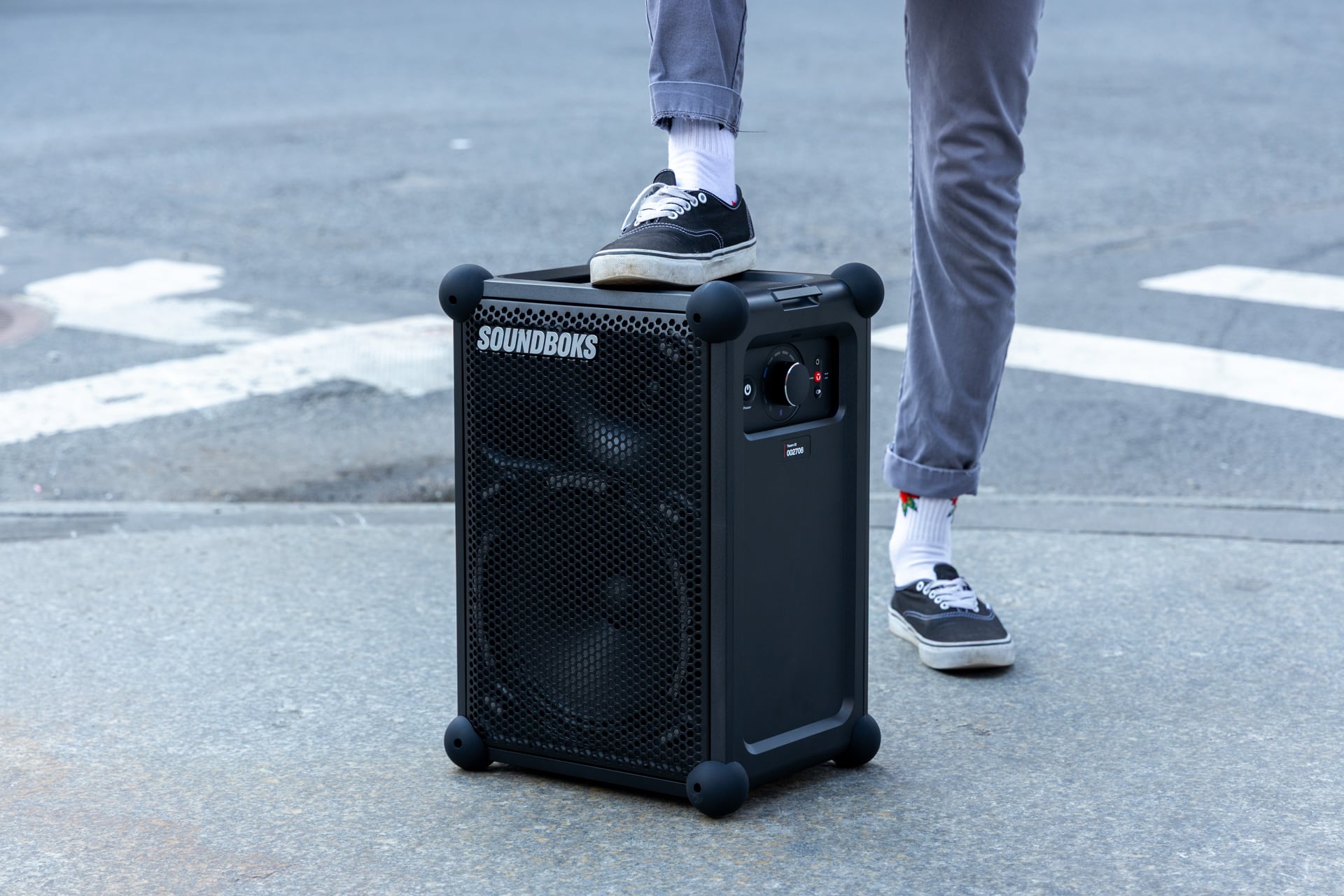
 © Raymond Wong / Gizmodo To test out that volume, I went to Washington Square Park in Manhattan and let loose. The Soundboks Mix is indeed loud, folks. It didn’t quake the Earth upon which we walk or anything like that, but it’s got juice. I tested the party speaker at a range of volumes playing music across different genres—mostly rock, but some electronic music and soul—and the park got an earful. I can’t say for certain, but I’m pretty sure I chased off two guys hitting a volleyball around. You heard it here first: if you hate people playing volleyball, the Soundboks Mix is a repellent.

 It’s hard to quantify volume into words, but if I were to try, I would say that the Soundboks Mix is loud enough for a graduation party or a medium-sized quinceañera. It’s not going to bring down the house like a full PA, but if you’re outside within a frisbee distance of the speaker, you’re going to hear it. I also tested the Soundboks Mix briefly at full volume in my office playing Creed’s “One Last Breath,” and it was loud enough to make me feel like we could get kicked out, both for the Creed and the volume. © Raymond Wong / Gizmodo Maybe I’m masochistic, but I was actually expecting it to be a little louder—maybe I’m just old and have bad hearing, though. I guess it’s good that it isn’t. Permanent hearing loss isn’t high on my list of occupational hazards.

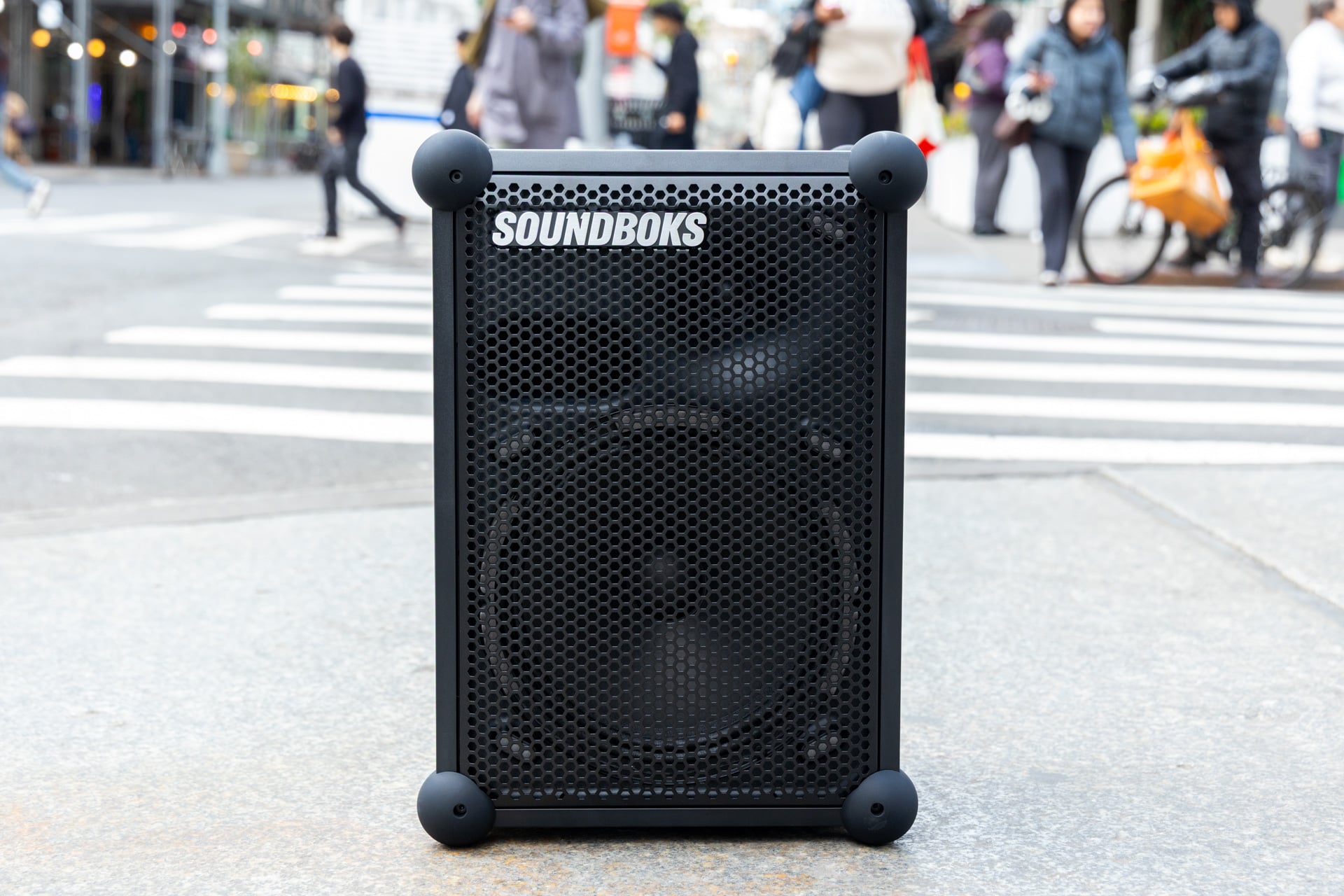
 One thing you’ll be happy to know is that the Soundboks Mix isn’t just loud; it also manages to stave off distortion even at high volumes. Even at 11 out of 11, the Soundboks Mix sounded pretty clear, both from close up and from about 30 feet away. This isn’t the most impressive speaker I’ve heard in the sound department—you’re not getting Sonos outside—but for a party, where people need volume and not necessarily fidelity, it does the trick. I played a few Steely Dan songs at 50% volume and was pleased with the soundstage. There’s a tasteful amount of low end that doesn’t drown out mids and highs. Vocals were clear, and I never felt like I was sorely lacking in any frequency range. Likewise, when I played songs like “Digital Love” by Daft Punk, the bass was present and tangible without overpowering, and auto-tuned vocals didn’t sound tinny or cheap. Using a party speaker outside isn’t the most high-fidelity way to listen to anything, but for what the experience is, I think the Soundboks Mix is pretty solid.

 © Raymond Wong / Gizmodo If you absolutely need more volume and you have the budget, you can also couple the Soundboks Mix with another Soundboks speaker and use them in pairs in stereo mode. I was only sent one speaker for review, so I didn’t get a chance to test that feature out, but I assume it kicks everything up a notch, as celebrity chef Emeril Lagasse would say. Loudness and audio quality aren’t the only things you have to consider when you’re looking at party speaker. You also have to think about rolling joints.

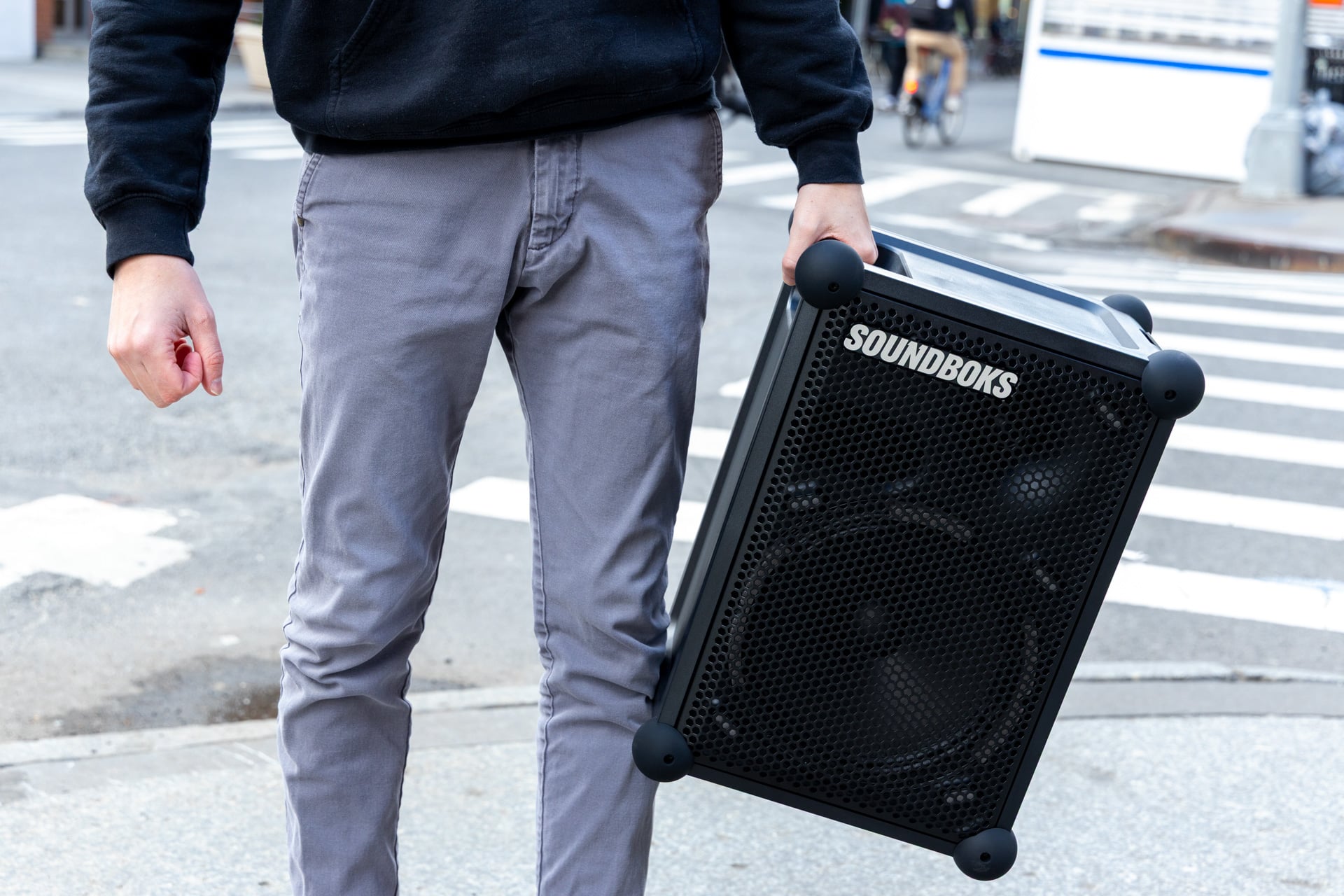
 Portability is friendability If there’s one thing that party speakers aren’t known for, it’s being easy to carry around. To get loud, they have to be big—that’s literally just how physics works. But how big is too big? It’s difficult to strike a balance between giving you enough oomph to really project into a party and enough portability so that you don’t feel like you need to rent an ATV just to drag the speaker down the beach. Having carried the speaker from my office to Washington Square Park, which is about 0.3 miles according to Google Maps, I can say for certain that the experience wasn’t so bad. © Raymond Wong / Gizmodo There’s a built-in handle, which helps, but to be honest, it does weigh 21.4 pounds, so putting all the weight on one hand is a bit much. If you’re moving the Soundboks Mix over longer distances, I would recommend either holding it to your chest like a baby or buying one of Soundboks’ first-party straps that can hook to the speaker, allowing you to sling it over your back. Soundboks didn’t send over a strap for me to try, so I went with the baby method, which was fine, if not ideal. Its portability also helped make me a friend, who asked me to play some music while he rolled joints. I don’t smoke weed because it makes me feel like the world is ending, but my new friend did offer to share, which was a nice gesture. His first sound request was Beyoncé’s “Me, Myself, and I,” which honestly sounded pretty good at full volume.

 The whole thing was kind of heart-warming, really. It’s how I imagine people felt about boomboxes back in the day, when portable ways to play weren’t easy to come by. And I assume the experience is a lot better than it used to be from a convenience standpoint—especially because of the battery. © Raymond Wong / Gizmodo One cool thing about the Soundboks Mix is that it has a removable battery that you can just pull out and top up with USB-C. That also means you can hot swap it if you really need a new battery ASAP, though you’ll have to buy an extra for 0. There’s also an app for convenience, but it’s pretty barebones. © Raymond Wong / Gizmodo I like that you can adjust volume from the Soundboks app as well as EQ—there are presets for indoor and outdoor as well as custom EQ if you’re feeling picky. I’ll be honest, I didn’t hear a huge difference between the outdoor and indoor EQs, but according to the bars, the outdoor EQ brings down the mids just a tad, letting bass and treble take the lead.

 There is, however, a way to get quick battery readings, which is just odd. Soundboks claims that the Mix gets 8 hours of battery at full volume, though it was hard to get a read since the only way to monitor battery life was to use one of the five circular light indicators on the battery itself. You have to press the button and then just go off those increments and vibes. It’s not ideal. I played the Soundboks Mix for an hour at 60% volume, and none of the five circles dropped out, so take that for what you will. © Raymond Wong / Gizmodo Outside of volume adjustment and EQ, you can also turn the Soundboks Mix off through the app and initiate the “TeamUp” feature to pair the Mix with other Soundboks speakers. It’s nice to be able to adjust the volume remotely, but to be honest, the built-in volume dial on the Soundboks mix feels so nice and premium (it’s metal and there’s plenty of resistance) that I didn’t want to adjust the volume any other way. Button-wise, there’s also a power button and a button for the TeamUp feature that allows you to pair speakers together. There’s also a “Bond” button that can cycle through modes when you’re using TeamUp and Bluetooth connections. Lastly, there’s a 3.5mm aux in if that’s your thing.

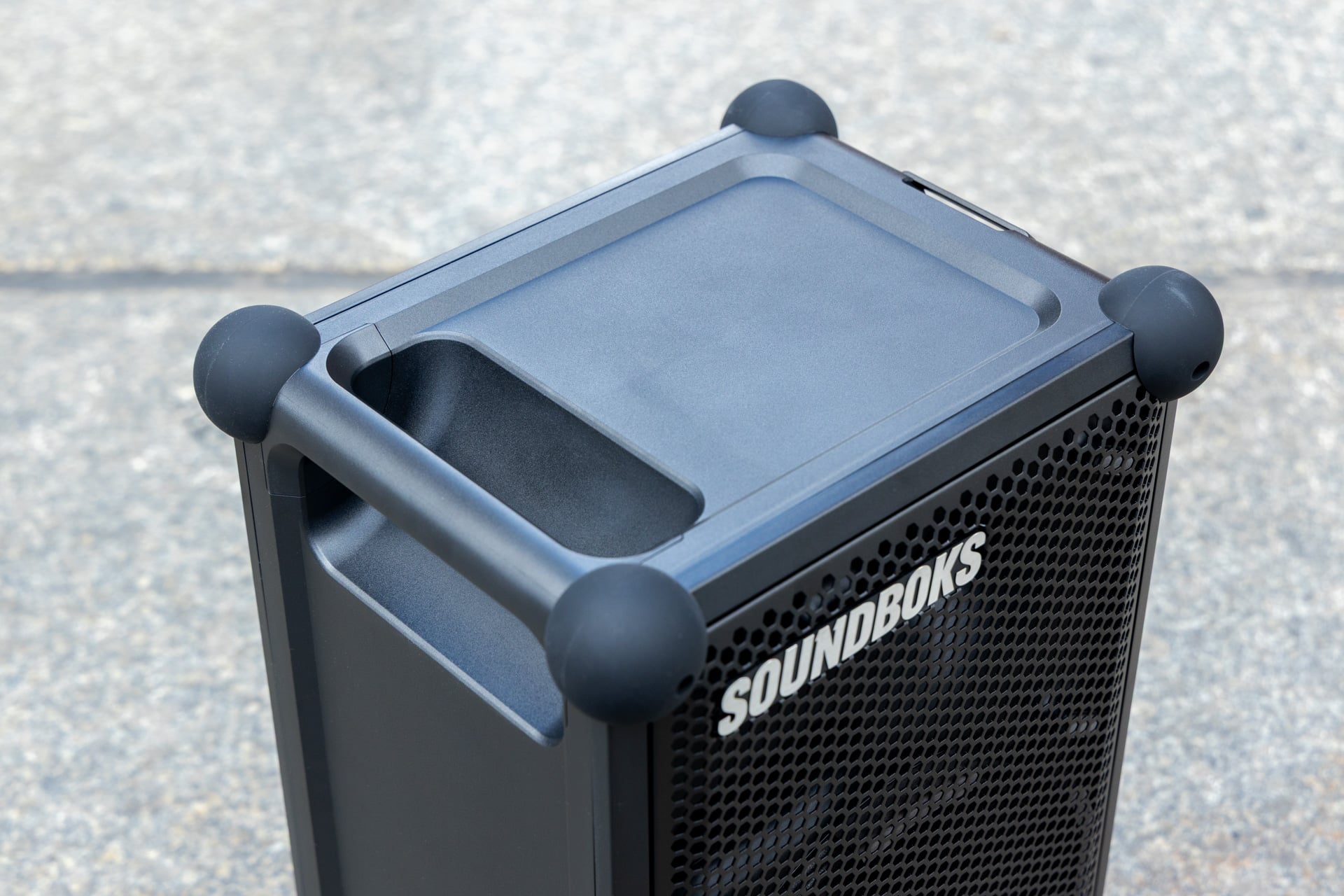
 The Soundboks Mix keeps things pretty simple design-wise, but one nice touch is the inclusion of rubber balls on the bottom of each corner, which makes setting it down feel safe and easy. You also won’t have to worry about the Soundboks Mix getting fried in the rain, either. The speaker is IP65-rated, meaning it’s resistant to dust and water, and if you get caught in the rain, you should be fine. Should you Mix it up? © Raymond Wong / Gizmodo Listen, 0 is a lot of money to spend on a speaker, even if it can get as loud as a chainsaw. This isn’t something that you’re going to want to use all the time, and it certainly isn’t the most versatile speaker in the world, but no party speaker really is. If you’re looking for something that gets loud, sounds good, and can be built out to get even louder and more obnoxious, the Soundboks Mix is not a bad pick. It helps that it’s still somewhat portable despite its loudness, too, so if you plan on hauling this to the beach or something, it’s not an insurmountable task.

 Party speakers aren’t for everyone, but if they’re for you, then the Mix might be a great way to make friends and maybe get a little high on someone else’s supply.        #Soundoks #Mix #Review #LoudAss #Party #Speaker #Highaudio,Reviews,Wireless Speakers
© Raymond Wong / Gizmodo

To test out that volume, I went to Washington Square Park in Manhattan and let loose. The Soundboks Mix is indeed loud, folks. It didn’t quake the Earth upon which we walk or anything like that, but it’s got juice. I tested the party speaker at a range of volumes playing music across different genres—mostly rock, but some electronic music and soul—and the park got an earful. I can’t say for certain, but I’m pretty sure I chased off two guys hitting a volleyball around. You heard it here first: if you hate people playing volleyball, the Soundboks Mix is a repellent.

It’s hard to quantify volume into words, but if I were to try, I would say that the Soundboks Mix is loud enough for a graduation party or a medium-sized quinceañera. It’s not going to bring down the house like a full PA, but if you’re outside within a frisbee distance of the speaker, you’re going to hear it. I also tested the Soundboks Mix briefly at full volume in my office playing Creed’s “One Last Breath,” and it was loud enough to make me feel like we could get kicked out, both for the Creed and the volume.

Soundboks Mix Party Speaker Review
© Raymond Wong / Gizmodo

Maybe I’m masochistic, but I was actually expecting it to be a little louder—maybe I’m just old and have bad hearing, though. I guess it’s good that it isn’t. Permanent hearing loss isn’t high on my list of occupational hazards.

One thing you’ll be happy to know is that the Soundboks Mix isn’t just loud; it also manages to stave off distortion even at high volumes. Even at 11 out of 11, the Soundboks Mix sounded pretty clear, both from close up and from about 30 feet away. This isn’t the most impressive speaker I’ve heard in the sound department—you’re not getting Sonos outside—but for a party, where people need volume and not necessarily fidelity, it does the trick.

I played a few Steely Dan songs at 50% volume and was pleased with the soundstage. There’s a tasteful amount of low end that doesn’t drown out mids and highs. Vocals were clear, and I never felt like I was sorely lacking in any frequency range. Likewise, when I played songs like “Digital Love” by Daft Punk, the bass was present and tangible without overpowering, and auto-tuned vocals didn’t sound tinny or cheap. Using a party speaker outside isn’t the most high-fidelity way to listen to anything, but for what the experience is, I think the Soundboks Mix is pretty solid.

Soundboks Mix Party Speaker Review
© Raymond Wong / Gizmodo

If you absolutely need more volume and you have the budget, you can also couple the Soundboks Mix with another Soundboks speaker and use them in pairs in stereo mode. I was only sent one speaker for review, so I didn’t get a chance to test that feature out, but I assume it kicks everything up a notch, as celebrity chef Emeril Lagasse would say.

Loudness and audio quality aren’t the only things you have to consider when you’re looking at party speaker. You also have to think about rolling joints.

Portability is friendability

If there’s one thing that party speakers aren’t known for, it’s being easy to carry around. To get loud, they have to be big—that’s literally just how physics works. But how big is too big? It’s difficult to strike a balance between giving you enough oomph to really project into a party and enough portability so that you don’t feel like you need to rent an ATV just to drag the speaker down the beach. Having carried the speaker from my office to Washington Square Park, which is about 0.3 miles according to Google Maps, I can say for certain that the experience wasn’t so bad.

Soundboks Party SpSoundboks Mix Party Speaker Revieweaker Review 04
© Raymond Wong / Gizmodo

There’s a built-in handle, which helps, but to be honest, it does weigh 21.4 pounds, so putting all the weight on one hand is a bit much. If you’re moving the Soundboks Mix over longer distances, I would recommend either holding it to your chest like a baby or buying one of Soundboks’ first-party straps that can hook to the speaker, allowing you to sling it over your back. Soundboks didn’t send over a strap for me to try, so I went with the baby method, which was fine, if not ideal.

Its portability also helped make me a friend, who asked me to play some music while he rolled joints. I don’t smoke weed because it makes me feel like the world is ending, but my new friend did offer to share, which was a nice gesture. His first sound request was Beyoncé’s “Me, Myself, and I,” which honestly sounded pretty good at full volume.

The whole thing was kind of heart-warming, really. It’s how I imagine people felt about boomboxes back in the day, when portable ways to play weren’t easy to come by. And I assume the experience is a lot better than it used to be from a convenience standpoint—especially because of the battery.

Soundboks Mix Party Speaker Review
© Raymond Wong / Gizmodo

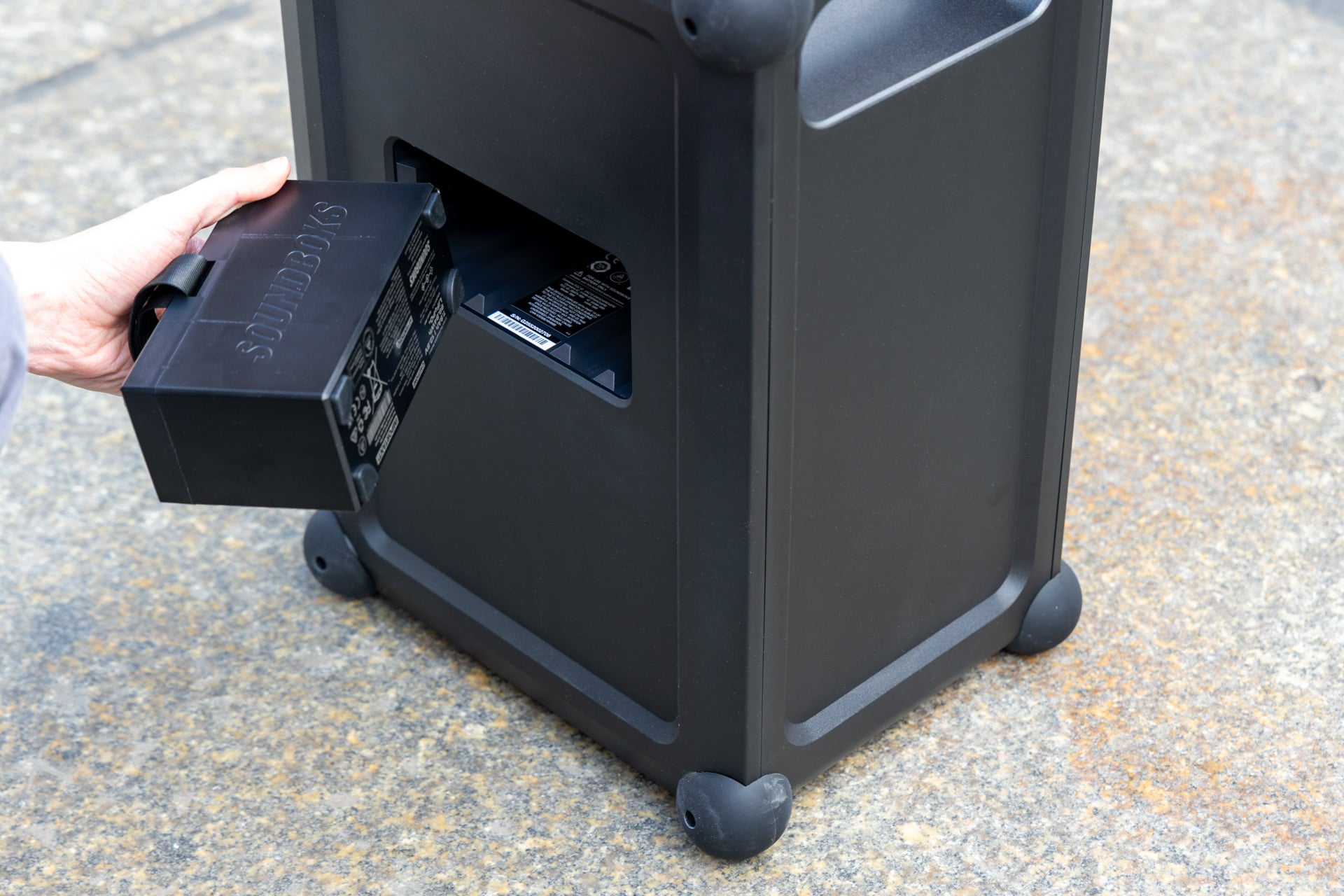
One cool thing about the Soundboks Mix is that it has a removable battery that you can just pull out and top up with USB-C. That also means you can hot swap it if you really need a new battery ASAP, though you’ll have to buy an extra for $150. There’s also an app for convenience, but it’s pretty barebones.

Soundboks Mix Party Speaker Review
© Raymond Wong / Gizmodo

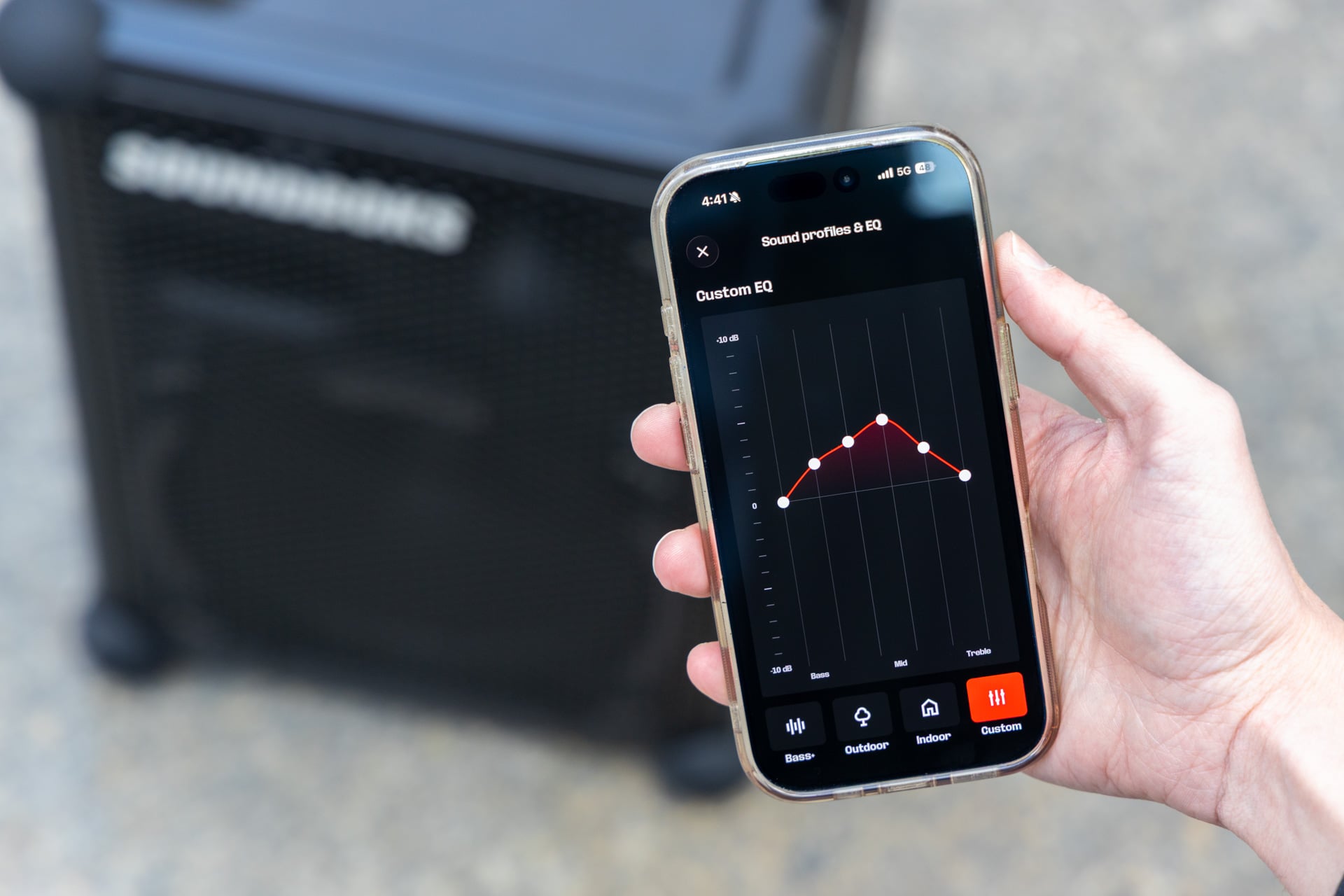
I like that you can adjust volume from the Soundboks app as well as EQ—there are presets for indoor and outdoor as well as custom EQ if you’re feeling picky. I’ll be honest, I didn’t hear a huge difference between the outdoor and indoor EQs, but according to the bars, the outdoor EQ brings down the mids just a tad, letting bass and treble take the lead.

There is, however, a way to get quick battery readings, which is just odd. Soundboks claims that the Mix gets 8 hours of battery at full volume, though it was hard to get a read since the only way to monitor battery life was to use one of the five circular light indicators on the battery itself. You have to press the button and then just go off those increments and vibes. It’s not ideal. I played the Soundboks Mix for an hour at 60% volume, and none of the five circles dropped out, so take that for what you will.

Soundboks Mix Party Speaker Review
© Raymond Wong / Gizmodo

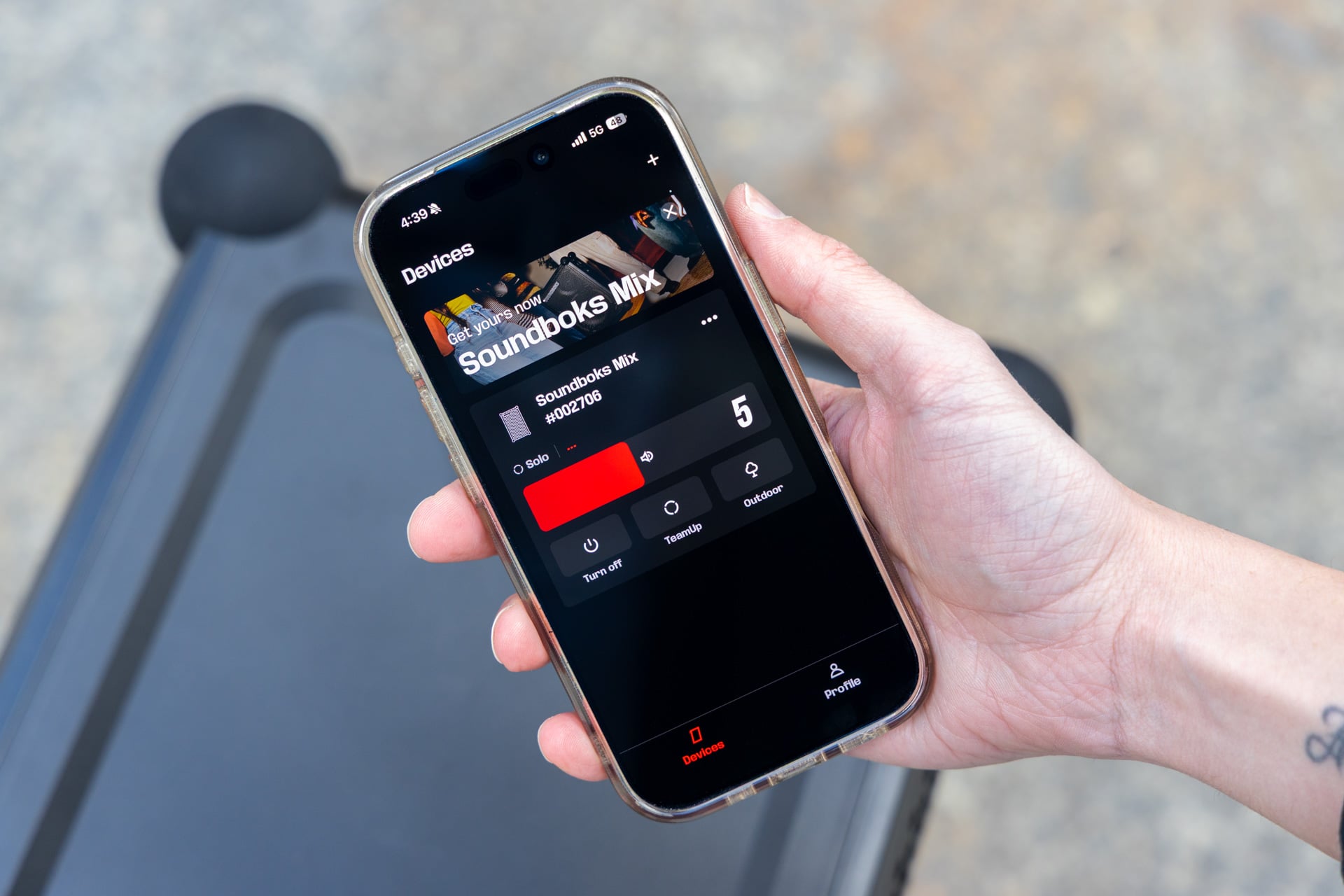
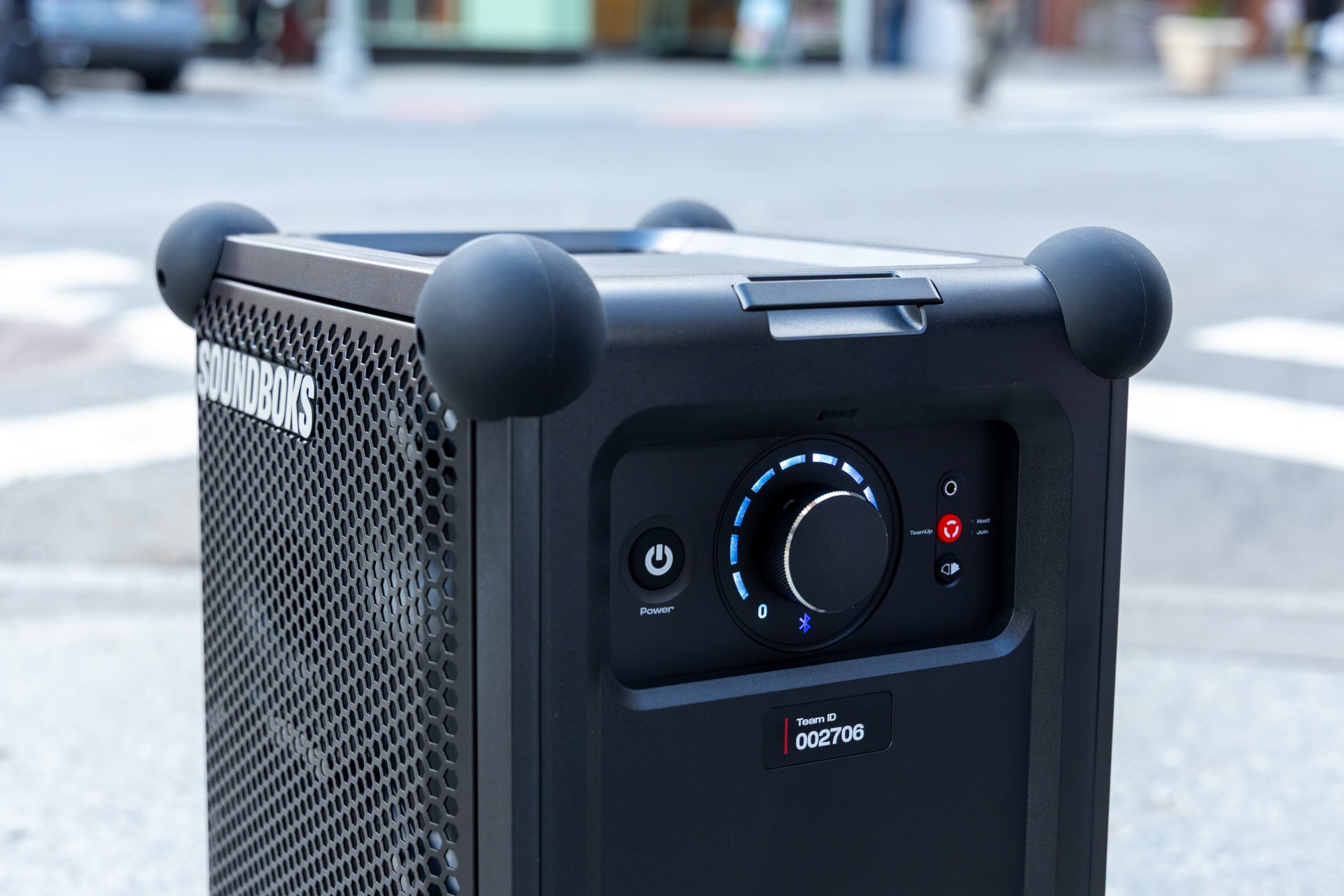
Outside of volume adjustment and EQ, you can also turn the Soundboks Mix off through the app and initiate the “TeamUp” feature to pair the Mix with other Soundboks speakers. It’s nice to be able to adjust the volume remotely, but to be honest, the built-in volume dial on the Soundboks mix feels so nice and premium (it’s metal and there’s plenty of resistance) that I didn’t want to adjust the volume any other way. Button-wise, there’s also a power button and a button for the TeamUp feature that allows you to pair speakers together. There’s also a “Bond” button that can cycle through modes when you’re using TeamUp and Bluetooth connections. Lastly, there’s a 3.5mm aux in if that’s your thing.

The Soundboks Mix keeps things pretty simple design-wise, but one nice touch is the inclusion of rubber balls on the bottom of each corner, which makes setting it down feel safe and easy. You also won’t have to worry about the Soundboks Mix getting fried in the rain, either. The speaker is IP65-rated, meaning it’s resistant to dust and water, and if you get caught in the rain, you should be fine.

Should you Mix it up?

Soundboks Mix Party Speaker Review
© Raymond Wong / Gizmodo

Listen, $800 is a lot of money to spend on a speaker, even if it can get as loud as a chainsaw. This isn’t something that you’re going to want to use all the time, and it certainly isn’t the most versatile speaker in the world, but no party speaker really is. If you’re looking for something that gets loud, sounds good, and can be built out to get even louder and more obnoxious, the Soundboks Mix is not a bad pick. It helps that it’s still somewhat portable despite its loudness, too, so if you plan on hauling this to the beach or something, it’s not an insurmountable task.

Party speakers aren’t for everyone, but if they’re for you, then the Mix might be a great way to make friends and maybe get a little high on someone else’s supply.

#Soundoks #Mix #Review #LoudAss #Party #Speaker #Highaudio,Reviews,Wireless Speakers">Soundoks Mix Review: This Loud-Ass Party Speaker Almost Got Me High AF
                Party speakers aren’t really my thing. It’s not that I don’t like to party—I do. Not in a “friends and family surprise you at your house for a serious talk” kind of way, but in a “mid-30s, I have sh*t to do in the morning” kind of way. Really, I just don’t like to annoy people more than I have to.

 New York City isn’t known for its serenity, but it takes a certain level of decorum to get along, and party speakers, with their inherent obnoxiousness, break a very tenuous code. They’re big (not great for small living spaces), loud (not great for proximate neighbors), and expensive (not great for paying rent on time). They’re, in many ways, antithetical to what most New Yorkers (and other urban-dwelling people) look for in personal audio. They’re also, as I learned in my experience using the 21-pound Soundboks Mix party speaker, actually a great way to make friends.                        Soundboks Mix           The Soundboks Mix is a party speaker that’s loud and portable with decent sound.                                                                                                                                                                                              Loud!                                                                                   Still pretty portable despite its size                                                                                   Sound is pretty good                                                                                                                                                                                                                                                    Sound is good but not great                                                                                   No way to get battery readings from the app                                                                                   Underwhelming EQ options                                                                                   Party speakers are pricey and so is the Soundboks Mix                                                                                                                                      This speaker goes to 11 Party speakers are first and foremost meant for parties, and the 0 Soundbox Mix is no different. Soundboks is known for its Bluetooth speakers and, in particular, for making ones that get ridiculously loud. In case you had any doubt about the loudness, the Soundboks Mix even has a volume dial on the side that goes to 11 instead of 10, Spinal Tap-style.

 © Raymond Wong / Gizmodo To test out that volume, I went to Washington Square Park in Manhattan and let loose. The Soundboks Mix is indeed loud, folks. It didn’t quake the Earth upon which we walk or anything like that, but it’s got juice. I tested the party speaker at a range of volumes playing music across different genres—mostly rock, but some electronic music and soul—and the park got an earful. I can’t say for certain, but I’m pretty sure I chased off two guys hitting a volleyball around. You heard it here first: if you hate people playing volleyball, the Soundboks Mix is a repellent.

 It’s hard to quantify volume into words, but if I were to try, I would say that the Soundboks Mix is loud enough for a graduation party or a medium-sized quinceañera. It’s not going to bring down the house like a full PA, but if you’re outside within a frisbee distance of the speaker, you’re going to hear it. I also tested the Soundboks Mix briefly at full volume in my office playing Creed’s “One Last Breath,” and it was loud enough to make me feel like we could get kicked out, both for the Creed and the volume. © Raymond Wong / Gizmodo Maybe I’m masochistic, but I was actually expecting it to be a little louder—maybe I’m just old and have bad hearing, though. I guess it’s good that it isn’t. Permanent hearing loss isn’t high on my list of occupational hazards.

 One thing you’ll be happy to know is that the Soundboks Mix isn’t just loud; it also manages to stave off distortion even at high volumes. Even at 11 out of 11, the Soundboks Mix sounded pretty clear, both from close up and from about 30 feet away. This isn’t the most impressive speaker I’ve heard in the sound department—you’re not getting Sonos outside—but for a party, where people need volume and not necessarily fidelity, it does the trick. I played a few Steely Dan songs at 50% volume and was pleased with the soundstage. There’s a tasteful amount of low end that doesn’t drown out mids and highs. Vocals were clear, and I never felt like I was sorely lacking in any frequency range. Likewise, when I played songs like “Digital Love” by Daft Punk, the bass was present and tangible without overpowering, and auto-tuned vocals didn’t sound tinny or cheap. Using a party speaker outside isn’t the most high-fidelity way to listen to anything, but for what the experience is, I think the Soundboks Mix is pretty solid.

 © Raymond Wong / Gizmodo If you absolutely need more volume and you have the budget, you can also couple the Soundboks Mix with another Soundboks speaker and use them in pairs in stereo mode. I was only sent one speaker for review, so I didn’t get a chance to test that feature out, but I assume it kicks everything up a notch, as celebrity chef Emeril Lagasse would say. Loudness and audio quality aren’t the only things you have to consider when you’re looking at party speaker. You also have to think about rolling joints.

 Portability is friendability If there’s one thing that party speakers aren’t known for, it’s being easy to carry around. To get loud, they have to be big—that’s literally just how physics works. But how big is too big? It’s difficult to strike a balance between giving you enough oomph to really project into a party and enough portability so that you don’t feel like you need to rent an ATV just to drag the speaker down the beach. Having carried the speaker from my office to Washington Square Park, which is about 0.3 miles according to Google Maps, I can say for certain that the experience wasn’t so bad. © Raymond Wong / Gizmodo There’s a built-in handle, which helps, but to be honest, it does weigh 21.4 pounds, so putting all the weight on one hand is a bit much. If you’re moving the Soundboks Mix over longer distances, I would recommend either holding it to your chest like a baby or buying one of Soundboks’ first-party straps that can hook to the speaker, allowing you to sling it over your back. Soundboks didn’t send over a strap for me to try, so I went with the baby method, which was fine, if not ideal. Its portability also helped make me a friend, who asked me to play some music while he rolled joints. I don’t smoke weed because it makes me feel like the world is ending, but my new friend did offer to share, which was a nice gesture. His first sound request was Beyoncé’s “Me, Myself, and I,” which honestly sounded pretty good at full volume.

 The whole thing was kind of heart-warming, really. It’s how I imagine people felt about boomboxes back in the day, when portable ways to play weren’t easy to come by. And I assume the experience is a lot better than it used to be from a convenience standpoint—especially because of the battery. © Raymond Wong / Gizmodo One cool thing about the Soundboks Mix is that it has a removable battery that you can just pull out and top up with USB-C. That also means you can hot swap it if you really need a new battery ASAP, though you’ll have to buy an extra for 0. There’s also an app for convenience, but it’s pretty barebones. © Raymond Wong / Gizmodo I like that you can adjust volume from the Soundboks app as well as EQ—there are presets for indoor and outdoor as well as custom EQ if you’re feeling picky. I’ll be honest, I didn’t hear a huge difference between the outdoor and indoor EQs, but according to the bars, the outdoor EQ brings down the mids just a tad, letting bass and treble take the lead.

 There is, however, a way to get quick battery readings, which is just odd. Soundboks claims that the Mix gets 8 hours of battery at full volume, though it was hard to get a read since the only way to monitor battery life was to use one of the five circular light indicators on the battery itself. You have to press the button and then just go off those increments and vibes. It’s not ideal. I played the Soundboks Mix for an hour at 60% volume, and none of the five circles dropped out, so take that for what you will. © Raymond Wong / Gizmodo Outside of volume adjustment and EQ, you can also turn the Soundboks Mix off through the app and initiate the “TeamUp” feature to pair the Mix with other Soundboks speakers. It’s nice to be able to adjust the volume remotely, but to be honest, the built-in volume dial on the Soundboks mix feels so nice and premium (it’s metal and there’s plenty of resistance) that I didn’t want to adjust the volume any other way. Button-wise, there’s also a power button and a button for the TeamUp feature that allows you to pair speakers together. There’s also a “Bond” button that can cycle through modes when you’re using TeamUp and Bluetooth connections. Lastly, there’s a 3.5mm aux in if that’s your thing.

 The Soundboks Mix keeps things pretty simple design-wise, but one nice touch is the inclusion of rubber balls on the bottom of each corner, which makes setting it down feel safe and easy. You also won’t have to worry about the Soundboks Mix getting fried in the rain, either. The speaker is IP65-rated, meaning it’s resistant to dust and water, and if you get caught in the rain, you should be fine. Should you Mix it up? © Raymond Wong / Gizmodo Listen, 0 is a lot of money to spend on a speaker, even if it can get as loud as a chainsaw. This isn’t something that you’re going to want to use all the time, and it certainly isn’t the most versatile speaker in the world, but no party speaker really is. If you’re looking for something that gets loud, sounds good, and can be built out to get even louder and more obnoxious, the Soundboks Mix is not a bad pick. It helps that it’s still somewhat portable despite its loudness, too, so if you plan on hauling this to the beach or something, it’s not an insurmountable task.

 Party speakers aren’t for everyone, but if they’re for you, then the Mix might be a great way to make friends and maybe get a little high on someone else’s supply.        #Soundoks #Mix #Review #LoudAss #Party #Speaker #Highaudio,Reviews,Wireless Speakers

party speaker, actually a great way to make friends.


Soundboks Mix

The Soundboks Mix is a party speaker that’s loud and portable with decent sound.

  • Loud!
  • Still pretty portable despite its size
  • Sound is pretty good
  • Sound is good but not great
  • No way to get battery readings from the app
  • Underwhelming EQ options
  • Party speakers are pricey and so is the Soundboks Mix

This speaker goes to 11

Party speakers are first and foremost meant for parties, and the $800 Soundbox Mix is no different. Soundboks is known for its Bluetooth speakers and, in particular, for making ones that get ridiculously loud. In case you had any doubt about the loudness, the Soundboks Mix even has a volume dial on the side that goes to 11 instead of 10, Spinal Tap-style.

Soundoks Mix Review: This Loud-Ass Party Speaker Almost Got Me High AF
                Party speakers aren’t really my thing. It’s not that I don’t like to party—I do. Not in a “friends and family surprise you at your house for a serious talk” kind of way, but in a “mid-30s, I have sh*t to do in the morning” kind of way. Really, I just don’t like to annoy people more than I have to.

 New York City isn’t known for its serenity, but it takes a certain level of decorum to get along, and party speakers, with their inherent obnoxiousness, break a very tenuous code. They’re big (not great for small living spaces), loud (not great for proximate neighbors), and expensive (not great for paying rent on time). They’re, in many ways, antithetical to what most New Yorkers (and other urban-dwelling people) look for in personal audio. They’re also, as I learned in my experience using the 21-pound Soundboks Mix party speaker, actually a great way to make friends.                        Soundboks Mix           The Soundboks Mix is a party speaker that’s loud and portable with decent sound.                                                                                                                                                                                              Loud!                                                                                   Still pretty portable despite its size                                                                                   Sound is pretty good                                                                                                                                                                                                                                                    Sound is good but not great                                                                                   No way to get battery readings from the app                                                                                   Underwhelming EQ options                                                                                   Party speakers are pricey and so is the Soundboks Mix                                                                                                                                      This speaker goes to 11 Party speakers are first and foremost meant for parties, and the 0 Soundbox Mix is no different. Soundboks is known for its Bluetooth speakers and, in particular, for making ones that get ridiculously loud. In case you had any doubt about the loudness, the Soundboks Mix even has a volume dial on the side that goes to 11 instead of 10, Spinal Tap-style.

 © Raymond Wong / Gizmodo To test out that volume, I went to Washington Square Park in Manhattan and let loose. The Soundboks Mix is indeed loud, folks. It didn’t quake the Earth upon which we walk or anything like that, but it’s got juice. I tested the party speaker at a range of volumes playing music across different genres—mostly rock, but some electronic music and soul—and the park got an earful. I can’t say for certain, but I’m pretty sure I chased off two guys hitting a volleyball around. You heard it here first: if you hate people playing volleyball, the Soundboks Mix is a repellent.

 It’s hard to quantify volume into words, but if I were to try, I would say that the Soundboks Mix is loud enough for a graduation party or a medium-sized quinceañera. It’s not going to bring down the house like a full PA, but if you’re outside within a frisbee distance of the speaker, you’re going to hear it. I also tested the Soundboks Mix briefly at full volume in my office playing Creed’s “One Last Breath,” and it was loud enough to make me feel like we could get kicked out, both for the Creed and the volume. © Raymond Wong / Gizmodo Maybe I’m masochistic, but I was actually expecting it to be a little louder—maybe I’m just old and have bad hearing, though. I guess it’s good that it isn’t. Permanent hearing loss isn’t high on my list of occupational hazards.

 One thing you’ll be happy to know is that the Soundboks Mix isn’t just loud; it also manages to stave off distortion even at high volumes. Even at 11 out of 11, the Soundboks Mix sounded pretty clear, both from close up and from about 30 feet away. This isn’t the most impressive speaker I’ve heard in the sound department—you’re not getting Sonos outside—but for a party, where people need volume and not necessarily fidelity, it does the trick. I played a few Steely Dan songs at 50% volume and was pleased with the soundstage. There’s a tasteful amount of low end that doesn’t drown out mids and highs. Vocals were clear, and I never felt like I was sorely lacking in any frequency range. Likewise, when I played songs like “Digital Love” by Daft Punk, the bass was present and tangible without overpowering, and auto-tuned vocals didn’t sound tinny or cheap. Using a party speaker outside isn’t the most high-fidelity way to listen to anything, but for what the experience is, I think the Soundboks Mix is pretty solid.

 © Raymond Wong / Gizmodo If you absolutely need more volume and you have the budget, you can also couple the Soundboks Mix with another Soundboks speaker and use them in pairs in stereo mode. I was only sent one speaker for review, so I didn’t get a chance to test that feature out, but I assume it kicks everything up a notch, as celebrity chef Emeril Lagasse would say. Loudness and audio quality aren’t the only things you have to consider when you’re looking at party speaker. You also have to think about rolling joints.

 Portability is friendability If there’s one thing that party speakers aren’t known for, it’s being easy to carry around. To get loud, they have to be big—that’s literally just how physics works. But how big is too big? It’s difficult to strike a balance between giving you enough oomph to really project into a party and enough portability so that you don’t feel like you need to rent an ATV just to drag the speaker down the beach. Having carried the speaker from my office to Washington Square Park, which is about 0.3 miles according to Google Maps, I can say for certain that the experience wasn’t so bad. © Raymond Wong / Gizmodo There’s a built-in handle, which helps, but to be honest, it does weigh 21.4 pounds, so putting all the weight on one hand is a bit much. If you’re moving the Soundboks Mix over longer distances, I would recommend either holding it to your chest like a baby or buying one of Soundboks’ first-party straps that can hook to the speaker, allowing you to sling it over your back. Soundboks didn’t send over a strap for me to try, so I went with the baby method, which was fine, if not ideal. Its portability also helped make me a friend, who asked me to play some music while he rolled joints. I don’t smoke weed because it makes me feel like the world is ending, but my new friend did offer to share, which was a nice gesture. His first sound request was Beyoncé’s “Me, Myself, and I,” which honestly sounded pretty good at full volume.

 The whole thing was kind of heart-warming, really. It’s how I imagine people felt about boomboxes back in the day, when portable ways to play weren’t easy to come by. And I assume the experience is a lot better than it used to be from a convenience standpoint—especially because of the battery. © Raymond Wong / Gizmodo One cool thing about the Soundboks Mix is that it has a removable battery that you can just pull out and top up with USB-C. That also means you can hot swap it if you really need a new battery ASAP, though you’ll have to buy an extra for 0. There’s also an app for convenience, but it’s pretty barebones. © Raymond Wong / Gizmodo I like that you can adjust volume from the Soundboks app as well as EQ—there are presets for indoor and outdoor as well as custom EQ if you’re feeling picky. I’ll be honest, I didn’t hear a huge difference between the outdoor and indoor EQs, but according to the bars, the outdoor EQ brings down the mids just a tad, letting bass and treble take the lead.

 There is, however, a way to get quick battery readings, which is just odd. Soundboks claims that the Mix gets 8 hours of battery at full volume, though it was hard to get a read since the only way to monitor battery life was to use one of the five circular light indicators on the battery itself. You have to press the button and then just go off those increments and vibes. It’s not ideal. I played the Soundboks Mix for an hour at 60% volume, and none of the five circles dropped out, so take that for what you will. © Raymond Wong / Gizmodo Outside of volume adjustment and EQ, you can also turn the Soundboks Mix off through the app and initiate the “TeamUp” feature to pair the Mix with other Soundboks speakers. It’s nice to be able to adjust the volume remotely, but to be honest, the built-in volume dial on the Soundboks mix feels so nice and premium (it’s metal and there’s plenty of resistance) that I didn’t want to adjust the volume any other way. Button-wise, there’s also a power button and a button for the TeamUp feature that allows you to pair speakers together. There’s also a “Bond” button that can cycle through modes when you’re using TeamUp and Bluetooth connections. Lastly, there’s a 3.5mm aux in if that’s your thing.

 The Soundboks Mix keeps things pretty simple design-wise, but one nice touch is the inclusion of rubber balls on the bottom of each corner, which makes setting it down feel safe and easy. You also won’t have to worry about the Soundboks Mix getting fried in the rain, either. The speaker is IP65-rated, meaning it’s resistant to dust and water, and if you get caught in the rain, you should be fine. Should you Mix it up? © Raymond Wong / Gizmodo Listen, 0 is a lot of money to spend on a speaker, even if it can get as loud as a chainsaw. This isn’t something that you’re going to want to use all the time, and it certainly isn’t the most versatile speaker in the world, but no party speaker really is. If you’re looking for something that gets loud, sounds good, and can be built out to get even louder and more obnoxious, the Soundboks Mix is not a bad pick. It helps that it’s still somewhat portable despite its loudness, too, so if you plan on hauling this to the beach or something, it’s not an insurmountable task.

 Party speakers aren’t for everyone, but if they’re for you, then the Mix might be a great way to make friends and maybe get a little high on someone else’s supply.        #Soundoks #Mix #Review #LoudAss #Party #Speaker #Highaudio,Reviews,Wireless Speakers
© Raymond Wong / Gizmodo

To test out that volume, I went to Washington Square Park in Manhattan and let loose. The Soundboks Mix is indeed loud, folks. It didn’t quake the Earth upon which we walk or anything like that, but it’s got juice. I tested the party speaker at a range of volumes playing music across different genres—mostly rock, but some electronic music and soul—and the park got an earful. I can’t say for certain, but I’m pretty sure I chased off two guys hitting a volleyball around. You heard it here first: if you hate people playing volleyball, the Soundboks Mix is a repellent.

It’s hard to quantify volume into words, but if I were to try, I would say that the Soundboks Mix is loud enough for a graduation party or a medium-sized quinceañera. It’s not going to bring down the house like a full PA, but if you’re outside within a frisbee distance of the speaker, you’re going to hear it. I also tested the Soundboks Mix briefly at full volume in my office playing Creed’s “One Last Breath,” and it was loud enough to make me feel like we could get kicked out, both for the Creed and the volume.

Soundboks Mix Party Speaker Review
© Raymond Wong / Gizmodo

Maybe I’m masochistic, but I was actually expecting it to be a little louder—maybe I’m just old and have bad hearing, though. I guess it’s good that it isn’t. Permanent hearing loss isn’t high on my list of occupational hazards.

One thing you’ll be happy to know is that the Soundboks Mix isn’t just loud; it also manages to stave off distortion even at high volumes. Even at 11 out of 11, the Soundboks Mix sounded pretty clear, both from close up and from about 30 feet away. This isn’t the most impressive speaker I’ve heard in the sound department—you’re not getting Sonos outside—but for a party, where people need volume and not necessarily fidelity, it does the trick.

I played a few Steely Dan songs at 50% volume and was pleased with the soundstage. There’s a tasteful amount of low end that doesn’t drown out mids and highs. Vocals were clear, and I never felt like I was sorely lacking in any frequency range. Likewise, when I played songs like “Digital Love” by Daft Punk, the bass was present and tangible without overpowering, and auto-tuned vocals didn’t sound tinny or cheap. Using a party speaker outside isn’t the most high-fidelity way to listen to anything, but for what the experience is, I think the Soundboks Mix is pretty solid.

Soundboks Mix Party Speaker Review
© Raymond Wong / Gizmodo

If you absolutely need more volume and you have the budget, you can also couple the Soundboks Mix with another Soundboks speaker and use them in pairs in stereo mode. I was only sent one speaker for review, so I didn’t get a chance to test that feature out, but I assume it kicks everything up a notch, as celebrity chef Emeril Lagasse would say.

Loudness and audio quality aren’t the only things you have to consider when you’re looking at party speaker. You also have to think about rolling joints.

Portability is friendability

If there’s one thing that party speakers aren’t known for, it’s being easy to carry around. To get loud, they have to be big—that’s literally just how physics works. But how big is too big? It’s difficult to strike a balance between giving you enough oomph to really project into a party and enough portability so that you don’t feel like you need to rent an ATV just to drag the speaker down the beach. Having carried the speaker from my office to Washington Square Park, which is about 0.3 miles according to Google Maps, I can say for certain that the experience wasn’t so bad.

Soundboks Party SpSoundboks Mix Party Speaker Revieweaker Review 04
© Raymond Wong / Gizmodo

There’s a built-in handle, which helps, but to be honest, it does weigh 21.4 pounds, so putting all the weight on one hand is a bit much. If you’re moving the Soundboks Mix over longer distances, I would recommend either holding it to your chest like a baby or buying one of Soundboks’ first-party straps that can hook to the speaker, allowing you to sling it over your back. Soundboks didn’t send over a strap for me to try, so I went with the baby method, which was fine, if not ideal.

Its portability also helped make me a friend, who asked me to play some music while he rolled joints. I don’t smoke weed because it makes me feel like the world is ending, but my new friend did offer to share, which was a nice gesture. His first sound request was Beyoncé’s “Me, Myself, and I,” which honestly sounded pretty good at full volume.

The whole thing was kind of heart-warming, really. It’s how I imagine people felt about boomboxes back in the day, when portable ways to play weren’t easy to come by. And I assume the experience is a lot better than it used to be from a convenience standpoint—especially because of the battery.

Soundboks Mix Party Speaker Review
© Raymond Wong / Gizmodo

One cool thing about the Soundboks Mix is that it has a removable battery that you can just pull out and top up with USB-C. That also means you can hot swap it if you really need a new battery ASAP, though you’ll have to buy an extra for $150. There’s also an app for convenience, but it’s pretty barebones.

Soundboks Mix Party Speaker Review
© Raymond Wong / Gizmodo

I like that you can adjust volume from the Soundboks app as well as EQ—there are presets for indoor and outdoor as well as custom EQ if you’re feeling picky. I’ll be honest, I didn’t hear a huge difference between the outdoor and indoor EQs, but according to the bars, the outdoor EQ brings down the mids just a tad, letting bass and treble take the lead.

There is, however, a way to get quick battery readings, which is just odd. Soundboks claims that the Mix gets 8 hours of battery at full volume, though it was hard to get a read since the only way to monitor battery life was to use one of the five circular light indicators on the battery itself. You have to press the button and then just go off those increments and vibes. It’s not ideal. I played the Soundboks Mix for an hour at 60% volume, and none of the five circles dropped out, so take that for what you will.

Soundboks Mix Party Speaker Review
© Raymond Wong / Gizmodo

Outside of volume adjustment and EQ, you can also turn the Soundboks Mix off through the app and initiate the “TeamUp” feature to pair the Mix with other Soundboks speakers. It’s nice to be able to adjust the volume remotely, but to be honest, the built-in volume dial on the Soundboks mix feels so nice and premium (it’s metal and there’s plenty of resistance) that I didn’t want to adjust the volume any other way. Button-wise, there’s also a power button and a button for the TeamUp feature that allows you to pair speakers together. There’s also a “Bond” button that can cycle through modes when you’re using TeamUp and Bluetooth connections. Lastly, there’s a 3.5mm aux in if that’s your thing.

The Soundboks Mix keeps things pretty simple design-wise, but one nice touch is the inclusion of rubber balls on the bottom of each corner, which makes setting it down feel safe and easy. You also won’t have to worry about the Soundboks Mix getting fried in the rain, either. The speaker is IP65-rated, meaning it’s resistant to dust and water, and if you get caught in the rain, you should be fine.

Should you Mix it up?

Soundboks Mix Party Speaker Review
© Raymond Wong / Gizmodo

Listen, $800 is a lot of money to spend on a speaker, even if it can get as loud as a chainsaw. This isn’t something that you’re going to want to use all the time, and it certainly isn’t the most versatile speaker in the world, but no party speaker really is. If you’re looking for something that gets loud, sounds good, and can be built out to get even louder and more obnoxious, the Soundboks Mix is not a bad pick. It helps that it’s still somewhat portable despite its loudness, too, so if you plan on hauling this to the beach or something, it’s not an insurmountable task.

Party speakers aren’t for everyone, but if they’re for you, then the Mix might be a great way to make friends and maybe get a little high on someone else’s supply.

#Soundoks #Mix #Review #LoudAss #Party #Speaker #Highaudio,Reviews,Wireless Speakers">Soundoks Mix Review: This Loud-Ass Party Speaker Almost Got Me High AF

Party speakers aren’t really my thing. It’s not that I don’t like to party—I do. Not in a “friends and family surprise you at your house for a serious talk” kind of way, but in a “mid-30s, I have sh*t to do in the morning” kind of way. Really, I just don’t like to annoy people more than I have to.

New York City isn’t known for its serenity, but it takes a certain level of decorum to get along, and party speakers, with their inherent obnoxiousness, break a very tenuous code. They’re big (not great for small living spaces), loud (not great for proximate neighbors), and expensive (not great for paying rent on time). They’re, in many ways, antithetical to what most New Yorkers (and other urban-dwelling people) look for in personal audio.

They’re also, as I learned in my experience using the 21-pound Soundboks Mix party speaker, actually a great way to make friends.


Soundboks Mix

The Soundboks Mix is a party speaker that’s loud and portable with decent sound.

  • Loud!
  • Still pretty portable despite its size
  • Sound is pretty good
  • Sound is good but not great
  • No way to get battery readings from the app
  • Underwhelming EQ options
  • Party speakers are pricey and so is the Soundboks Mix

This speaker goes to 11

Party speakers are first and foremost meant for parties, and the $800 Soundbox Mix is no different. Soundboks is known for its Bluetooth speakers and, in particular, for making ones that get ridiculously loud. In case you had any doubt about the loudness, the Soundboks Mix even has a volume dial on the side that goes to 11 instead of 10, Spinal Tap-style.

Soundoks Mix Review: This Loud-Ass Party Speaker Almost Got Me High AF
                Party speakers aren’t really my thing. It’s not that I don’t like to party—I do. Not in a “friends and family surprise you at your house for a serious talk” kind of way, but in a “mid-30s, I have sh*t to do in the morning” kind of way. Really, I just don’t like to annoy people more than I have to.

 New York City isn’t known for its serenity, but it takes a certain level of decorum to get along, and party speakers, with their inherent obnoxiousness, break a very tenuous code. They’re big (not great for small living spaces), loud (not great for proximate neighbors), and expensive (not great for paying rent on time). They’re, in many ways, antithetical to what most New Yorkers (and other urban-dwelling people) look for in personal audio. They’re also, as I learned in my experience using the 21-pound Soundboks Mix party speaker, actually a great way to make friends.                        Soundboks Mix           The Soundboks Mix is a party speaker that’s loud and portable with decent sound.                                                                                                                                                                                              Loud!                                                                                   Still pretty portable despite its size                                                                                   Sound is pretty good                                                                                                                                                                                                                                                    Sound is good but not great                                                                                   No way to get battery readings from the app                                                                                   Underwhelming EQ options                                                                                   Party speakers are pricey and so is the Soundboks Mix                                                                                                                                      This speaker goes to 11 Party speakers are first and foremost meant for parties, and the 0 Soundbox Mix is no different. Soundboks is known for its Bluetooth speakers and, in particular, for making ones that get ridiculously loud. In case you had any doubt about the loudness, the Soundboks Mix even has a volume dial on the side that goes to 11 instead of 10, Spinal Tap-style.

 © Raymond Wong / Gizmodo To test out that volume, I went to Washington Square Park in Manhattan and let loose. The Soundboks Mix is indeed loud, folks. It didn’t quake the Earth upon which we walk or anything like that, but it’s got juice. I tested the party speaker at a range of volumes playing music across different genres—mostly rock, but some electronic music and soul—and the park got an earful. I can’t say for certain, but I’m pretty sure I chased off two guys hitting a volleyball around. You heard it here first: if you hate people playing volleyball, the Soundboks Mix is a repellent.

 It’s hard to quantify volume into words, but if I were to try, I would say that the Soundboks Mix is loud enough for a graduation party or a medium-sized quinceañera. It’s not going to bring down the house like a full PA, but if you’re outside within a frisbee distance of the speaker, you’re going to hear it. I also tested the Soundboks Mix briefly at full volume in my office playing Creed’s “One Last Breath,” and it was loud enough to make me feel like we could get kicked out, both for the Creed and the volume. © Raymond Wong / Gizmodo Maybe I’m masochistic, but I was actually expecting it to be a little louder—maybe I’m just old and have bad hearing, though. I guess it’s good that it isn’t. Permanent hearing loss isn’t high on my list of occupational hazards.

 One thing you’ll be happy to know is that the Soundboks Mix isn’t just loud; it also manages to stave off distortion even at high volumes. Even at 11 out of 11, the Soundboks Mix sounded pretty clear, both from close up and from about 30 feet away. This isn’t the most impressive speaker I’ve heard in the sound department—you’re not getting Sonos outside—but for a party, where people need volume and not necessarily fidelity, it does the trick. I played a few Steely Dan songs at 50% volume and was pleased with the soundstage. There’s a tasteful amount of low end that doesn’t drown out mids and highs. Vocals were clear, and I never felt like I was sorely lacking in any frequency range. Likewise, when I played songs like “Digital Love” by Daft Punk, the bass was present and tangible without overpowering, and auto-tuned vocals didn’t sound tinny or cheap. Using a party speaker outside isn’t the most high-fidelity way to listen to anything, but for what the experience is, I think the Soundboks Mix is pretty solid.

 © Raymond Wong / Gizmodo If you absolutely need more volume and you have the budget, you can also couple the Soundboks Mix with another Soundboks speaker and use them in pairs in stereo mode. I was only sent one speaker for review, so I didn’t get a chance to test that feature out, but I assume it kicks everything up a notch, as celebrity chef Emeril Lagasse would say. Loudness and audio quality aren’t the only things you have to consider when you’re looking at party speaker. You also have to think about rolling joints.

 Portability is friendability If there’s one thing that party speakers aren’t known for, it’s being easy to carry around. To get loud, they have to be big—that’s literally just how physics works. But how big is too big? It’s difficult to strike a balance between giving you enough oomph to really project into a party and enough portability so that you don’t feel like you need to rent an ATV just to drag the speaker down the beach. Having carried the speaker from my office to Washington Square Park, which is about 0.3 miles according to Google Maps, I can say for certain that the experience wasn’t so bad. © Raymond Wong / Gizmodo There’s a built-in handle, which helps, but to be honest, it does weigh 21.4 pounds, so putting all the weight on one hand is a bit much. If you’re moving the Soundboks Mix over longer distances, I would recommend either holding it to your chest like a baby or buying one of Soundboks’ first-party straps that can hook to the speaker, allowing you to sling it over your back. Soundboks didn’t send over a strap for me to try, so I went with the baby method, which was fine, if not ideal. Its portability also helped make me a friend, who asked me to play some music while he rolled joints. I don’t smoke weed because it makes me feel like the world is ending, but my new friend did offer to share, which was a nice gesture. His first sound request was Beyoncé’s “Me, Myself, and I,” which honestly sounded pretty good at full volume.

 The whole thing was kind of heart-warming, really. It’s how I imagine people felt about boomboxes back in the day, when portable ways to play weren’t easy to come by. And I assume the experience is a lot better than it used to be from a convenience standpoint—especially because of the battery. © Raymond Wong / Gizmodo One cool thing about the Soundboks Mix is that it has a removable battery that you can just pull out and top up with USB-C. That also means you can hot swap it if you really need a new battery ASAP, though you’ll have to buy an extra for 0. There’s also an app for convenience, but it’s pretty barebones. © Raymond Wong / Gizmodo I like that you can adjust volume from the Soundboks app as well as EQ—there are presets for indoor and outdoor as well as custom EQ if you’re feeling picky. I’ll be honest, I didn’t hear a huge difference between the outdoor and indoor EQs, but according to the bars, the outdoor EQ brings down the mids just a tad, letting bass and treble take the lead.

 There is, however, a way to get quick battery readings, which is just odd. Soundboks claims that the Mix gets 8 hours of battery at full volume, though it was hard to get a read since the only way to monitor battery life was to use one of the five circular light indicators on the battery itself. You have to press the button and then just go off those increments and vibes. It’s not ideal. I played the Soundboks Mix for an hour at 60% volume, and none of the five circles dropped out, so take that for what you will. © Raymond Wong / Gizmodo Outside of volume adjustment and EQ, you can also turn the Soundboks Mix off through the app and initiate the “TeamUp” feature to pair the Mix with other Soundboks speakers. It’s nice to be able to adjust the volume remotely, but to be honest, the built-in volume dial on the Soundboks mix feels so nice and premium (it’s metal and there’s plenty of resistance) that I didn’t want to adjust the volume any other way. Button-wise, there’s also a power button and a button for the TeamUp feature that allows you to pair speakers together. There’s also a “Bond” button that can cycle through modes when you’re using TeamUp and Bluetooth connections. Lastly, there’s a 3.5mm aux in if that’s your thing.

 The Soundboks Mix keeps things pretty simple design-wise, but one nice touch is the inclusion of rubber balls on the bottom of each corner, which makes setting it down feel safe and easy. You also won’t have to worry about the Soundboks Mix getting fried in the rain, either. The speaker is IP65-rated, meaning it’s resistant to dust and water, and if you get caught in the rain, you should be fine. Should you Mix it up? © Raymond Wong / Gizmodo Listen, 0 is a lot of money to spend on a speaker, even if it can get as loud as a chainsaw. This isn’t something that you’re going to want to use all the time, and it certainly isn’t the most versatile speaker in the world, but no party speaker really is. If you’re looking for something that gets loud, sounds good, and can be built out to get even louder and more obnoxious, the Soundboks Mix is not a bad pick. It helps that it’s still somewhat portable despite its loudness, too, so if you plan on hauling this to the beach or something, it’s not an insurmountable task.

 Party speakers aren’t for everyone, but if they’re for you, then the Mix might be a great way to make friends and maybe get a little high on someone else’s supply.        #Soundoks #Mix #Review #LoudAss #Party #Speaker #Highaudio,Reviews,Wireless Speakers
© Raymond Wong / Gizmodo

To test out that volume, I went to Washington Square Park in Manhattan and let loose. The Soundboks Mix is indeed loud, folks. It didn’t quake the Earth upon which we walk or anything like that, but it’s got juice. I tested the party speaker at a range of volumes playing music across different genres—mostly rock, but some electronic music and soul—and the park got an earful. I can’t say for certain, but I’m pretty sure I chased off two guys hitting a volleyball around. You heard it here first: if you hate people playing volleyball, the Soundboks Mix is a repellent.

It’s hard to quantify volume into words, but if I were to try, I would say that the Soundboks Mix is loud enough for a graduation party or a medium-sized quinceañera. It’s not going to bring down the house like a full PA, but if you’re outside within a frisbee distance of the speaker, you’re going to hear it. I also tested the Soundboks Mix briefly at full volume in my office playing Creed’s “One Last Breath,” and it was loud enough to make me feel like we could get kicked out, both for the Creed and the volume.

Soundboks Mix Party Speaker Review
© Raymond Wong / Gizmodo

Maybe I’m masochistic, but I was actually expecting it to be a little louder—maybe I’m just old and have bad hearing, though. I guess it’s good that it isn’t. Permanent hearing loss isn’t high on my list of occupational hazards.

One thing you’ll be happy to know is that the Soundboks Mix isn’t just loud; it also manages to stave off distortion even at high volumes. Even at 11 out of 11, the Soundboks Mix sounded pretty clear, both from close up and from about 30 feet away. This isn’t the most impressive speaker I’ve heard in the sound department—you’re not getting Sonos outside—but for a party, where people need volume and not necessarily fidelity, it does the trick.

I played a few Steely Dan songs at 50% volume and was pleased with the soundstage. There’s a tasteful amount of low end that doesn’t drown out mids and highs. Vocals were clear, and I never felt like I was sorely lacking in any frequency range. Likewise, when I played songs like “Digital Love” by Daft Punk, the bass was present and tangible without overpowering, and auto-tuned vocals didn’t sound tinny or cheap. Using a party speaker outside isn’t the most high-fidelity way to listen to anything, but for what the experience is, I think the Soundboks Mix is pretty solid.

Soundboks Mix Party Speaker Review
© Raymond Wong / Gizmodo

If you absolutely need more volume and you have the budget, you can also couple the Soundboks Mix with another Soundboks speaker and use them in pairs in stereo mode. I was only sent one speaker for review, so I didn’t get a chance to test that feature out, but I assume it kicks everything up a notch, as celebrity chef Emeril Lagasse would say.

Loudness and audio quality aren’t the only things you have to consider when you’re looking at party speaker. You also have to think about rolling joints.

Portability is friendability

If there’s one thing that party speakers aren’t known for, it’s being easy to carry around. To get loud, they have to be big—that’s literally just how physics works. But how big is too big? It’s difficult to strike a balance between giving you enough oomph to really project into a party and enough portability so that you don’t feel like you need to rent an ATV just to drag the speaker down the beach. Having carried the speaker from my office to Washington Square Park, which is about 0.3 miles according to Google Maps, I can say for certain that the experience wasn’t so bad.

Soundboks Party SpSoundboks Mix Party Speaker Revieweaker Review 04
© Raymond Wong / Gizmodo

There’s a built-in handle, which helps, but to be honest, it does weigh 21.4 pounds, so putting all the weight on one hand is a bit much. If you’re moving the Soundboks Mix over longer distances, I would recommend either holding it to your chest like a baby or buying one of Soundboks’ first-party straps that can hook to the speaker, allowing you to sling it over your back. Soundboks didn’t send over a strap for me to try, so I went with the baby method, which was fine, if not ideal.

Its portability also helped make me a friend, who asked me to play some music while he rolled joints. I don’t smoke weed because it makes me feel like the world is ending, but my new friend did offer to share, which was a nice gesture. His first sound request was Beyoncé’s “Me, Myself, and I,” which honestly sounded pretty good at full volume.

The whole thing was kind of heart-warming, really. It’s how I imagine people felt about boomboxes back in the day, when portable ways to play weren’t easy to come by. And I assume the experience is a lot better than it used to be from a convenience standpoint—especially because of the battery.

Soundboks Mix Party Speaker Review
© Raymond Wong / Gizmodo

One cool thing about the Soundboks Mix is that it has a removable battery that you can just pull out and top up with USB-C. That also means you can hot swap it if you really need a new battery ASAP, though you’ll have to buy an extra for $150. There’s also an app for convenience, but it’s pretty barebones.

Soundboks Mix Party Speaker Review
© Raymond Wong / Gizmodo

I like that you can adjust volume from the Soundboks app as well as EQ—there are presets for indoor and outdoor as well as custom EQ if you’re feeling picky. I’ll be honest, I didn’t hear a huge difference between the outdoor and indoor EQs, but according to the bars, the outdoor EQ brings down the mids just a tad, letting bass and treble take the lead.

There is, however, a way to get quick battery readings, which is just odd. Soundboks claims that the Mix gets 8 hours of battery at full volume, though it was hard to get a read since the only way to monitor battery life was to use one of the five circular light indicators on the battery itself. You have to press the button and then just go off those increments and vibes. It’s not ideal. I played the Soundboks Mix for an hour at 60% volume, and none of the five circles dropped out, so take that for what you will.

Soundboks Mix Party Speaker Review
© Raymond Wong / Gizmodo

Outside of volume adjustment and EQ, you can also turn the Soundboks Mix off through the app and initiate the “TeamUp” feature to pair the Mix with other Soundboks speakers. It’s nice to be able to adjust the volume remotely, but to be honest, the built-in volume dial on the Soundboks mix feels so nice and premium (it’s metal and there’s plenty of resistance) that I didn’t want to adjust the volume any other way. Button-wise, there’s also a power button and a button for the TeamUp feature that allows you to pair speakers together. There’s also a “Bond” button that can cycle through modes when you’re using TeamUp and Bluetooth connections. Lastly, there’s a 3.5mm aux in if that’s your thing.

The Soundboks Mix keeps things pretty simple design-wise, but one nice touch is the inclusion of rubber balls on the bottom of each corner, which makes setting it down feel safe and easy. You also won’t have to worry about the Soundboks Mix getting fried in the rain, either. The speaker is IP65-rated, meaning it’s resistant to dust and water, and if you get caught in the rain, you should be fine.

Should you Mix it up?

Soundboks Mix Party Speaker Review
© Raymond Wong / Gizmodo

Listen, $800 is a lot of money to spend on a speaker, even if it can get as loud as a chainsaw. This isn’t something that you’re going to want to use all the time, and it certainly isn’t the most versatile speaker in the world, but no party speaker really is. If you’re looking for something that gets loud, sounds good, and can be built out to get even louder and more obnoxious, the Soundboks Mix is not a bad pick. It helps that it’s still somewhat portable despite its loudness, too, so if you plan on hauling this to the beach or something, it’s not an insurmountable task.

Party speakers aren’t for everyone, but if they’re for you, then the Mix might be a great way to make friends and maybe get a little high on someone else’s supply.

#Soundoks #Mix #Review #LoudAss #Party #Speaker #Highaudio,Reviews,Wireless Speakers
Lego-style propaganda videos alleging war crimes are flooding online feeds, echoing the White House’s own turn toward cryptic teaser clips and meme-native visuals. This is not just content drift. It is a new front in the information war, one where speed, ambiguity, and algorithmic reach matter as much as accuracy.

One Iran-linked outlet, Explosive News, can reportedly turn around a two-minute synthetic Lego segment in about 24 hours. The speed is the point. Synthetic media does not need to hold up forever; it only needs to travel before verification catches up.

Last month, the White House added to that confusion when it posted two vague “launching soon” videos, then removed them after online investigators and open source researchers began dissecting them.

The reveal turned out to be anticlimactic: a promotional push for the official White House app. But the episode demonstrated how thoroughly official communication has absorbed the aesthetics of leaks, virality, and platform-native intrigue. Even when official accounts adopt the aesthetics of a leak, questioning whether a record is real or synthetic is the only defensive move left.

Real vs. Synthetic: The New Friction

A zero digital footprint used to signal authenticity. Now, it can signal the opposite. The absence of a trail no longer means something is original—it may mean it was never captured by a lens at all. The signal has inverted. Truth lags; engagement leads.

Automated traffic now commands an estimated 51 percent of internet activity, scaling eight times faster than human traffic according to the 2026 State of AI Traffic & Cyberthreat Benchmark Report. These systems don’t just distribute content, they prioritize low-quality virality, ensuring the synthetic record travels while verification is still catching up.

Open source investigators are still holding the line, but they are fighting a volume war. The rise of hyperactive “super sharers,” often backed by paid verification, adds a layer of false authority that traditional open source intelligence (OSINT) now has to navigate.

“We’re perpetually catching up to someone pressing repost without a second thought,” says Maryam Ishani, an OSINT journalist covering the conflict. “The algorithm prioritizes that reflex, and our information is always going to be one step behind.”

At the same time, the surge of war-monitoring accounts is beginning to interfere with reporting itself. Manisha Ganguly, visual forensics lead at The Guardian and an OSINT specialist investigating war crimes, points to the false certainty created by the flood of aggregated content on Telegram and X.

“Open source verification starts to create false certainty when it stops being a method of inquiry—through confirmation bias, or when OSINT is used to cosmetically validate official accounts or knowingly misapplied to align with ideological narratives rather than interrogate them,” Ganguly says.

While this plays out, the verification toolkit itself is becoming harder to access. On April 4, Planet Labs—one of the most relied-upon commercial satellite providers for conflict journalism—announced it would indefinitely withhold imagery of Iran and the broader Middle East conflict zone, retroactive to March 9, following a request from the US government.

The response from US defense secretary Pete Hegseth to concerns about the delay was unambiguous: “Open source is not the place to determine what did or did not happen.”

That shift matters. When access to primary visual evidence is restricted, the ability to independently verify events narrows. And in that narrowing gap, something else expands: Generative AI doesn’t just fill the silence—it competes to define what’s seen in the first place.

Generative AI Is Getting Harder to Spot

Generative AI platforms have been learning from their mistakes. Henk van Ess, an investigative trainer and verification specialist, says many of the classic tells—incorrect finger counts, garbled protest signs, distorted text—have largely been fixed in the latest generation of models. Tools like Imagen 3, Midjourney, and Dall·E have improved in prompt understanding, photorealism, and text-in-image rendering.

But the harder problem is what van Ess calls the hybrid.

#Internet #Broke #Everyones #Bullshit #Detectorspropaganda,artificial intelligence,open source,satellite images,iran,war,politics">How the Internet Broke Everyone’s Bullshit DetectorsLego-style propaganda videos alleging war crimes are flooding online feeds, echoing the White House’s own turn toward cryptic teaser clips and meme-native visuals. This is not just content drift. It is a new front in the information war, one where speed, ambiguity, and algorithmic reach matter as much as accuracy.One Iran-linked outlet, Explosive News, can reportedly turn around a two-minute synthetic Lego segment in about 24 hours. The speed is the point. Synthetic media does not need to hold up forever; it only needs to travel before verification catches up.Last month, the White House added to that confusion when it posted two vague “launching soon” videos, then removed them after online investigators and open source researchers began dissecting them.The reveal turned out to be anticlimactic: a promotional push for the official White House app. But the episode demonstrated how thoroughly official communication has absorbed the aesthetics of leaks, virality, and platform-native intrigue. Even when official accounts adopt the aesthetics of a leak, questioning whether a record is real or synthetic is the only defensive move left.Real vs. Synthetic: The New FrictionA zero digital footprint used to signal authenticity. Now, it can signal the opposite. The absence of a trail no longer means something is original—it may mean it was never captured by a lens at all. The signal has inverted. Truth lags; engagement leads.Automated traffic now commands an estimated 51 percent of internet activity, scaling eight times faster than human traffic according to the 2026 State of AI Traffic & Cyberthreat Benchmark Report. These systems don’t just distribute content, they prioritize low-quality virality, ensuring the synthetic record travels while verification is still catching up.Open source investigators are still holding the line, but they are fighting a volume war. The rise of hyperactive “super sharers,” often backed by paid verification, adds a layer of false authority that traditional open source intelligence (OSINT) now has to navigate.“We’re perpetually catching up to someone pressing repost without a second thought,” says Maryam Ishani, an OSINT journalist covering the conflict. “The algorithm prioritizes that reflex, and our information is always going to be one step behind.”At the same time, the surge of war-monitoring accounts is beginning to interfere with reporting itself. Manisha Ganguly, visual forensics lead at The Guardian and an OSINT specialist investigating war crimes, points to the false certainty created by the flood of aggregated content on Telegram and X.“Open source verification starts to create false certainty when it stops being a method of inquiry—through confirmation bias, or when OSINT is used to cosmetically validate official accounts or knowingly misapplied to align with ideological narratives rather than interrogate them,” Ganguly says.While this plays out, the verification toolkit itself is becoming harder to access. On April 4, Planet Labs—one of the most relied-upon commercial satellite providers for conflict journalism—announced it would indefinitely withhold imagery of Iran and the broader Middle East conflict zone, retroactive to March 9, following a request from the US government.The response from US defense secretary Pete Hegseth to concerns about the delay was unambiguous: “Open source is not the place to determine what did or did not happen.”That shift matters. When access to primary visual evidence is restricted, the ability to independently verify events narrows. And in that narrowing gap, something else expands: Generative AI doesn’t just fill the silence—it competes to define what’s seen in the first place.Generative AI Is Getting Harder to SpotGenerative AI platforms have been learning from their mistakes. Henk van Ess, an investigative trainer and verification specialist, says many of the classic tells—incorrect finger counts, garbled protest signs, distorted text—have largely been fixed in the latest generation of models. Tools like Imagen 3, Midjourney, and Dall·E have improved in prompt understanding, photorealism, and text-in-image rendering.But the harder problem is what van Ess calls the hybrid.#Internet #Broke #Everyones #Bullshit #Detectorspropaganda,artificial intelligence,open source,satellite images,iran,war,politics

flooding online feeds, echoing the White House’s own turn toward cryptic teaser clips and meme-native visuals. This is not just content drift. It is a new front in the information war, one where speed, ambiguity, and algorithmic reach matter as much as accuracy.

One Iran-linked outlet, Explosive News, can reportedly turn around a two-minute synthetic Lego segment in about 24 hours. The speed is the point. Synthetic media does not need to hold up forever; it only needs to travel before verification catches up.

Last month, the White House added to that confusion when it posted two vague “launching soon” videos, then removed them after online investigators and open source researchers began dissecting them.

The reveal turned out to be anticlimactic: a promotional push for the official White House app. But the episode demonstrated how thoroughly official communication has absorbed the aesthetics of leaks, virality, and platform-native intrigue. Even when official accounts adopt the aesthetics of a leak, questioning whether a record is real or synthetic is the only defensive move left.

Real vs. Synthetic: The New Friction

A zero digital footprint used to signal authenticity. Now, it can signal the opposite. The absence of a trail no longer means something is original—it may mean it was never captured by a lens at all. The signal has inverted. Truth lags; engagement leads.

Automated traffic now commands an estimated 51 percent of internet activity, scaling eight times faster than human traffic according to the 2026 State of AI Traffic & Cyberthreat Benchmark Report. These systems don’t just distribute content, they prioritize low-quality virality, ensuring the synthetic record travels while verification is still catching up.

Open source investigators are still holding the line, but they are fighting a volume war. The rise of hyperactive “super sharers,” often backed by paid verification, adds a layer of false authority that traditional open source intelligence (OSINT) now has to navigate.

“We’re perpetually catching up to someone pressing repost without a second thought,” says Maryam Ishani, an OSINT journalist covering the conflict. “The algorithm prioritizes that reflex, and our information is always going to be one step behind.”

At the same time, the surge of war-monitoring accounts is beginning to interfere with reporting itself. Manisha Ganguly, visual forensics lead at The Guardian and an OSINT specialist investigating war crimes, points to the false certainty created by the flood of aggregated content on Telegram and X.

“Open source verification starts to create false certainty when it stops being a method of inquiry—through confirmation bias, or when OSINT is used to cosmetically validate official accounts or knowingly misapplied to align with ideological narratives rather than interrogate them,” Ganguly says.

While this plays out, the verification toolkit itself is becoming harder to access. On April 4, Planet Labs—one of the most relied-upon commercial satellite providers for conflict journalism—announced it would indefinitely withhold imagery of Iran and the broader Middle East conflict zone, retroactive to March 9, following a request from the US government.

The response from US defense secretary Pete Hegseth to concerns about the delay was unambiguous: “Open source is not the place to determine what did or did not happen.”

That shift matters. When access to primary visual evidence is restricted, the ability to independently verify events narrows. And in that narrowing gap, something else expands: Generative AI doesn’t just fill the silence—it competes to define what’s seen in the first place.

Generative AI Is Getting Harder to Spot

Generative AI platforms have been learning from their mistakes. Henk van Ess, an investigative trainer and verification specialist, says many of the classic tells—incorrect finger counts, garbled protest signs, distorted text—have largely been fixed in the latest generation of models. Tools like Imagen 3, Midjourney, and Dall·E have improved in prompt understanding, photorealism, and text-in-image rendering.

But the harder problem is what van Ess calls the hybrid.

#Internet #Broke #Everyones #Bullshit #Detectorspropaganda,artificial intelligence,open source,satellite images,iran,war,politics">How the Internet Broke Everyone’s Bullshit Detectors

Lego-style propaganda videos alleging war crimes are flooding online feeds, echoing the White House’s own turn toward cryptic teaser clips and meme-native visuals. This is not just content drift. It is a new front in the information war, one where speed, ambiguity, and algorithmic reach matter as much as accuracy.

One Iran-linked outlet, Explosive News, can reportedly turn around a two-minute synthetic Lego segment in about 24 hours. The speed is the point. Synthetic media does not need to hold up forever; it only needs to travel before verification catches up.

Last month, the White House added to that confusion when it posted two vague “launching soon” videos, then removed them after online investigators and open source researchers began dissecting them.

The reveal turned out to be anticlimactic: a promotional push for the official White House app. But the episode demonstrated how thoroughly official communication has absorbed the aesthetics of leaks, virality, and platform-native intrigue. Even when official accounts adopt the aesthetics of a leak, questioning whether a record is real or synthetic is the only defensive move left.

Real vs. Synthetic: The New Friction

A zero digital footprint used to signal authenticity. Now, it can signal the opposite. The absence of a trail no longer means something is original—it may mean it was never captured by a lens at all. The signal has inverted. Truth lags; engagement leads.

Automated traffic now commands an estimated 51 percent of internet activity, scaling eight times faster than human traffic according to the 2026 State of AI Traffic & Cyberthreat Benchmark Report. These systems don’t just distribute content, they prioritize low-quality virality, ensuring the synthetic record travels while verification is still catching up.

Open source investigators are still holding the line, but they are fighting a volume war. The rise of hyperactive “super sharers,” often backed by paid verification, adds a layer of false authority that traditional open source intelligence (OSINT) now has to navigate.

“We’re perpetually catching up to someone pressing repost without a second thought,” says Maryam Ishani, an OSINT journalist covering the conflict. “The algorithm prioritizes that reflex, and our information is always going to be one step behind.”

At the same time, the surge of war-monitoring accounts is beginning to interfere with reporting itself. Manisha Ganguly, visual forensics lead at The Guardian and an OSINT specialist investigating war crimes, points to the false certainty created by the flood of aggregated content on Telegram and X.

“Open source verification starts to create false certainty when it stops being a method of inquiry—through confirmation bias, or when OSINT is used to cosmetically validate official accounts or knowingly misapplied to align with ideological narratives rather than interrogate them,” Ganguly says.

While this plays out, the verification toolkit itself is becoming harder to access. On April 4, Planet Labs—one of the most relied-upon commercial satellite providers for conflict journalism—announced it would indefinitely withhold imagery of Iran and the broader Middle East conflict zone, retroactive to March 9, following a request from the US government.

The response from US defense secretary Pete Hegseth to concerns about the delay was unambiguous: “Open source is not the place to determine what did or did not happen.”

That shift matters. When access to primary visual evidence is restricted, the ability to independently verify events narrows. And in that narrowing gap, something else expands: Generative AI doesn’t just fill the silence—it competes to define what’s seen in the first place.

Generative AI Is Getting Harder to Spot

Generative AI platforms have been learning from their mistakes. Henk van Ess, an investigative trainer and verification specialist, says many of the classic tells—incorrect finger counts, garbled protest signs, distorted text—have largely been fixed in the latest generation of models. Tools like Imagen 3, Midjourney, and Dall·E have improved in prompt understanding, photorealism, and text-in-image rendering.

But the harder problem is what van Ess calls the hybrid.

#Internet #Broke #Everyones #Bullshit #Detectorspropaganda,artificial intelligence,open source,satellite images,iran,war,politics

Post Comment