×
The best iPad to buy

The best iPad to buy

There are no bad iPads. That’s the best news about Apple’s tablet lineup: 15 years after Steve Jobs first debuted the device, the iPad is the best tablet on the market, and it’s not particularly close. Apple’s App Store is enormous and filled with great apps, Apple’s performance and battery life are consistently excellent, and the iPad is still the company’s most versatile device. That’s one easy answer to your question: yes, if you want a tablet you should buy an iPad. Even last year’s iPad, or heck, last-last year’s iPad is still a solid device. Buying an older but better device — last year’s Pro instead of this year’s Air, for instance — is a tried and true iPad formula.

But which of all those good iPads should you buy? That’s never been more complicated. Apple sells six different iPads — the Pro in two sizes, the Air in two sizes, the Mini, and the regular ol’ iPad — all of which come with different specs and accessory options. It’s all too much.

I’ve tested every iPad currently on the market and have been an iPad user and reviewer since the very first model. (I’m pretty sure I got a job in 2010 because I had a brand-new iPad with me at the interview, but that’s another story.) After using all these tablets and accessories, I think I can help you make the choice.

The simplest way to pick an iPad is by process of elimination. First, there’s your budget: you can spend $350 on an iPad, you can spend $2,728 on an iPad Pro, or you can spend just about anything in between. You should also decide whether you need an Apple Pencil and which one has the features you need, because not every iPad supports every model. The same goes for the keyboard attachments. Between price and accessories, your choice might be instantly obvious.

More broadly, though, your iPad-buying journey starts with two crucial questions. The first is: what kind of iPad user are you? There are roughly two types. The first and most common iPad user mostly uses it like a larger iPhone: it’s a bigger screen on which to send emails, do the crossword, watch Netflix, and other fairly casual activities. The second type of iPad user, on the other hand, uses it like a touchscreen Mac: it’s for video editing, 3D modeling, creating presentations, crushing spreadsheets, and generally Doing Work of all sorts. You’ll also email and Netflix, of course, but you want your iPad to be a primary computing device.

I think most people fall into the first category. (Honestly, I also think a lot of people who believe they fall into the second category… mostly don’t.)

What to consider when buying an iPad:

iPads are incredibly versatile gadgets, so we test them in as many real-world ways as possible. We use them for video chats, we play high-end games and casual ones, we edit complex video, we fall asleep on the couch watching Netflix. We pay close attention to performance, battery life, durability, and compatibility with important apps and accessories. We’ve reviewed every iPad on the market, along with their most important competitors, and track software updates closely as they change the devices’ appeal.

Yes, this is obvious, but it’s good to know how much you want to spend before shopping — otherwise, you risk succumbing to Apple’s incredible ability to always get you spending just a little more. You can get a new iPad for as little as $350, or you can spend well over $1,000 for a top model. Knowing how much you want to pay will guide you to the right models. It might even guide you to older models; sometimes the last-gen iPad, at a steep discount, can be the one to buy.

The most common iPad size these days has a roughly 11-inch screen. This is probably the right size for most people: 11 inches is ideal for a wide variety of things and is flexible for both holding in your hands and using with a keyboard. If you primarily plan to use your iPad for reading, you might want to go with something smaller; if you intend to replace a laptop with an iPad, you might want a bigger model. Be warned, though: a 13-inch iPad is a truly humongous thing.

Apple’s accessory compatibility is somewhat fragmented across its iPad lineup. It has several different Pencil stylus models, a number of different keyboard attachments, and a wide variety of case options. While some iPad models share accessories with others, not all of them do, so if you want to use a specific accessory with your iPad, it’s important to make sure both are compatible before you buy them.

The second question is more complicated to answer, and it’s what makes the iPad-buying process so tricky right now: how long do you expect to keep your iPad? If you’re looking for a device for the kids to beat up or something that will be your travel companion until you inevitably leave it somewhere, you’re going to end up with a very different device than if you’re shopping for your main computer for the next decade. In general, if you take care of your iPad, I think you can reasonably expect it to last at least five years — so that’s the timeline I have in mind as we go through this guide.

I used to say that almost everyone should just get the base iPad. Now, I think there are two options worth seriously considering. No matter which one you choose, all the models on this list will receive Apple’s iPadOS 26 update, which launches on September 15th (and may be out by the time you read this).

An 11th-generation iPad on a couch.

$299

The Good

  • The cheapest iPad by far
  • Comes in lots of fun colors
  • Plenty capable for casual use

The Bad

  • The worst screen in the lineup
  • Much older chip
  • No Pencil Pro support

Screen: 11-inch, 2360 x 1640 resolution / Processor: Apple A16 / Storage: 128GB to 512GB Port: USB-C / Cellular: 5G (optional) / Speakers: stereo / Compatible accessories: Apple Magic Keyboard Folio, Apple Pencil (USB-C)

Apple’s base model is still a really good tablet and a pretty good deal: you could buy the $349 tablet and the (wildly overpriced but still very nice) $250 Magic Keyboard Folio for the price of the iPad Air. Now that it comes with at least 128GB of storage, I have few complaints with this device.

The 11-inch screen is the right size for most iPad things, the camera is good and is located in the right place, it supports the Apple Pencil — though not the newer Pencil Pro — and even its A16 chip is plenty for most casual iPad uses. All the other iPads have slightly nicer screens, particularly the antireflective coating that helps mitigate glare, but that’s almost certainly not worth the additional price for most buyers.

Here’s my reservation: the base model iPad is further behind the Air than ever before, and I worry about how that’ll play out over the next few years. If you decide to start using your iPad for more creative tasks, then you might regret not getting the Air’s M3 chip. If, by some miracle, Apple Intelligence becomes awesome in the next few years, you won’t be able to use it.

If you only wanted an iPad to last a couple years, for everyday iPad tasks, I’d tell you to buy this one without a second’s hesitation. But there’s a chance this one will feel old and outdated long before the Air does.

Read our full iPad (11th-gen) review.
A photo of an iPad Air on a table.A photo of an iPad Air on a table.

$537

The Good

  • M3 chip is fast
  • Excellent accessory support
  • Better display than the base model

The Bad

  • Has Touch ID, not Face ID
  • Much more expensive than the base model
  • AI is not an upgrade so far

Screen: 11-inch, 2360 x 1640 resolution; 13-inch, 2732 x 2048 resolution / Processor: Apple M3 / Storage: 128GB to 1TB / Ports: USB-C / Cellular: 5G (optional) / Speakers: stereo / Compatible accessories: Apple Magic Keyboard for iPad Air, Apple Pencil Pro, Pencil USB-C

The iPad Air is supposed to be the perfect middle ground of the iPad lineup, and this year’s model gets pretty close. The M3 chip is only a tiny upgrade over the M2 — I don’t even notice it in day-to-day use — but I’ll never complain about having newer chips. The biggest upgrade to the Air this year is actually the new Magic Keyboard, which adds a row of function keys and makes the setup a much more credible laptop replacement. (The new keyboard also works with the M2 Air, and if you can find that device on sale somewhere, it’s still a great tablet.)

The base iPad to iPad Air upgrade is straightforward enough. You get better accessories, a somewhat better screen, and a noticeably better processor for $250. (You also get the option of a 13-inch device for another $200, but I think an 11-inch iPad is the right size for most people — the 13-inch models start to feel more like laptops than tablets.) If you’re playing Netflix and browsing the web, that $250 won’t get you much, but as soon as you start noodling around in Final Cut or even GarageBand, you’ll notice the difference. There’s a lot of room to grow into the Air, whereas the base iPad may hit its ceiling much sooner.

The other thing the Air offers that the base iPad doesn’t is Apple Intelligence. Right now, this is not a problem: there is exactly nothing in Apple Intelligence worth spending $250 on. But if you’re an AI believer, you should know that the base iPad won’t get whatever’s coming.

Read our full iPad Air M3 review.
A photo of a person pinching the screen on an iPad Pro.A photo of a person pinching the screen on an iPad Pro.

$1195

The Good

  • Outrageously powerful
  • Gorgeous screen and design
  • Full accessory support

The Bad

  • Outrageously expensive
  • Like, MacBook Pro-level expensive

Screen: 11-inch, 2420 x 1668 resolution 120Hz OLED; 13-inch, 2752 x 2064 resolution 120Hz OLED; nano-texture glass optional / Processor: Apple M4 / Storage: 256GB–2TB / Ports: USB-C / Cellular: 5G (optional) / Speakers: four / Compatible accessories: Apple Magic Keyboard, Apple Pencil Pro, Pencil USB-C

If you’re not worried about price tags, this is easy: the latest iPad Pro is my favorite tablet of all time. The Tandem OLED screen is bright and crisp, the tablet is barely thicker than its USB-C port, it’s light, it’s thin, and it’s about as well made as you could expect a tablet to be. The M4 chip is plenty fast even for high-end games and ultra-complex creativity apps. It supports the new, lighter, better Magic Keyboard case and the Pencil Pro. I have plenty of qualms about how powerful iPadOS is, and the limits it places on just how powerfully you can use an iPad, but the M4 Pro is everything you’d want in a tablet.

But oh boy, the price. The Pro starts at $999 for the 11-inch model, and if you want a keyboard, a Pencil, and even a single storage upgrade, you’re quickly looking at a $2,000 purchase. If we’re just talking about a Netflix and email machine, we’re long past the point of diminishing returns. But if you don’t care, and you just want the best thing money can buy? Here it is. You won’t be disappointed.

Read our full iPad Pro review.
A photo of the iPad Mini, in portrait mode, on a table.A photo of the iPad Mini, in portrait mode, on a table.

$474

The Good

  • Ideal for one-handed use
  • Works with the Pencil Pro

The Bad

  • Missing some accessory support
  • Camera’s in the wrong spot

Screen: 8.3-inch, 2266 x 1488 resolution 60Hz Mini LED / Processor: Apple A17 Pro / Storage: up to 2TB / Port: USB-C / Cellular: 5G (optional) / Speakers: quad / Compatible accessories: Apple Pencil Pro, Pencil USB-C, Smart Folio

You’re either an iPad Mini person or you’re not. I very much am: I’ve used a Mini for years as my device for reading in bed, watching movies on airplanes, and playing games on the go. The latest Mini is a bit of a disappointment, with a slightly underpowered processor and an old design that could have used smaller bezels and a relocated camera. But it’s still the iPad Mini, and it’s still good enough for most tablet things. If you want an iPad Mini, this is it.

Read our full iPad Mini review.

An aside on specs and extras

Once you’ve picked an iPad model, you still have a bunch of decisions to make. And many of them are about specs and features that will cost you hundreds of dollars. Here are my recommendations for some of the things you’ll encounter:

  • Cellular coverage: You probably don’t need this. Unless you live in a really remote place, Wi-Fi is available in most places. That said, I’ve found that I use cell-equipped iPads far more often when I can just pull them out and know they’re connected — there’s something about busting it out in the park or on the subway that just feels great. Plus, it’s a really useful hotspot for other devices. This isn’t the first place I’d spend my money, though.
  • Storage: This is the first place I’d spend my money. All the iPads now come with at least 128GB of storage, which is a big upgrade — 64GB was just never enough. Even now, though, I recommend springing for 256GB if you can afford it; you’d be surprised at how quickly your photos, videos, and Netflix downloads add up.
  • Engraving: Don’t do this. It screws up returns and makes selling or giving it away harder. Just don’t do it.
  • Apple Pencil: As much as I’d love for this to be an all-purpose accessory, it’s really not. Buy it (either the USB-C or the Pro) if you plan to handwrite or draw a lot. Otherwise, skip it.
  • Magic Keyboard: This is the first accessory I’d recommend to most people — many people type a lot on their iPads, and it’s also a handy stand and dock for the tablet. You can find cheaper keyboard docks than Apple’s, but I haven’t found one I like better. It’s expensive no matter which model you buy, though.

My gadget shopping advice is always to buy the best thing you can afford and hold it for as long as possible, and that’s more doable with an iPad than almost any other device category. If you have the extra $100 to spend on storage, do it. If you want to upgrade because you think AI will get more powerful in the next few years, go for it! Just make sure you know which kind of iPad user you really are, and get the best one you’ll actually make use of. Hopefully for a long time to come.

For the first time in a while, the iPad lineup feels fairly up to date. The Air, Mini, and base model have all been updated in the last several months. The Pro is actually the oldest device in the lineup, and Bloomberg has reported that an M5-powered Pro could be coming as soon as this year.

Apple does appear to be updating its devices more often than before, sometimes on an iPhone-style annual schedule. Obviously, your iPad doesn’t need to be upgraded that often, and the year-to-year upgrades tend to be small. So our advice still holds: if you need a new one, now’s a good time. If you don’t, there seems to always be an upgrade just around the corner.

Update, September 10th: Adjusted prices and availability.

0 Comments

Follow topics and authors from this story to see more like this in your personalized homepage feed and to receive email updates.


Source link
#iPad #buy

Soundboks Mix party speaker, actually a great way to make friends.


Soundboks Mix

The Soundboks Mix is a party speaker that’s loud and portable with decent sound.

  • Loud!
  • Still pretty portable despite its size
  • Sound is pretty good
  • Sound is good but not great
  • No way to get battery readings from the app
  • Underwhelming EQ options
  • Party speakers are pricey and so is the Soundboks Mix

This speaker goes to 11

Party speakers are first and foremost meant for parties, and the $800 Soundbox Mix is no different. Soundboks is known for its Bluetooth speakers and, in particular, for making ones that get ridiculously loud. In case you had any doubt about the loudness, the Soundboks Mix even has a volume dial on the side that goes to 11 instead of 10, Spinal Tap-style.

Soundoks Mix Review: This Loud-Ass Party Speaker Almost Got Me High AF
                Party speakers aren’t really my thing. It’s not that I don’t like to party—I do. Not in a “friends and family surprise you at your house for a serious talk” kind of way, but in a “mid-30s, I have sh*t to do in the morning” kind of way. Really, I just don’t like to annoy people more than I have to.

 New York City isn’t known for its serenity, but it takes a certain level of decorum to get along, and party speakers, with their inherent obnoxiousness, break a very tenuous code. They’re big (not great for small living spaces), loud (not great for proximate neighbors), and expensive (not great for paying rent on time). They’re, in many ways, antithetical to what most New Yorkers (and other urban-dwelling people) look for in personal audio. They’re also, as I learned in my experience using the 21-pound Soundboks Mix party speaker, actually a great way to make friends.                        Soundboks Mix           The Soundboks Mix is a party speaker that’s loud and portable with decent sound.                                                                                                                                                                                              Loud!                                                                                   Still pretty portable despite its size                                                                                   Sound is pretty good                                                                                                                                                                                                                                                    Sound is good but not great                                                                                   No way to get battery readings from the app                                                                                   Underwhelming EQ options                                                                                   Party speakers are pricey and so is the Soundboks Mix                                                                                                                                      This speaker goes to 11 Party speakers are first and foremost meant for parties, and the 0 Soundbox Mix is no different. Soundboks is known for its Bluetooth speakers and, in particular, for making ones that get ridiculously loud. In case you had any doubt about the loudness, the Soundboks Mix even has a volume dial on the side that goes to 11 instead of 10, Spinal Tap-style.

 © Raymond Wong / Gizmodo To test out that volume, I went to Washington Square Park in Manhattan and let loose. The Soundboks Mix is indeed loud, folks. It didn’t quake the Earth upon which we walk or anything like that, but it’s got juice. I tested the party speaker at a range of volumes playing music across different genres—mostly rock, but some electronic music and soul—and the park got an earful. I can’t say for certain, but I’m pretty sure I chased off two guys hitting a volleyball around. You heard it here first: if you hate people playing volleyball, the Soundboks Mix is a repellent.

 It’s hard to quantify volume into words, but if I were to try, I would say that the Soundboks Mix is loud enough for a graduation party or a medium-sized quinceañera. It’s not going to bring down the house like a full PA, but if you’re outside within a frisbee distance of the speaker, you’re going to hear it. I also tested the Soundboks Mix briefly at full volume in my office playing Creed’s “One Last Breath,” and it was loud enough to make me feel like we could get kicked out, both for the Creed and the volume. © Raymond Wong / Gizmodo Maybe I’m masochistic, but I was actually expecting it to be a little louder—maybe I’m just old and have bad hearing, though. I guess it’s good that it isn’t. Permanent hearing loss isn’t high on my list of occupational hazards.

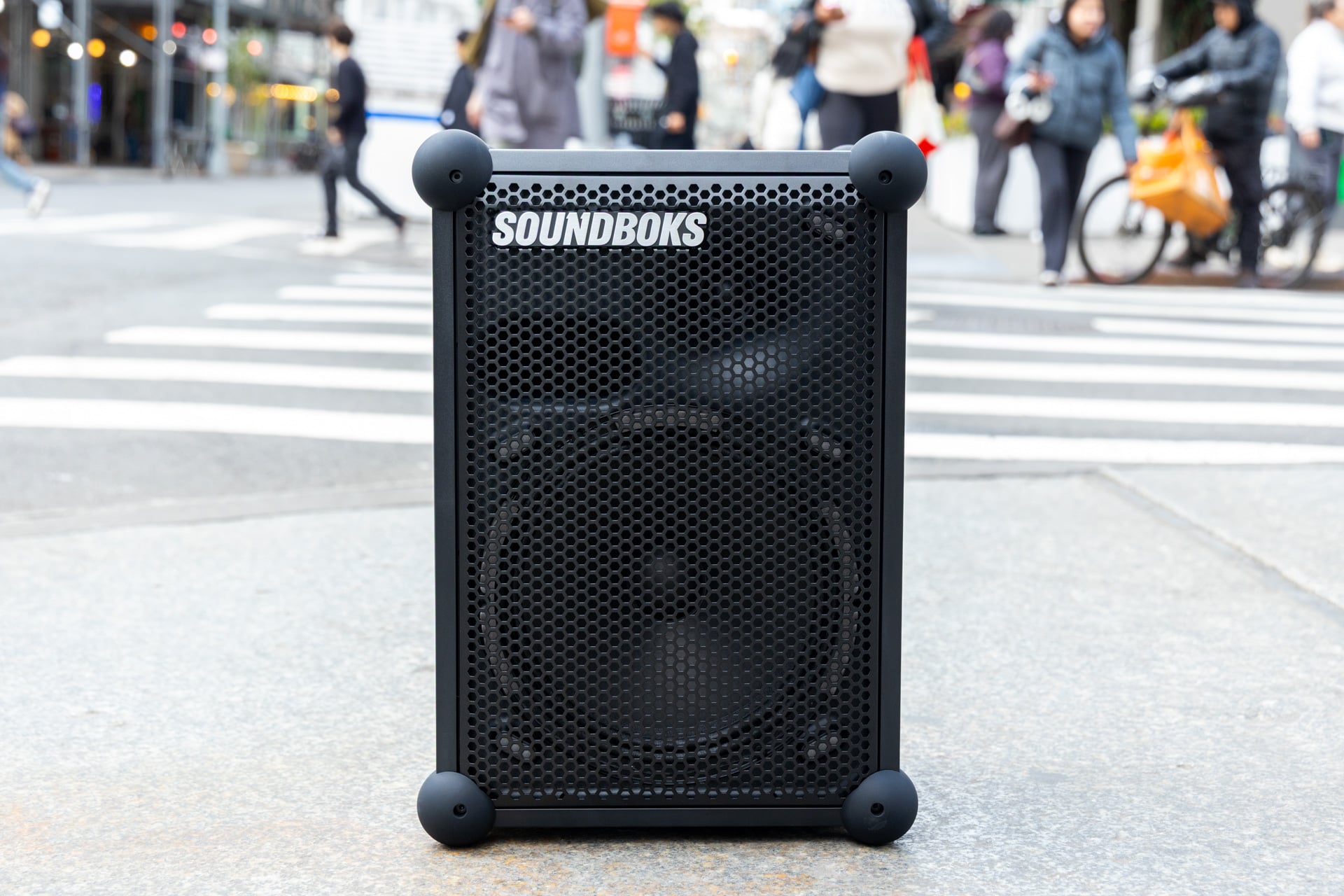
 One thing you’ll be happy to know is that the Soundboks Mix isn’t just loud; it also manages to stave off distortion even at high volumes. Even at 11 out of 11, the Soundboks Mix sounded pretty clear, both from close up and from about 30 feet away. This isn’t the most impressive speaker I’ve heard in the sound department—you’re not getting Sonos outside—but for a party, where people need volume and not necessarily fidelity, it does the trick. I played a few Steely Dan songs at 50% volume and was pleased with the soundstage. There’s a tasteful amount of low end that doesn’t drown out mids and highs. Vocals were clear, and I never felt like I was sorely lacking in any frequency range. Likewise, when I played songs like “Digital Love” by Daft Punk, the bass was present and tangible without overpowering, and auto-tuned vocals didn’t sound tinny or cheap. Using a party speaker outside isn’t the most high-fidelity way to listen to anything, but for what the experience is, I think the Soundboks Mix is pretty solid.

 © Raymond Wong / Gizmodo If you absolutely need more volume and you have the budget, you can also couple the Soundboks Mix with another Soundboks speaker and use them in pairs in stereo mode. I was only sent one speaker for review, so I didn’t get a chance to test that feature out, but I assume it kicks everything up a notch, as celebrity chef Emeril Lagasse would say. Loudness and audio quality aren’t the only things you have to consider when you’re looking at party speaker. You also have to think about rolling joints.

 Portability is friendability If there’s one thing that party speakers aren’t known for, it’s being easy to carry around. To get loud, they have to be big—that’s literally just how physics works. But how big is too big? It’s difficult to strike a balance between giving you enough oomph to really project into a party and enough portability so that you don’t feel like you need to rent an ATV just to drag the speaker down the beach. Having carried the speaker from my office to Washington Square Park, which is about 0.3 miles according to Google Maps, I can say for certain that the experience wasn’t so bad. © Raymond Wong / Gizmodo There’s a built-in handle, which helps, but to be honest, it does weigh 21.4 pounds, so putting all the weight on one hand is a bit much. If you’re moving the Soundboks Mix over longer distances, I would recommend either holding it to your chest like a baby or buying one of Soundboks’ first-party straps that can hook to the speaker, allowing you to sling it over your back. Soundboks didn’t send over a strap for me to try, so I went with the baby method, which was fine, if not ideal. Its portability also helped make me a friend, who asked me to play some music while he rolled joints. I don’t smoke weed because it makes me feel like the world is ending, but my new friend did offer to share, which was a nice gesture. His first sound request was Beyoncé’s “Me, Myself, and I,” which honestly sounded pretty good at full volume.

 The whole thing was kind of heart-warming, really. It’s how I imagine people felt about boomboxes back in the day, when portable ways to play weren’t easy to come by. And I assume the experience is a lot better than it used to be from a convenience standpoint—especially because of the battery. © Raymond Wong / Gizmodo One cool thing about the Soundboks Mix is that it has a removable battery that you can just pull out and top up with USB-C. That also means you can hot swap it if you really need a new battery ASAP, though you’ll have to buy an extra for 0. There’s also an app for convenience, but it’s pretty barebones. © Raymond Wong / Gizmodo I like that you can adjust volume from the Soundboks app as well as EQ—there are presets for indoor and outdoor as well as custom EQ if you’re feeling picky. I’ll be honest, I didn’t hear a huge difference between the outdoor and indoor EQs, but according to the bars, the outdoor EQ brings down the mids just a tad, letting bass and treble take the lead.

 There is, however, a way to get quick battery readings, which is just odd. Soundboks claims that the Mix gets 8 hours of battery at full volume, though it was hard to get a read since the only way to monitor battery life was to use one of the five circular light indicators on the battery itself. You have to press the button and then just go off those increments and vibes. It’s not ideal. I played the Soundboks Mix for an hour at 60% volume, and none of the five circles dropped out, so take that for what you will. © Raymond Wong / Gizmodo Outside of volume adjustment and EQ, you can also turn the Soundboks Mix off through the app and initiate the “TeamUp” feature to pair the Mix with other Soundboks speakers. It’s nice to be able to adjust the volume remotely, but to be honest, the built-in volume dial on the Soundboks mix feels so nice and premium (it’s metal and there’s plenty of resistance) that I didn’t want to adjust the volume any other way. Button-wise, there’s also a power button and a button for the TeamUp feature that allows you to pair speakers together. There’s also a “Bond” button that can cycle through modes when you’re using TeamUp and Bluetooth connections. Lastly, there’s a 3.5mm aux in if that’s your thing.

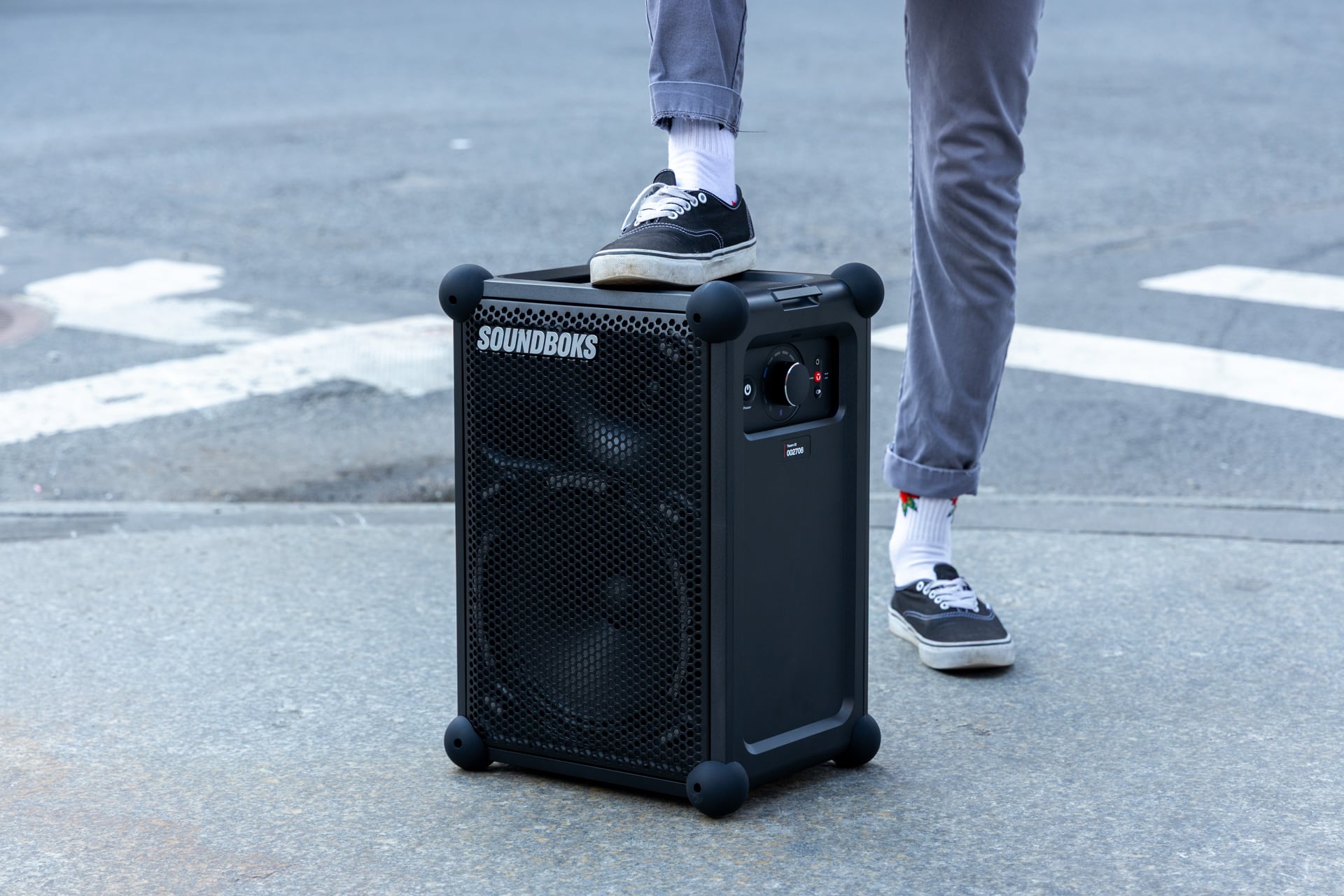
 The Soundboks Mix keeps things pretty simple design-wise, but one nice touch is the inclusion of rubber balls on the bottom of each corner, which makes setting it down feel safe and easy. You also won’t have to worry about the Soundboks Mix getting fried in the rain, either. The speaker is IP65-rated, meaning it’s resistant to dust and water, and if you get caught in the rain, you should be fine. Should you Mix it up? © Raymond Wong / Gizmodo Listen, 0 is a lot of money to spend on a speaker, even if it can get as loud as a chainsaw. This isn’t something that you’re going to want to use all the time, and it certainly isn’t the most versatile speaker in the world, but no party speaker really is. If you’re looking for something that gets loud, sounds good, and can be built out to get even louder and more obnoxious, the Soundboks Mix is not a bad pick. It helps that it’s still somewhat portable despite its loudness, too, so if you plan on hauling this to the beach or something, it’s not an insurmountable task.

 Party speakers aren’t for everyone, but if they’re for you, then the Mix might be a great way to make friends and maybe get a little high on someone else’s supply.        #Soundoks #Mix #Review #LoudAss #Party #Speaker #Highaudio,Reviews,Wireless Speakers
© Raymond Wong / Gizmodo

To test out that volume, I went to Washington Square Park in Manhattan and let loose. The Soundboks Mix is indeed loud, folks. It didn’t quake the Earth upon which we walk or anything like that, but it’s got juice. I tested the party speaker at a range of volumes playing music across different genres—mostly rock, but some electronic music and soul—and the park got an earful. I can’t say for certain, but I’m pretty sure I chased off two guys hitting a volleyball around. You heard it here first: if you hate people playing volleyball, the Soundboks Mix is a repellent.

It’s hard to quantify volume into words, but if I were to try, I would say that the Soundboks Mix is loud enough for a graduation party or a medium-sized quinceañera. It’s not going to bring down the house like a full PA, but if you’re outside within a frisbee distance of the speaker, you’re going to hear it. I also tested the Soundboks Mix briefly at full volume in my office playing Creed’s “One Last Breath,” and it was loud enough to make me feel like we could get kicked out, both for the Creed and the volume.

Soundboks Mix Party Speaker Review
© Raymond Wong / Gizmodo

Maybe I’m masochistic, but I was actually expecting it to be a little louder—maybe I’m just old and have bad hearing, though. I guess it’s good that it isn’t. Permanent hearing loss isn’t high on my list of occupational hazards.

One thing you’ll be happy to know is that the Soundboks Mix isn’t just loud; it also manages to stave off distortion even at high volumes. Even at 11 out of 11, the Soundboks Mix sounded pretty clear, both from close up and from about 30 feet away. This isn’t the most impressive speaker I’ve heard in the sound department—you’re not getting Sonos outside—but for a party, where people need volume and not necessarily fidelity, it does the trick.

I played a few Steely Dan songs at 50% volume and was pleased with the soundstage. There’s a tasteful amount of low end that doesn’t drown out mids and highs. Vocals were clear, and I never felt like I was sorely lacking in any frequency range. Likewise, when I played songs like “Digital Love” by Daft Punk, the bass was present and tangible without overpowering, and auto-tuned vocals didn’t sound tinny or cheap. Using a party speaker outside isn’t the most high-fidelity way to listen to anything, but for what the experience is, I think the Soundboks Mix is pretty solid.

Soundboks Mix Party Speaker Review
© Raymond Wong / Gizmodo

If you absolutely need more volume and you have the budget, you can also couple the Soundboks Mix with another Soundboks speaker and use them in pairs in stereo mode. I was only sent one speaker for review, so I didn’t get a chance to test that feature out, but I assume it kicks everything up a notch, as celebrity chef Emeril Lagasse would say.

Loudness and audio quality aren’t the only things you have to consider when you’re looking at party speaker. You also have to think about rolling joints.

Portability is friendability

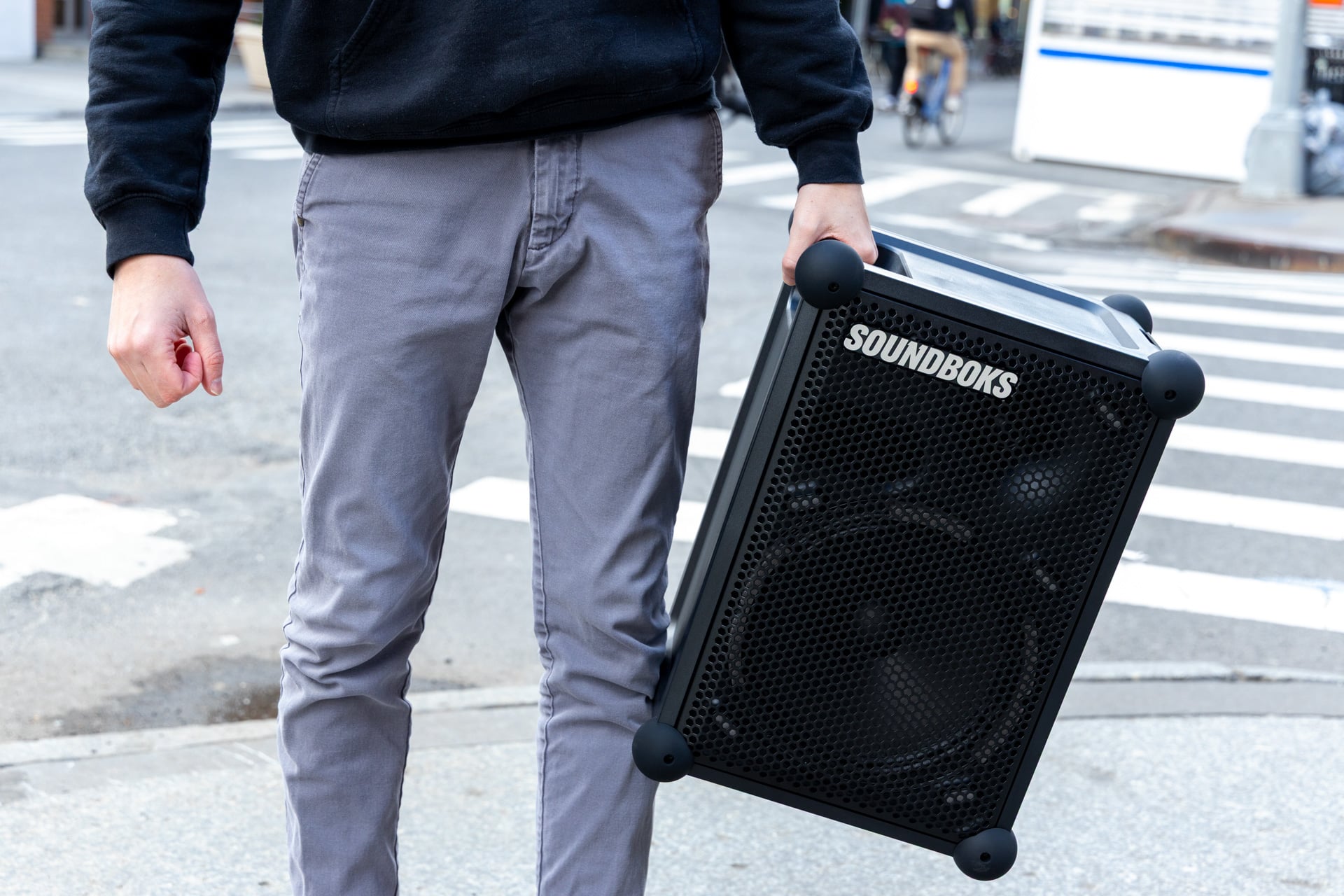
If there’s one thing that party speakers aren’t known for, it’s being easy to carry around. To get loud, they have to be big—that’s literally just how physics works. But how big is too big? It’s difficult to strike a balance between giving you enough oomph to really project into a party and enough portability so that you don’t feel like you need to rent an ATV just to drag the speaker down the beach. Having carried the speaker from my office to Washington Square Park, which is about 0.3 miles according to Google Maps, I can say for certain that the experience wasn’t so bad.

Soundboks Party SpSoundboks Mix Party Speaker Revieweaker Review 04
© Raymond Wong / Gizmodo

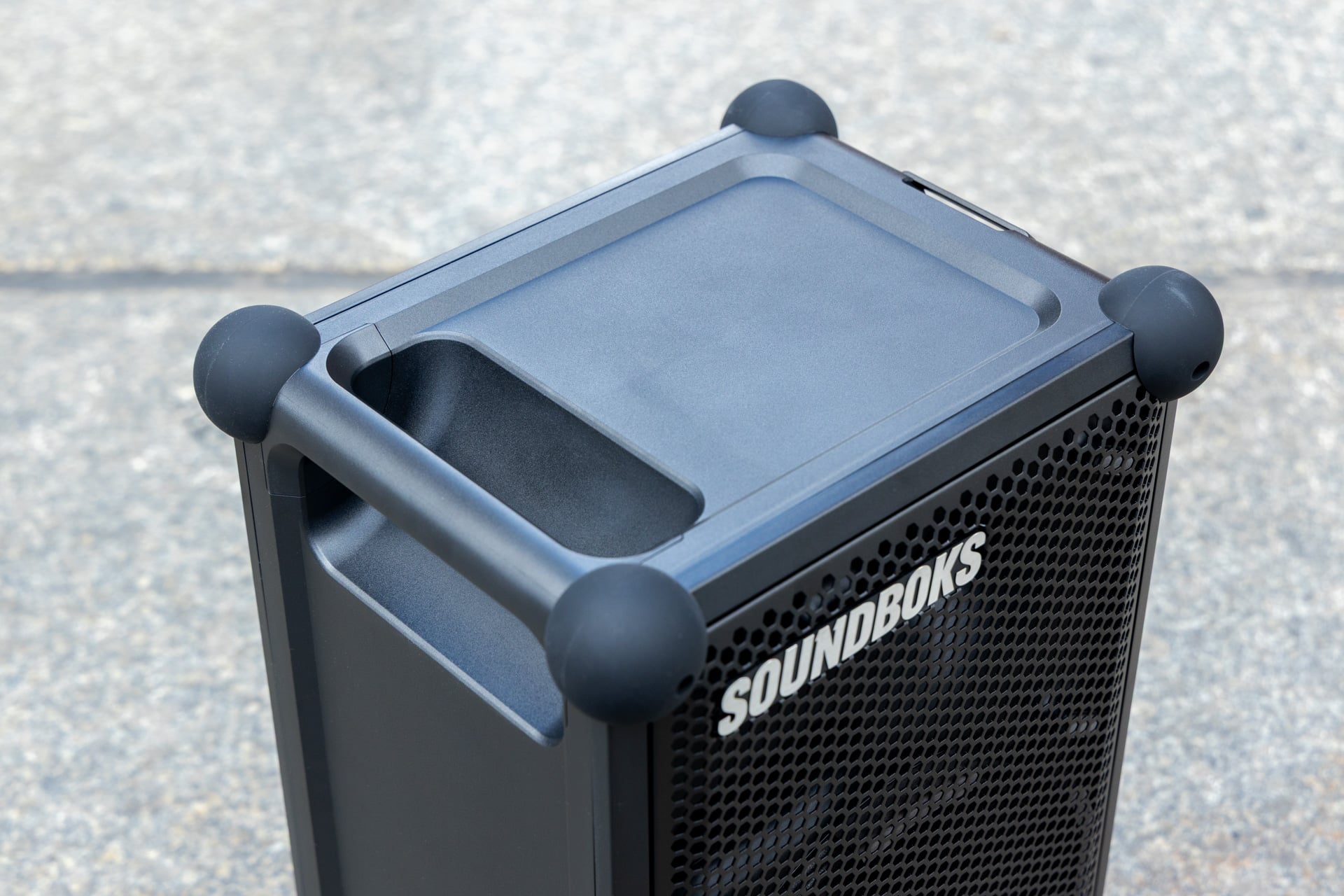
There’s a built-in handle, which helps, but to be honest, it does weigh 21.4 pounds, so putting all the weight on one hand is a bit much. If you’re moving the Soundboks Mix over longer distances, I would recommend either holding it to your chest like a baby or buying one of Soundboks’ first-party straps that can hook to the speaker, allowing you to sling it over your back. Soundboks didn’t send over a strap for me to try, so I went with the baby method, which was fine, if not ideal.

Its portability also helped make me a friend, who asked me to play some music while he rolled joints. I don’t smoke weed because it makes me feel like the world is ending, but my new friend did offer to share, which was a nice gesture. His first sound request was Beyoncé’s “Me, Myself, and I,” which honestly sounded pretty good at full volume.

The whole thing was kind of heart-warming, really. It’s how I imagine people felt about boomboxes back in the day, when portable ways to play weren’t easy to come by. And I assume the experience is a lot better than it used to be from a convenience standpoint—especially because of the battery.

Soundboks Mix Party Speaker Review
© Raymond Wong / Gizmodo

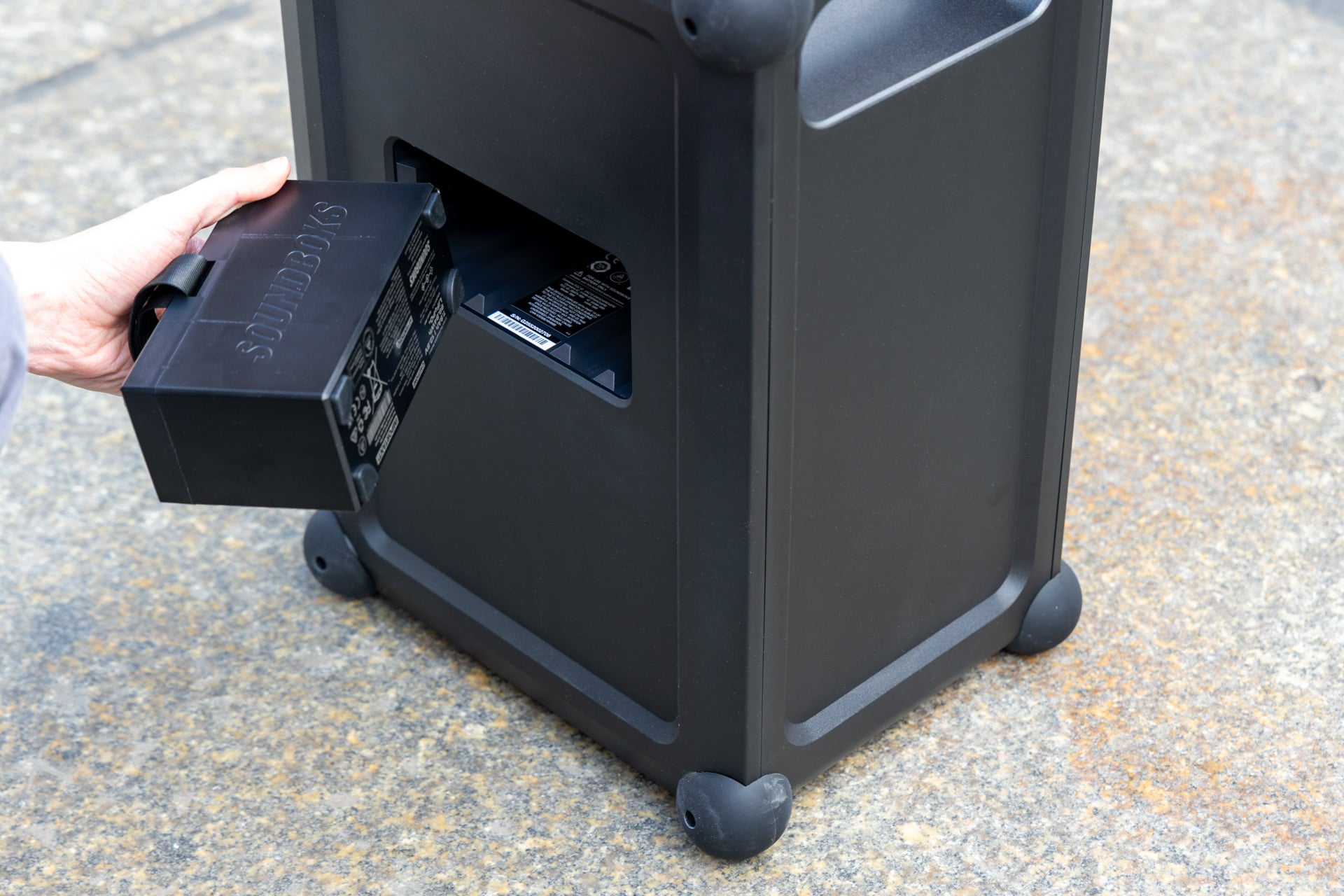
One cool thing about the Soundboks Mix is that it has a removable battery that you can just pull out and top up with USB-C. That also means you can hot swap it if you really need a new battery ASAP, though you’ll have to buy an extra for $150. There’s also an app for convenience, but it’s pretty barebones.

Soundboks Mix Party Speaker Review
© Raymond Wong / Gizmodo

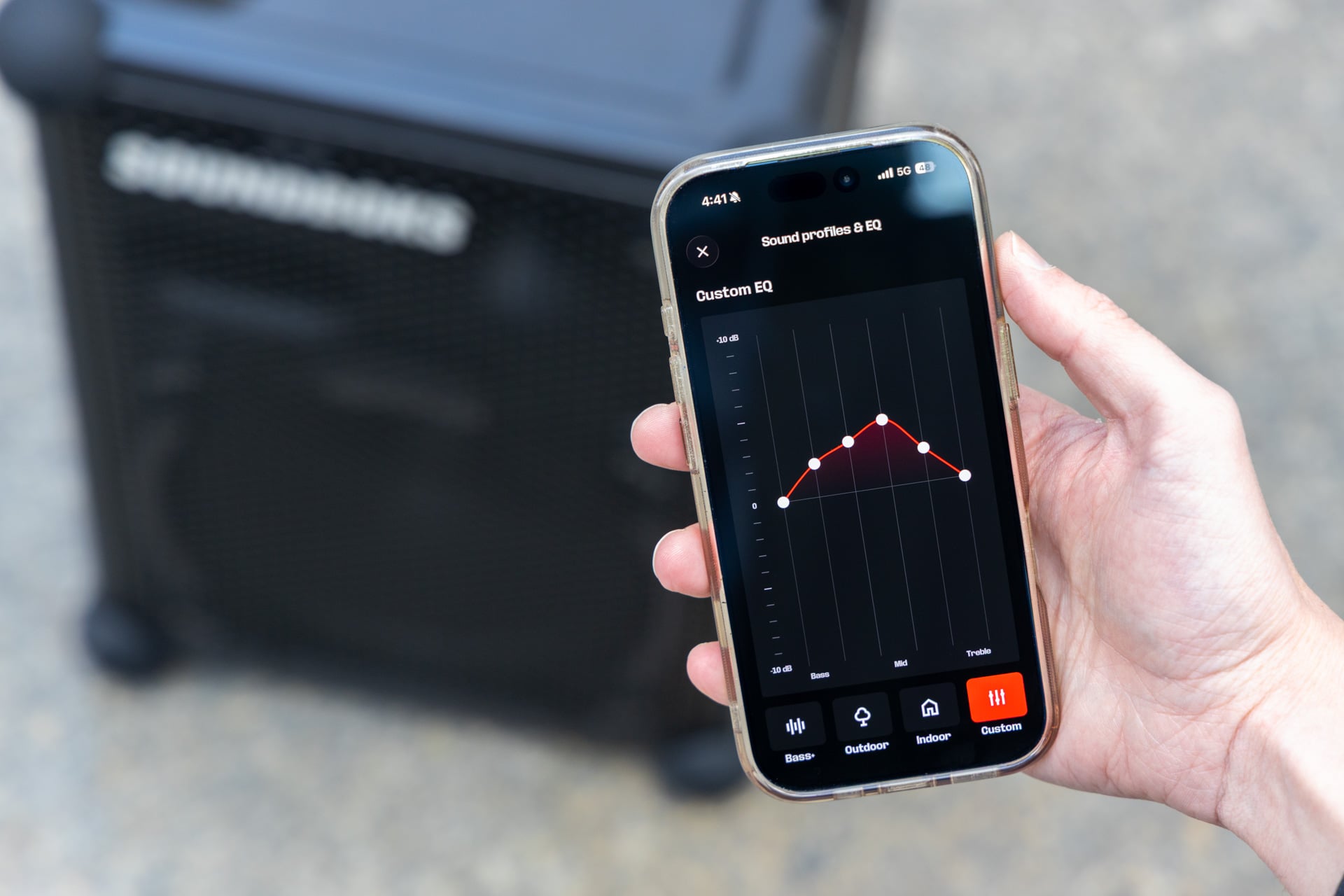
I like that you can adjust volume from the Soundboks app as well as EQ—there are presets for indoor and outdoor as well as custom EQ if you’re feeling picky. I’ll be honest, I didn’t hear a huge difference between the outdoor and indoor EQs, but according to the bars, the outdoor EQ brings down the mids just a tad, letting bass and treble take the lead.

There is, however, a way to get quick battery readings, which is just odd. Soundboks claims that the Mix gets 8 hours of battery at full volume, though it was hard to get a read since the only way to monitor battery life was to use one of the five circular light indicators on the battery itself. You have to press the button and then just go off those increments and vibes. It’s not ideal. I played the Soundboks Mix for an hour at 60% volume, and none of the five circles dropped out, so take that for what you will.

Soundboks Mix Party Speaker Review
© Raymond Wong / Gizmodo

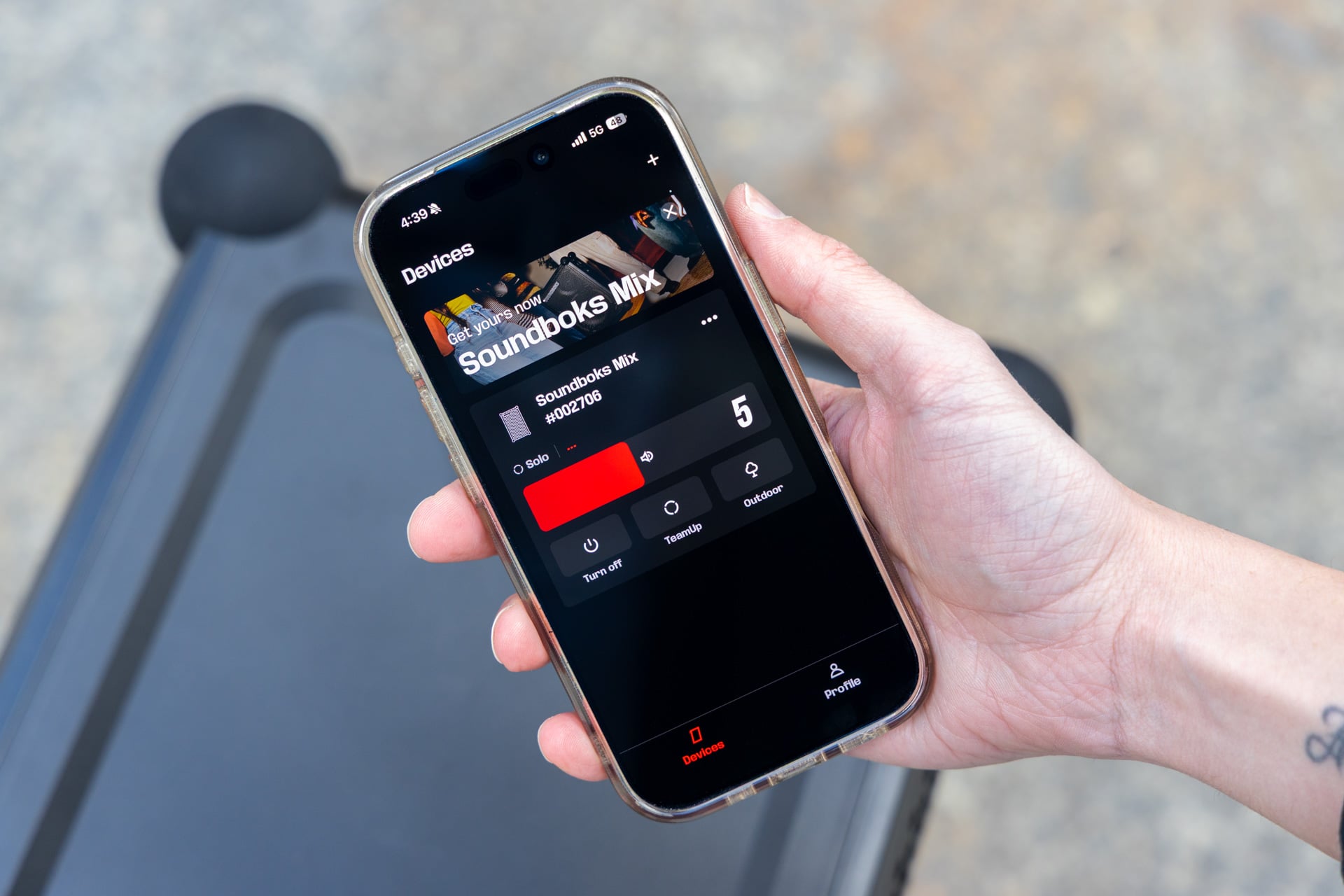
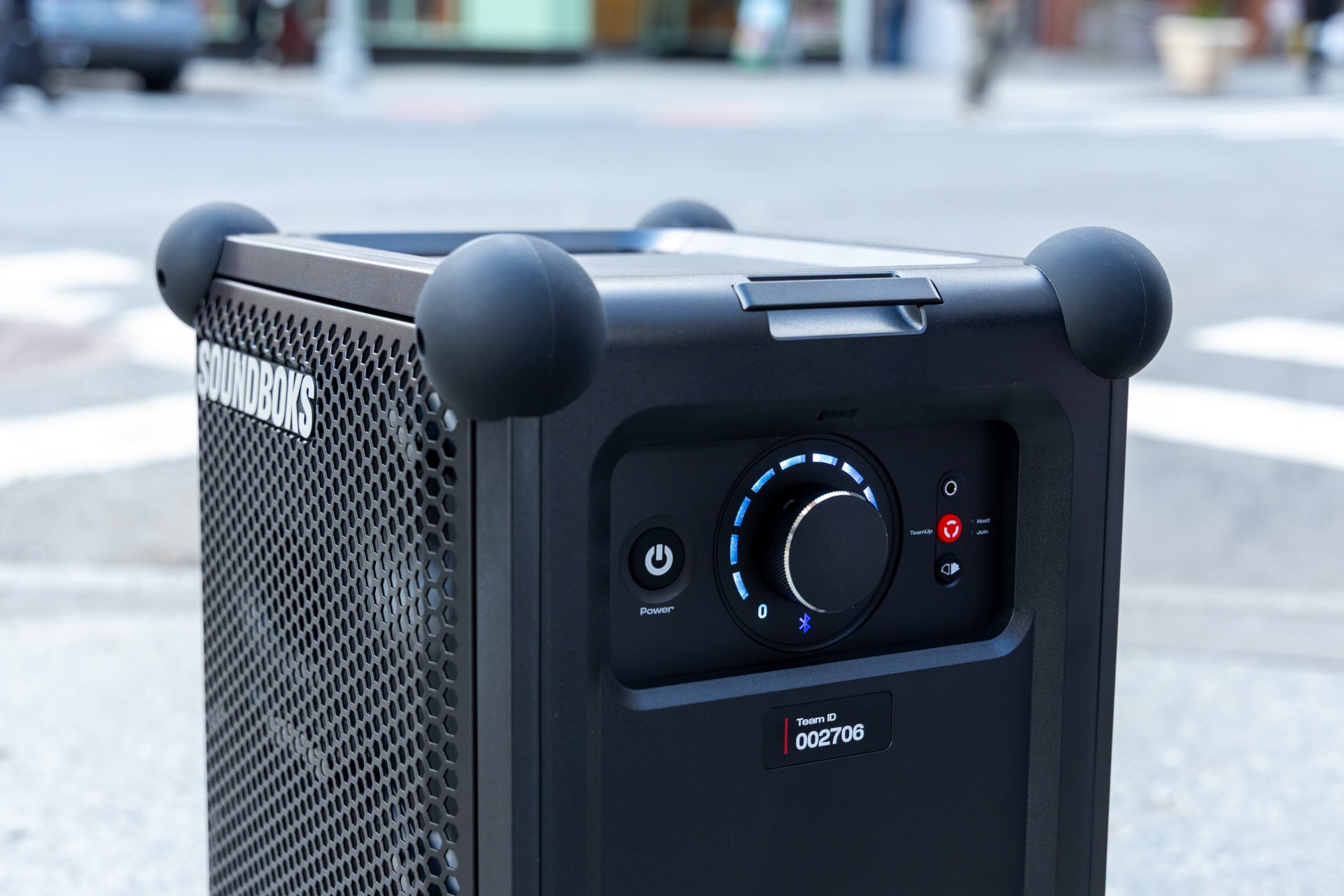
Outside of volume adjustment and EQ, you can also turn the Soundboks Mix off through the app and initiate the “TeamUp” feature to pair the Mix with other Soundboks speakers. It’s nice to be able to adjust the volume remotely, but to be honest, the built-in volume dial on the Soundboks mix feels so nice and premium (it’s metal and there’s plenty of resistance) that I didn’t want to adjust the volume any other way. Button-wise, there’s also a power button and a button for the TeamUp feature that allows you to pair speakers together. There’s also a “Bond” button that can cycle through modes when you’re using TeamUp and Bluetooth connections. Lastly, there’s a 3.5mm aux in if that’s your thing.

The Soundboks Mix keeps things pretty simple design-wise, but one nice touch is the inclusion of rubber balls on the bottom of each corner, which makes setting it down feel safe and easy. You also won’t have to worry about the Soundboks Mix getting fried in the rain, either. The speaker is IP65-rated, meaning it’s resistant to dust and water, and if you get caught in the rain, you should be fine.

Should you Mix it up?

Soundboks Mix Party Speaker Review
© Raymond Wong / Gizmodo

Listen, $800 is a lot of money to spend on a speaker, even if it can get as loud as a chainsaw. This isn’t something that you’re going to want to use all the time, and it certainly isn’t the most versatile speaker in the world, but no party speaker really is. If you’re looking for something that gets loud, sounds good, and can be built out to get even louder and more obnoxious, the Soundboks Mix is not a bad pick. It helps that it’s still somewhat portable despite its loudness, too, so if you plan on hauling this to the beach or something, it’s not an insurmountable task.

Party speakers aren’t for everyone, but if they’re for you, then the Mix might be a great way to make friends and maybe get a little high on someone else’s supply.

#Soundoks #Mix #Review #LoudAss #Party #Speaker #Highaudio,Reviews,Wireless Speakers">Soundoks Mix Review: This Loud-Ass Party Speaker Almost Got Me High AF
                Party speakers aren’t really my thing. It’s not that I don’t like to party—I do. Not in a “friends and family surprise you at your house for a serious talk” kind of way, but in a “mid-30s, I have sh*t to do in the morning” kind of way. Really, I just don’t like to annoy people more than I have to.

 New York City isn’t known for its serenity, but it takes a certain level of decorum to get along, and party speakers, with their inherent obnoxiousness, break a very tenuous code. They’re big (not great for small living spaces), loud (not great for proximate neighbors), and expensive (not great for paying rent on time). They’re, in many ways, antithetical to what most New Yorkers (and other urban-dwelling people) look for in personal audio. They’re also, as I learned in my experience using the 21-pound Soundboks Mix party speaker, actually a great way to make friends.                        Soundboks Mix           The Soundboks Mix is a party speaker that’s loud and portable with decent sound.                                                                                                                                                                                              Loud!                                                                                   Still pretty portable despite its size                                                                                   Sound is pretty good                                                                                                                                                                                                                                                    Sound is good but not great                                                                                   No way to get battery readings from the app                                                                                   Underwhelming EQ options                                                                                   Party speakers are pricey and so is the Soundboks Mix                                                                                                                                      This speaker goes to 11 Party speakers are first and foremost meant for parties, and the 0 Soundbox Mix is no different. Soundboks is known for its Bluetooth speakers and, in particular, for making ones that get ridiculously loud. In case you had any doubt about the loudness, the Soundboks Mix even has a volume dial on the side that goes to 11 instead of 10, Spinal Tap-style.

 © Raymond Wong / Gizmodo To test out that volume, I went to Washington Square Park in Manhattan and let loose. The Soundboks Mix is indeed loud, folks. It didn’t quake the Earth upon which we walk or anything like that, but it’s got juice. I tested the party speaker at a range of volumes playing music across different genres—mostly rock, but some electronic music and soul—and the park got an earful. I can’t say for certain, but I’m pretty sure I chased off two guys hitting a volleyball around. You heard it here first: if you hate people playing volleyball, the Soundboks Mix is a repellent.

 It’s hard to quantify volume into words, but if I were to try, I would say that the Soundboks Mix is loud enough for a graduation party or a medium-sized quinceañera. It’s not going to bring down the house like a full PA, but if you’re outside within a frisbee distance of the speaker, you’re going to hear it. I also tested the Soundboks Mix briefly at full volume in my office playing Creed’s “One Last Breath,” and it was loud enough to make me feel like we could get kicked out, both for the Creed and the volume. © Raymond Wong / Gizmodo Maybe I’m masochistic, but I was actually expecting it to be a little louder—maybe I’m just old and have bad hearing, though. I guess it’s good that it isn’t. Permanent hearing loss isn’t high on my list of occupational hazards.

 One thing you’ll be happy to know is that the Soundboks Mix isn’t just loud; it also manages to stave off distortion even at high volumes. Even at 11 out of 11, the Soundboks Mix sounded pretty clear, both from close up and from about 30 feet away. This isn’t the most impressive speaker I’ve heard in the sound department—you’re not getting Sonos outside—but for a party, where people need volume and not necessarily fidelity, it does the trick. I played a few Steely Dan songs at 50% volume and was pleased with the soundstage. There’s a tasteful amount of low end that doesn’t drown out mids and highs. Vocals were clear, and I never felt like I was sorely lacking in any frequency range. Likewise, when I played songs like “Digital Love” by Daft Punk, the bass was present and tangible without overpowering, and auto-tuned vocals didn’t sound tinny or cheap. Using a party speaker outside isn’t the most high-fidelity way to listen to anything, but for what the experience is, I think the Soundboks Mix is pretty solid.

 © Raymond Wong / Gizmodo If you absolutely need more volume and you have the budget, you can also couple the Soundboks Mix with another Soundboks speaker and use them in pairs in stereo mode. I was only sent one speaker for review, so I didn’t get a chance to test that feature out, but I assume it kicks everything up a notch, as celebrity chef Emeril Lagasse would say. Loudness and audio quality aren’t the only things you have to consider when you’re looking at party speaker. You also have to think about rolling joints.

 Portability is friendability If there’s one thing that party speakers aren’t known for, it’s being easy to carry around. To get loud, they have to be big—that’s literally just how physics works. But how big is too big? It’s difficult to strike a balance between giving you enough oomph to really project into a party and enough portability so that you don’t feel like you need to rent an ATV just to drag the speaker down the beach. Having carried the speaker from my office to Washington Square Park, which is about 0.3 miles according to Google Maps, I can say for certain that the experience wasn’t so bad. © Raymond Wong / Gizmodo There’s a built-in handle, which helps, but to be honest, it does weigh 21.4 pounds, so putting all the weight on one hand is a bit much. If you’re moving the Soundboks Mix over longer distances, I would recommend either holding it to your chest like a baby or buying one of Soundboks’ first-party straps that can hook to the speaker, allowing you to sling it over your back. Soundboks didn’t send over a strap for me to try, so I went with the baby method, which was fine, if not ideal. Its portability also helped make me a friend, who asked me to play some music while he rolled joints. I don’t smoke weed because it makes me feel like the world is ending, but my new friend did offer to share, which was a nice gesture. His first sound request was Beyoncé’s “Me, Myself, and I,” which honestly sounded pretty good at full volume.

 The whole thing was kind of heart-warming, really. It’s how I imagine people felt about boomboxes back in the day, when portable ways to play weren’t easy to come by. And I assume the experience is a lot better than it used to be from a convenience standpoint—especially because of the battery. © Raymond Wong / Gizmodo One cool thing about the Soundboks Mix is that it has a removable battery that you can just pull out and top up with USB-C. That also means you can hot swap it if you really need a new battery ASAP, though you’ll have to buy an extra for 0. There’s also an app for convenience, but it’s pretty barebones. © Raymond Wong / Gizmodo I like that you can adjust volume from the Soundboks app as well as EQ—there are presets for indoor and outdoor as well as custom EQ if you’re feeling picky. I’ll be honest, I didn’t hear a huge difference between the outdoor and indoor EQs, but according to the bars, the outdoor EQ brings down the mids just a tad, letting bass and treble take the lead.

 There is, however, a way to get quick battery readings, which is just odd. Soundboks claims that the Mix gets 8 hours of battery at full volume, though it was hard to get a read since the only way to monitor battery life was to use one of the five circular light indicators on the battery itself. You have to press the button and then just go off those increments and vibes. It’s not ideal. I played the Soundboks Mix for an hour at 60% volume, and none of the five circles dropped out, so take that for what you will. © Raymond Wong / Gizmodo Outside of volume adjustment and EQ, you can also turn the Soundboks Mix off through the app and initiate the “TeamUp” feature to pair the Mix with other Soundboks speakers. It’s nice to be able to adjust the volume remotely, but to be honest, the built-in volume dial on the Soundboks mix feels so nice and premium (it’s metal and there’s plenty of resistance) that I didn’t want to adjust the volume any other way. Button-wise, there’s also a power button and a button for the TeamUp feature that allows you to pair speakers together. There’s also a “Bond” button that can cycle through modes when you’re using TeamUp and Bluetooth connections. Lastly, there’s a 3.5mm aux in if that’s your thing.

 The Soundboks Mix keeps things pretty simple design-wise, but one nice touch is the inclusion of rubber balls on the bottom of each corner, which makes setting it down feel safe and easy. You also won’t have to worry about the Soundboks Mix getting fried in the rain, either. The speaker is IP65-rated, meaning it’s resistant to dust and water, and if you get caught in the rain, you should be fine. Should you Mix it up? © Raymond Wong / Gizmodo Listen, 0 is a lot of money to spend on a speaker, even if it can get as loud as a chainsaw. This isn’t something that you’re going to want to use all the time, and it certainly isn’t the most versatile speaker in the world, but no party speaker really is. If you’re looking for something that gets loud, sounds good, and can be built out to get even louder and more obnoxious, the Soundboks Mix is not a bad pick. It helps that it’s still somewhat portable despite its loudness, too, so if you plan on hauling this to the beach or something, it’s not an insurmountable task.

 Party speakers aren’t for everyone, but if they’re for you, then the Mix might be a great way to make friends and maybe get a little high on someone else’s supply.        #Soundoks #Mix #Review #LoudAss #Party #Speaker #Highaudio,Reviews,Wireless Speakers

party speaker, actually a great way to make friends.


Soundboks Mix

The Soundboks Mix is a party speaker that’s loud and portable with decent sound.

  • Loud!
  • Still pretty portable despite its size
  • Sound is pretty good
  • Sound is good but not great
  • No way to get battery readings from the app
  • Underwhelming EQ options
  • Party speakers are pricey and so is the Soundboks Mix

This speaker goes to 11

Party speakers are first and foremost meant for parties, and the $800 Soundbox Mix is no different. Soundboks is known for its Bluetooth speakers and, in particular, for making ones that get ridiculously loud. In case you had any doubt about the loudness, the Soundboks Mix even has a volume dial on the side that goes to 11 instead of 10, Spinal Tap-style.

Soundoks Mix Review: This Loud-Ass Party Speaker Almost Got Me High AF
                Party speakers aren’t really my thing. It’s not that I don’t like to party—I do. Not in a “friends and family surprise you at your house for a serious talk” kind of way, but in a “mid-30s, I have sh*t to do in the morning” kind of way. Really, I just don’t like to annoy people more than I have to.

 New York City isn’t known for its serenity, but it takes a certain level of decorum to get along, and party speakers, with their inherent obnoxiousness, break a very tenuous code. They’re big (not great for small living spaces), loud (not great for proximate neighbors), and expensive (not great for paying rent on time). They’re, in many ways, antithetical to what most New Yorkers (and other urban-dwelling people) look for in personal audio. They’re also, as I learned in my experience using the 21-pound Soundboks Mix party speaker, actually a great way to make friends.                        Soundboks Mix           The Soundboks Mix is a party speaker that’s loud and portable with decent sound.                                                                                                                                                                                              Loud!                                                                                   Still pretty portable despite its size                                                                                   Sound is pretty good                                                                                                                                                                                                                                                    Sound is good but not great                                                                                   No way to get battery readings from the app                                                                                   Underwhelming EQ options                                                                                   Party speakers are pricey and so is the Soundboks Mix                                                                                                                                      This speaker goes to 11 Party speakers are first and foremost meant for parties, and the 0 Soundbox Mix is no different. Soundboks is known for its Bluetooth speakers and, in particular, for making ones that get ridiculously loud. In case you had any doubt about the loudness, the Soundboks Mix even has a volume dial on the side that goes to 11 instead of 10, Spinal Tap-style.

 © Raymond Wong / Gizmodo To test out that volume, I went to Washington Square Park in Manhattan and let loose. The Soundboks Mix is indeed loud, folks. It didn’t quake the Earth upon which we walk or anything like that, but it’s got juice. I tested the party speaker at a range of volumes playing music across different genres—mostly rock, but some electronic music and soul—and the park got an earful. I can’t say for certain, but I’m pretty sure I chased off two guys hitting a volleyball around. You heard it here first: if you hate people playing volleyball, the Soundboks Mix is a repellent.

 It’s hard to quantify volume into words, but if I were to try, I would say that the Soundboks Mix is loud enough for a graduation party or a medium-sized quinceañera. It’s not going to bring down the house like a full PA, but if you’re outside within a frisbee distance of the speaker, you’re going to hear it. I also tested the Soundboks Mix briefly at full volume in my office playing Creed’s “One Last Breath,” and it was loud enough to make me feel like we could get kicked out, both for the Creed and the volume. © Raymond Wong / Gizmodo Maybe I’m masochistic, but I was actually expecting it to be a little louder—maybe I’m just old and have bad hearing, though. I guess it’s good that it isn’t. Permanent hearing loss isn’t high on my list of occupational hazards.

 One thing you’ll be happy to know is that the Soundboks Mix isn’t just loud; it also manages to stave off distortion even at high volumes. Even at 11 out of 11, the Soundboks Mix sounded pretty clear, both from close up and from about 30 feet away. This isn’t the most impressive speaker I’ve heard in the sound department—you’re not getting Sonos outside—but for a party, where people need volume and not necessarily fidelity, it does the trick. I played a few Steely Dan songs at 50% volume and was pleased with the soundstage. There’s a tasteful amount of low end that doesn’t drown out mids and highs. Vocals were clear, and I never felt like I was sorely lacking in any frequency range. Likewise, when I played songs like “Digital Love” by Daft Punk, the bass was present and tangible without overpowering, and auto-tuned vocals didn’t sound tinny or cheap. Using a party speaker outside isn’t the most high-fidelity way to listen to anything, but for what the experience is, I think the Soundboks Mix is pretty solid.

 © Raymond Wong / Gizmodo If you absolutely need more volume and you have the budget, you can also couple the Soundboks Mix with another Soundboks speaker and use them in pairs in stereo mode. I was only sent one speaker for review, so I didn’t get a chance to test that feature out, but I assume it kicks everything up a notch, as celebrity chef Emeril Lagasse would say. Loudness and audio quality aren’t the only things you have to consider when you’re looking at party speaker. You also have to think about rolling joints.

 Portability is friendability If there’s one thing that party speakers aren’t known for, it’s being easy to carry around. To get loud, they have to be big—that’s literally just how physics works. But how big is too big? It’s difficult to strike a balance between giving you enough oomph to really project into a party and enough portability so that you don’t feel like you need to rent an ATV just to drag the speaker down the beach. Having carried the speaker from my office to Washington Square Park, which is about 0.3 miles according to Google Maps, I can say for certain that the experience wasn’t so bad. © Raymond Wong / Gizmodo There’s a built-in handle, which helps, but to be honest, it does weigh 21.4 pounds, so putting all the weight on one hand is a bit much. If you’re moving the Soundboks Mix over longer distances, I would recommend either holding it to your chest like a baby or buying one of Soundboks’ first-party straps that can hook to the speaker, allowing you to sling it over your back. Soundboks didn’t send over a strap for me to try, so I went with the baby method, which was fine, if not ideal. Its portability also helped make me a friend, who asked me to play some music while he rolled joints. I don’t smoke weed because it makes me feel like the world is ending, but my new friend did offer to share, which was a nice gesture. His first sound request was Beyoncé’s “Me, Myself, and I,” which honestly sounded pretty good at full volume.

 The whole thing was kind of heart-warming, really. It’s how I imagine people felt about boomboxes back in the day, when portable ways to play weren’t easy to come by. And I assume the experience is a lot better than it used to be from a convenience standpoint—especially because of the battery. © Raymond Wong / Gizmodo One cool thing about the Soundboks Mix is that it has a removable battery that you can just pull out and top up with USB-C. That also means you can hot swap it if you really need a new battery ASAP, though you’ll have to buy an extra for 0. There’s also an app for convenience, but it’s pretty barebones. © Raymond Wong / Gizmodo I like that you can adjust volume from the Soundboks app as well as EQ—there are presets for indoor and outdoor as well as custom EQ if you’re feeling picky. I’ll be honest, I didn’t hear a huge difference between the outdoor and indoor EQs, but according to the bars, the outdoor EQ brings down the mids just a tad, letting bass and treble take the lead.

 There is, however, a way to get quick battery readings, which is just odd. Soundboks claims that the Mix gets 8 hours of battery at full volume, though it was hard to get a read since the only way to monitor battery life was to use one of the five circular light indicators on the battery itself. You have to press the button and then just go off those increments and vibes. It’s not ideal. I played the Soundboks Mix for an hour at 60% volume, and none of the five circles dropped out, so take that for what you will. © Raymond Wong / Gizmodo Outside of volume adjustment and EQ, you can also turn the Soundboks Mix off through the app and initiate the “TeamUp” feature to pair the Mix with other Soundboks speakers. It’s nice to be able to adjust the volume remotely, but to be honest, the built-in volume dial on the Soundboks mix feels so nice and premium (it’s metal and there’s plenty of resistance) that I didn’t want to adjust the volume any other way. Button-wise, there’s also a power button and a button for the TeamUp feature that allows you to pair speakers together. There’s also a “Bond” button that can cycle through modes when you’re using TeamUp and Bluetooth connections. Lastly, there’s a 3.5mm aux in if that’s your thing.

 The Soundboks Mix keeps things pretty simple design-wise, but one nice touch is the inclusion of rubber balls on the bottom of each corner, which makes setting it down feel safe and easy. You also won’t have to worry about the Soundboks Mix getting fried in the rain, either. The speaker is IP65-rated, meaning it’s resistant to dust and water, and if you get caught in the rain, you should be fine. Should you Mix it up? © Raymond Wong / Gizmodo Listen, 0 is a lot of money to spend on a speaker, even if it can get as loud as a chainsaw. This isn’t something that you’re going to want to use all the time, and it certainly isn’t the most versatile speaker in the world, but no party speaker really is. If you’re looking for something that gets loud, sounds good, and can be built out to get even louder and more obnoxious, the Soundboks Mix is not a bad pick. It helps that it’s still somewhat portable despite its loudness, too, so if you plan on hauling this to the beach or something, it’s not an insurmountable task.

 Party speakers aren’t for everyone, but if they’re for you, then the Mix might be a great way to make friends and maybe get a little high on someone else’s supply.        #Soundoks #Mix #Review #LoudAss #Party #Speaker #Highaudio,Reviews,Wireless Speakers
© Raymond Wong / Gizmodo

To test out that volume, I went to Washington Square Park in Manhattan and let loose. The Soundboks Mix is indeed loud, folks. It didn’t quake the Earth upon which we walk or anything like that, but it’s got juice. I tested the party speaker at a range of volumes playing music across different genres—mostly rock, but some electronic music and soul—and the park got an earful. I can’t say for certain, but I’m pretty sure I chased off two guys hitting a volleyball around. You heard it here first: if you hate people playing volleyball, the Soundboks Mix is a repellent.

It’s hard to quantify volume into words, but if I were to try, I would say that the Soundboks Mix is loud enough for a graduation party or a medium-sized quinceañera. It’s not going to bring down the house like a full PA, but if you’re outside within a frisbee distance of the speaker, you’re going to hear it. I also tested the Soundboks Mix briefly at full volume in my office playing Creed’s “One Last Breath,” and it was loud enough to make me feel like we could get kicked out, both for the Creed and the volume.

Soundboks Mix Party Speaker Review
© Raymond Wong / Gizmodo

Maybe I’m masochistic, but I was actually expecting it to be a little louder—maybe I’m just old and have bad hearing, though. I guess it’s good that it isn’t. Permanent hearing loss isn’t high on my list of occupational hazards.

One thing you’ll be happy to know is that the Soundboks Mix isn’t just loud; it also manages to stave off distortion even at high volumes. Even at 11 out of 11, the Soundboks Mix sounded pretty clear, both from close up and from about 30 feet away. This isn’t the most impressive speaker I’ve heard in the sound department—you’re not getting Sonos outside—but for a party, where people need volume and not necessarily fidelity, it does the trick.

I played a few Steely Dan songs at 50% volume and was pleased with the soundstage. There’s a tasteful amount of low end that doesn’t drown out mids and highs. Vocals were clear, and I never felt like I was sorely lacking in any frequency range. Likewise, when I played songs like “Digital Love” by Daft Punk, the bass was present and tangible without overpowering, and auto-tuned vocals didn’t sound tinny or cheap. Using a party speaker outside isn’t the most high-fidelity way to listen to anything, but for what the experience is, I think the Soundboks Mix is pretty solid.

Soundboks Mix Party Speaker Review
© Raymond Wong / Gizmodo

If you absolutely need more volume and you have the budget, you can also couple the Soundboks Mix with another Soundboks speaker and use them in pairs in stereo mode. I was only sent one speaker for review, so I didn’t get a chance to test that feature out, but I assume it kicks everything up a notch, as celebrity chef Emeril Lagasse would say.

Loudness and audio quality aren’t the only things you have to consider when you’re looking at party speaker. You also have to think about rolling joints.

Portability is friendability

If there’s one thing that party speakers aren’t known for, it’s being easy to carry around. To get loud, they have to be big—that’s literally just how physics works. But how big is too big? It’s difficult to strike a balance between giving you enough oomph to really project into a party and enough portability so that you don’t feel like you need to rent an ATV just to drag the speaker down the beach. Having carried the speaker from my office to Washington Square Park, which is about 0.3 miles according to Google Maps, I can say for certain that the experience wasn’t so bad.

Soundboks Party SpSoundboks Mix Party Speaker Revieweaker Review 04
© Raymond Wong / Gizmodo

There’s a built-in handle, which helps, but to be honest, it does weigh 21.4 pounds, so putting all the weight on one hand is a bit much. If you’re moving the Soundboks Mix over longer distances, I would recommend either holding it to your chest like a baby or buying one of Soundboks’ first-party straps that can hook to the speaker, allowing you to sling it over your back. Soundboks didn’t send over a strap for me to try, so I went with the baby method, which was fine, if not ideal.

Its portability also helped make me a friend, who asked me to play some music while he rolled joints. I don’t smoke weed because it makes me feel like the world is ending, but my new friend did offer to share, which was a nice gesture. His first sound request was Beyoncé’s “Me, Myself, and I,” which honestly sounded pretty good at full volume.

The whole thing was kind of heart-warming, really. It’s how I imagine people felt about boomboxes back in the day, when portable ways to play weren’t easy to come by. And I assume the experience is a lot better than it used to be from a convenience standpoint—especially because of the battery.

Soundboks Mix Party Speaker Review
© Raymond Wong / Gizmodo

One cool thing about the Soundboks Mix is that it has a removable battery that you can just pull out and top up with USB-C. That also means you can hot swap it if you really need a new battery ASAP, though you’ll have to buy an extra for $150. There’s also an app for convenience, but it’s pretty barebones.

Soundboks Mix Party Speaker Review
© Raymond Wong / Gizmodo

I like that you can adjust volume from the Soundboks app as well as EQ—there are presets for indoor and outdoor as well as custom EQ if you’re feeling picky. I’ll be honest, I didn’t hear a huge difference between the outdoor and indoor EQs, but according to the bars, the outdoor EQ brings down the mids just a tad, letting bass and treble take the lead.

There is, however, a way to get quick battery readings, which is just odd. Soundboks claims that the Mix gets 8 hours of battery at full volume, though it was hard to get a read since the only way to monitor battery life was to use one of the five circular light indicators on the battery itself. You have to press the button and then just go off those increments and vibes. It’s not ideal. I played the Soundboks Mix for an hour at 60% volume, and none of the five circles dropped out, so take that for what you will.

Soundboks Mix Party Speaker Review
© Raymond Wong / Gizmodo

Outside of volume adjustment and EQ, you can also turn the Soundboks Mix off through the app and initiate the “TeamUp” feature to pair the Mix with other Soundboks speakers. It’s nice to be able to adjust the volume remotely, but to be honest, the built-in volume dial on the Soundboks mix feels so nice and premium (it’s metal and there’s plenty of resistance) that I didn’t want to adjust the volume any other way. Button-wise, there’s also a power button and a button for the TeamUp feature that allows you to pair speakers together. There’s also a “Bond” button that can cycle through modes when you’re using TeamUp and Bluetooth connections. Lastly, there’s a 3.5mm aux in if that’s your thing.

The Soundboks Mix keeps things pretty simple design-wise, but one nice touch is the inclusion of rubber balls on the bottom of each corner, which makes setting it down feel safe and easy. You also won’t have to worry about the Soundboks Mix getting fried in the rain, either. The speaker is IP65-rated, meaning it’s resistant to dust and water, and if you get caught in the rain, you should be fine.

Should you Mix it up?

Soundboks Mix Party Speaker Review
© Raymond Wong / Gizmodo

Listen, $800 is a lot of money to spend on a speaker, even if it can get as loud as a chainsaw. This isn’t something that you’re going to want to use all the time, and it certainly isn’t the most versatile speaker in the world, but no party speaker really is. If you’re looking for something that gets loud, sounds good, and can be built out to get even louder and more obnoxious, the Soundboks Mix is not a bad pick. It helps that it’s still somewhat portable despite its loudness, too, so if you plan on hauling this to the beach or something, it’s not an insurmountable task.

Party speakers aren’t for everyone, but if they’re for you, then the Mix might be a great way to make friends and maybe get a little high on someone else’s supply.

#Soundoks #Mix #Review #LoudAss #Party #Speaker #Highaudio,Reviews,Wireless Speakers">Soundoks Mix Review: This Loud-Ass Party Speaker Almost Got Me High AF

Party speakers aren’t really my thing. It’s not that I don’t like to party—I do. Not in a “friends and family surprise you at your house for a serious talk” kind of way, but in a “mid-30s, I have sh*t to do in the morning” kind of way. Really, I just don’t like to annoy people more than I have to.

New York City isn’t known for its serenity, but it takes a certain level of decorum to get along, and party speakers, with their inherent obnoxiousness, break a very tenuous code. They’re big (not great for small living spaces), loud (not great for proximate neighbors), and expensive (not great for paying rent on time). They’re, in many ways, antithetical to what most New Yorkers (and other urban-dwelling people) look for in personal audio.

They’re also, as I learned in my experience using the 21-pound Soundboks Mix party speaker, actually a great way to make friends.


Soundboks Mix

The Soundboks Mix is a party speaker that’s loud and portable with decent sound.

  • Loud!
  • Still pretty portable despite its size
  • Sound is pretty good
  • Sound is good but not great
  • No way to get battery readings from the app
  • Underwhelming EQ options
  • Party speakers are pricey and so is the Soundboks Mix

This speaker goes to 11

Party speakers are first and foremost meant for parties, and the $800 Soundbox Mix is no different. Soundboks is known for its Bluetooth speakers and, in particular, for making ones that get ridiculously loud. In case you had any doubt about the loudness, the Soundboks Mix even has a volume dial on the side that goes to 11 instead of 10, Spinal Tap-style.

Soundoks Mix Review: This Loud-Ass Party Speaker Almost Got Me High AF
                Party speakers aren’t really my thing. It’s not that I don’t like to party—I do. Not in a “friends and family surprise you at your house for a serious talk” kind of way, but in a “mid-30s, I have sh*t to do in the morning” kind of way. Really, I just don’t like to annoy people more than I have to.

 New York City isn’t known for its serenity, but it takes a certain level of decorum to get along, and party speakers, with their inherent obnoxiousness, break a very tenuous code. They’re big (not great for small living spaces), loud (not great for proximate neighbors), and expensive (not great for paying rent on time). They’re, in many ways, antithetical to what most New Yorkers (and other urban-dwelling people) look for in personal audio. They’re also, as I learned in my experience using the 21-pound Soundboks Mix party speaker, actually a great way to make friends.                        Soundboks Mix           The Soundboks Mix is a party speaker that’s loud and portable with decent sound.                                                                                                                                                                                              Loud!                                                                                   Still pretty portable despite its size                                                                                   Sound is pretty good                                                                                                                                                                                                                                                    Sound is good but not great                                                                                   No way to get battery readings from the app                                                                                   Underwhelming EQ options                                                                                   Party speakers are pricey and so is the Soundboks Mix                                                                                                                                      This speaker goes to 11 Party speakers are first and foremost meant for parties, and the 0 Soundbox Mix is no different. Soundboks is known for its Bluetooth speakers and, in particular, for making ones that get ridiculously loud. In case you had any doubt about the loudness, the Soundboks Mix even has a volume dial on the side that goes to 11 instead of 10, Spinal Tap-style.

 © Raymond Wong / Gizmodo To test out that volume, I went to Washington Square Park in Manhattan and let loose. The Soundboks Mix is indeed loud, folks. It didn’t quake the Earth upon which we walk or anything like that, but it’s got juice. I tested the party speaker at a range of volumes playing music across different genres—mostly rock, but some electronic music and soul—and the park got an earful. I can’t say for certain, but I’m pretty sure I chased off two guys hitting a volleyball around. You heard it here first: if you hate people playing volleyball, the Soundboks Mix is a repellent.

 It’s hard to quantify volume into words, but if I were to try, I would say that the Soundboks Mix is loud enough for a graduation party or a medium-sized quinceañera. It’s not going to bring down the house like a full PA, but if you’re outside within a frisbee distance of the speaker, you’re going to hear it. I also tested the Soundboks Mix briefly at full volume in my office playing Creed’s “One Last Breath,” and it was loud enough to make me feel like we could get kicked out, both for the Creed and the volume. © Raymond Wong / Gizmodo Maybe I’m masochistic, but I was actually expecting it to be a little louder—maybe I’m just old and have bad hearing, though. I guess it’s good that it isn’t. Permanent hearing loss isn’t high on my list of occupational hazards.

 One thing you’ll be happy to know is that the Soundboks Mix isn’t just loud; it also manages to stave off distortion even at high volumes. Even at 11 out of 11, the Soundboks Mix sounded pretty clear, both from close up and from about 30 feet away. This isn’t the most impressive speaker I’ve heard in the sound department—you’re not getting Sonos outside—but for a party, where people need volume and not necessarily fidelity, it does the trick. I played a few Steely Dan songs at 50% volume and was pleased with the soundstage. There’s a tasteful amount of low end that doesn’t drown out mids and highs. Vocals were clear, and I never felt like I was sorely lacking in any frequency range. Likewise, when I played songs like “Digital Love” by Daft Punk, the bass was present and tangible without overpowering, and auto-tuned vocals didn’t sound tinny or cheap. Using a party speaker outside isn’t the most high-fidelity way to listen to anything, but for what the experience is, I think the Soundboks Mix is pretty solid.

 © Raymond Wong / Gizmodo If you absolutely need more volume and you have the budget, you can also couple the Soundboks Mix with another Soundboks speaker and use them in pairs in stereo mode. I was only sent one speaker for review, so I didn’t get a chance to test that feature out, but I assume it kicks everything up a notch, as celebrity chef Emeril Lagasse would say. Loudness and audio quality aren’t the only things you have to consider when you’re looking at party speaker. You also have to think about rolling joints.

 Portability is friendability If there’s one thing that party speakers aren’t known for, it’s being easy to carry around. To get loud, they have to be big—that’s literally just how physics works. But how big is too big? It’s difficult to strike a balance between giving you enough oomph to really project into a party and enough portability so that you don’t feel like you need to rent an ATV just to drag the speaker down the beach. Having carried the speaker from my office to Washington Square Park, which is about 0.3 miles according to Google Maps, I can say for certain that the experience wasn’t so bad. © Raymond Wong / Gizmodo There’s a built-in handle, which helps, but to be honest, it does weigh 21.4 pounds, so putting all the weight on one hand is a bit much. If you’re moving the Soundboks Mix over longer distances, I would recommend either holding it to your chest like a baby or buying one of Soundboks’ first-party straps that can hook to the speaker, allowing you to sling it over your back. Soundboks didn’t send over a strap for me to try, so I went with the baby method, which was fine, if not ideal. Its portability also helped make me a friend, who asked me to play some music while he rolled joints. I don’t smoke weed because it makes me feel like the world is ending, but my new friend did offer to share, which was a nice gesture. His first sound request was Beyoncé’s “Me, Myself, and I,” which honestly sounded pretty good at full volume.

 The whole thing was kind of heart-warming, really. It’s how I imagine people felt about boomboxes back in the day, when portable ways to play weren’t easy to come by. And I assume the experience is a lot better than it used to be from a convenience standpoint—especially because of the battery. © Raymond Wong / Gizmodo One cool thing about the Soundboks Mix is that it has a removable battery that you can just pull out and top up with USB-C. That also means you can hot swap it if you really need a new battery ASAP, though you’ll have to buy an extra for 0. There’s also an app for convenience, but it’s pretty barebones. © Raymond Wong / Gizmodo I like that you can adjust volume from the Soundboks app as well as EQ—there are presets for indoor and outdoor as well as custom EQ if you’re feeling picky. I’ll be honest, I didn’t hear a huge difference between the outdoor and indoor EQs, but according to the bars, the outdoor EQ brings down the mids just a tad, letting bass and treble take the lead.

 There is, however, a way to get quick battery readings, which is just odd. Soundboks claims that the Mix gets 8 hours of battery at full volume, though it was hard to get a read since the only way to monitor battery life was to use one of the five circular light indicators on the battery itself. You have to press the button and then just go off those increments and vibes. It’s not ideal. I played the Soundboks Mix for an hour at 60% volume, and none of the five circles dropped out, so take that for what you will. © Raymond Wong / Gizmodo Outside of volume adjustment and EQ, you can also turn the Soundboks Mix off through the app and initiate the “TeamUp” feature to pair the Mix with other Soundboks speakers. It’s nice to be able to adjust the volume remotely, but to be honest, the built-in volume dial on the Soundboks mix feels so nice and premium (it’s metal and there’s plenty of resistance) that I didn’t want to adjust the volume any other way. Button-wise, there’s also a power button and a button for the TeamUp feature that allows you to pair speakers together. There’s also a “Bond” button that can cycle through modes when you’re using TeamUp and Bluetooth connections. Lastly, there’s a 3.5mm aux in if that’s your thing.

 The Soundboks Mix keeps things pretty simple design-wise, but one nice touch is the inclusion of rubber balls on the bottom of each corner, which makes setting it down feel safe and easy. You also won’t have to worry about the Soundboks Mix getting fried in the rain, either. The speaker is IP65-rated, meaning it’s resistant to dust and water, and if you get caught in the rain, you should be fine. Should you Mix it up? © Raymond Wong / Gizmodo Listen, 0 is a lot of money to spend on a speaker, even if it can get as loud as a chainsaw. This isn’t something that you’re going to want to use all the time, and it certainly isn’t the most versatile speaker in the world, but no party speaker really is. If you’re looking for something that gets loud, sounds good, and can be built out to get even louder and more obnoxious, the Soundboks Mix is not a bad pick. It helps that it’s still somewhat portable despite its loudness, too, so if you plan on hauling this to the beach or something, it’s not an insurmountable task.

 Party speakers aren’t for everyone, but if they’re for you, then the Mix might be a great way to make friends and maybe get a little high on someone else’s supply.        #Soundoks #Mix #Review #LoudAss #Party #Speaker #Highaudio,Reviews,Wireless Speakers
© Raymond Wong / Gizmodo

To test out that volume, I went to Washington Square Park in Manhattan and let loose. The Soundboks Mix is indeed loud, folks. It didn’t quake the Earth upon which we walk or anything like that, but it’s got juice. I tested the party speaker at a range of volumes playing music across different genres—mostly rock, but some electronic music and soul—and the park got an earful. I can’t say for certain, but I’m pretty sure I chased off two guys hitting a volleyball around. You heard it here first: if you hate people playing volleyball, the Soundboks Mix is a repellent.

It’s hard to quantify volume into words, but if I were to try, I would say that the Soundboks Mix is loud enough for a graduation party or a medium-sized quinceañera. It’s not going to bring down the house like a full PA, but if you’re outside within a frisbee distance of the speaker, you’re going to hear it. I also tested the Soundboks Mix briefly at full volume in my office playing Creed’s “One Last Breath,” and it was loud enough to make me feel like we could get kicked out, both for the Creed and the volume.

Soundboks Mix Party Speaker Review
© Raymond Wong / Gizmodo

Maybe I’m masochistic, but I was actually expecting it to be a little louder—maybe I’m just old and have bad hearing, though. I guess it’s good that it isn’t. Permanent hearing loss isn’t high on my list of occupational hazards.

One thing you’ll be happy to know is that the Soundboks Mix isn’t just loud; it also manages to stave off distortion even at high volumes. Even at 11 out of 11, the Soundboks Mix sounded pretty clear, both from close up and from about 30 feet away. This isn’t the most impressive speaker I’ve heard in the sound department—you’re not getting Sonos outside—but for a party, where people need volume and not necessarily fidelity, it does the trick.

I played a few Steely Dan songs at 50% volume and was pleased with the soundstage. There’s a tasteful amount of low end that doesn’t drown out mids and highs. Vocals were clear, and I never felt like I was sorely lacking in any frequency range. Likewise, when I played songs like “Digital Love” by Daft Punk, the bass was present and tangible without overpowering, and auto-tuned vocals didn’t sound tinny or cheap. Using a party speaker outside isn’t the most high-fidelity way to listen to anything, but for what the experience is, I think the Soundboks Mix is pretty solid.

Soundboks Mix Party Speaker Review
© Raymond Wong / Gizmodo

If you absolutely need more volume and you have the budget, you can also couple the Soundboks Mix with another Soundboks speaker and use them in pairs in stereo mode. I was only sent one speaker for review, so I didn’t get a chance to test that feature out, but I assume it kicks everything up a notch, as celebrity chef Emeril Lagasse would say.

Loudness and audio quality aren’t the only things you have to consider when you’re looking at party speaker. You also have to think about rolling joints.

Portability is friendability

If there’s one thing that party speakers aren’t known for, it’s being easy to carry around. To get loud, they have to be big—that’s literally just how physics works. But how big is too big? It’s difficult to strike a balance between giving you enough oomph to really project into a party and enough portability so that you don’t feel like you need to rent an ATV just to drag the speaker down the beach. Having carried the speaker from my office to Washington Square Park, which is about 0.3 miles according to Google Maps, I can say for certain that the experience wasn’t so bad.

Soundboks Party SpSoundboks Mix Party Speaker Revieweaker Review 04
© Raymond Wong / Gizmodo

There’s a built-in handle, which helps, but to be honest, it does weigh 21.4 pounds, so putting all the weight on one hand is a bit much. If you’re moving the Soundboks Mix over longer distances, I would recommend either holding it to your chest like a baby or buying one of Soundboks’ first-party straps that can hook to the speaker, allowing you to sling it over your back. Soundboks didn’t send over a strap for me to try, so I went with the baby method, which was fine, if not ideal.

Its portability also helped make me a friend, who asked me to play some music while he rolled joints. I don’t smoke weed because it makes me feel like the world is ending, but my new friend did offer to share, which was a nice gesture. His first sound request was Beyoncé’s “Me, Myself, and I,” which honestly sounded pretty good at full volume.

The whole thing was kind of heart-warming, really. It’s how I imagine people felt about boomboxes back in the day, when portable ways to play weren’t easy to come by. And I assume the experience is a lot better than it used to be from a convenience standpoint—especially because of the battery.

Soundboks Mix Party Speaker Review
© Raymond Wong / Gizmodo

One cool thing about the Soundboks Mix is that it has a removable battery that you can just pull out and top up with USB-C. That also means you can hot swap it if you really need a new battery ASAP, though you’ll have to buy an extra for $150. There’s also an app for convenience, but it’s pretty barebones.

Soundboks Mix Party Speaker Review
© Raymond Wong / Gizmodo

I like that you can adjust volume from the Soundboks app as well as EQ—there are presets for indoor and outdoor as well as custom EQ if you’re feeling picky. I’ll be honest, I didn’t hear a huge difference between the outdoor and indoor EQs, but according to the bars, the outdoor EQ brings down the mids just a tad, letting bass and treble take the lead.

There is, however, a way to get quick battery readings, which is just odd. Soundboks claims that the Mix gets 8 hours of battery at full volume, though it was hard to get a read since the only way to monitor battery life was to use one of the five circular light indicators on the battery itself. You have to press the button and then just go off those increments and vibes. It’s not ideal. I played the Soundboks Mix for an hour at 60% volume, and none of the five circles dropped out, so take that for what you will.

Soundboks Mix Party Speaker Review
© Raymond Wong / Gizmodo

Outside of volume adjustment and EQ, you can also turn the Soundboks Mix off through the app and initiate the “TeamUp” feature to pair the Mix with other Soundboks speakers. It’s nice to be able to adjust the volume remotely, but to be honest, the built-in volume dial on the Soundboks mix feels so nice and premium (it’s metal and there’s plenty of resistance) that I didn’t want to adjust the volume any other way. Button-wise, there’s also a power button and a button for the TeamUp feature that allows you to pair speakers together. There’s also a “Bond” button that can cycle through modes when you’re using TeamUp and Bluetooth connections. Lastly, there’s a 3.5mm aux in if that’s your thing.

The Soundboks Mix keeps things pretty simple design-wise, but one nice touch is the inclusion of rubber balls on the bottom of each corner, which makes setting it down feel safe and easy. You also won’t have to worry about the Soundboks Mix getting fried in the rain, either. The speaker is IP65-rated, meaning it’s resistant to dust and water, and if you get caught in the rain, you should be fine.

Should you Mix it up?

Soundboks Mix Party Speaker Review
© Raymond Wong / Gizmodo

Listen, $800 is a lot of money to spend on a speaker, even if it can get as loud as a chainsaw. This isn’t something that you’re going to want to use all the time, and it certainly isn’t the most versatile speaker in the world, but no party speaker really is. If you’re looking for something that gets loud, sounds good, and can be built out to get even louder and more obnoxious, the Soundboks Mix is not a bad pick. It helps that it’s still somewhat portable despite its loudness, too, so if you plan on hauling this to the beach or something, it’s not an insurmountable task.

Party speakers aren’t for everyone, but if they’re for you, then the Mix might be a great way to make friends and maybe get a little high on someone else’s supply.

#Soundoks #Mix #Review #LoudAss #Party #Speaker #Highaudio,Reviews,Wireless Speakers
Lego-style propaganda videos alleging war crimes are flooding online feeds, echoing the White House’s own turn toward cryptic teaser clips and meme-native visuals. This is not just content drift. It is a new front in the information war, one where speed, ambiguity, and algorithmic reach matter as much as accuracy.

One Iran-linked outlet, Explosive News, can reportedly turn around a two-minute synthetic Lego segment in about 24 hours. The speed is the point. Synthetic media does not need to hold up forever; it only needs to travel before verification catches up.

Last month, the White House added to that confusion when it posted two vague “launching soon” videos, then removed them after online investigators and open source researchers began dissecting them.

The reveal turned out to be anticlimactic: a promotional push for the official White House app. But the episode demonstrated how thoroughly official communication has absorbed the aesthetics of leaks, virality, and platform-native intrigue. Even when official accounts adopt the aesthetics of a leak, questioning whether a record is real or synthetic is the only defensive move left.

Real vs. Synthetic: The New Friction

A zero digital footprint used to signal authenticity. Now, it can signal the opposite. The absence of a trail no longer means something is original—it may mean it was never captured by a lens at all. The signal has inverted. Truth lags; engagement leads.

Automated traffic now commands an estimated 51 percent of internet activity, scaling eight times faster than human traffic according to the 2026 State of AI Traffic & Cyberthreat Benchmark Report. These systems don’t just distribute content, they prioritize low-quality virality, ensuring the synthetic record travels while verification is still catching up.

Open source investigators are still holding the line, but they are fighting a volume war. The rise of hyperactive “super sharers,” often backed by paid verification, adds a layer of false authority that traditional open source intelligence (OSINT) now has to navigate.

“We’re perpetually catching up to someone pressing repost without a second thought,” says Maryam Ishani, an OSINT journalist covering the conflict. “The algorithm prioritizes that reflex, and our information is always going to be one step behind.”

At the same time, the surge of war-monitoring accounts is beginning to interfere with reporting itself. Manisha Ganguly, visual forensics lead at The Guardian and an OSINT specialist investigating war crimes, points to the false certainty created by the flood of aggregated content on Telegram and X.

“Open source verification starts to create false certainty when it stops being a method of inquiry—through confirmation bias, or when OSINT is used to cosmetically validate official accounts or knowingly misapplied to align with ideological narratives rather than interrogate them,” Ganguly says.

While this plays out, the verification toolkit itself is becoming harder to access. On April 4, Planet Labs—one of the most relied-upon commercial satellite providers for conflict journalism—announced it would indefinitely withhold imagery of Iran and the broader Middle East conflict zone, retroactive to March 9, following a request from the US government.

The response from US defense secretary Pete Hegseth to concerns about the delay was unambiguous: “Open source is not the place to determine what did or did not happen.”

That shift matters. When access to primary visual evidence is restricted, the ability to independently verify events narrows. And in that narrowing gap, something else expands: Generative AI doesn’t just fill the silence—it competes to define what’s seen in the first place.

Generative AI Is Getting Harder to Spot

Generative AI platforms have been learning from their mistakes. Henk van Ess, an investigative trainer and verification specialist, says many of the classic tells—incorrect finger counts, garbled protest signs, distorted text—have largely been fixed in the latest generation of models. Tools like Imagen 3, Midjourney, and Dall·E have improved in prompt understanding, photorealism, and text-in-image rendering.

But the harder problem is what van Ess calls the hybrid.

#Internet #Broke #Everyones #Bullshit #Detectorspropaganda,artificial intelligence,open source,satellite images,iran,war,politics">How the Internet Broke Everyone’s Bullshit DetectorsLego-style propaganda videos alleging war crimes are flooding online feeds, echoing the White House’s own turn toward cryptic teaser clips and meme-native visuals. This is not just content drift. It is a new front in the information war, one where speed, ambiguity, and algorithmic reach matter as much as accuracy.One Iran-linked outlet, Explosive News, can reportedly turn around a two-minute synthetic Lego segment in about 24 hours. The speed is the point. Synthetic media does not need to hold up forever; it only needs to travel before verification catches up.Last month, the White House added to that confusion when it posted two vague “launching soon” videos, then removed them after online investigators and open source researchers began dissecting them.The reveal turned out to be anticlimactic: a promotional push for the official White House app. But the episode demonstrated how thoroughly official communication has absorbed the aesthetics of leaks, virality, and platform-native intrigue. Even when official accounts adopt the aesthetics of a leak, questioning whether a record is real or synthetic is the only defensive move left.Real vs. Synthetic: The New FrictionA zero digital footprint used to signal authenticity. Now, it can signal the opposite. The absence of a trail no longer means something is original—it may mean it was never captured by a lens at all. The signal has inverted. Truth lags; engagement leads.Automated traffic now commands an estimated 51 percent of internet activity, scaling eight times faster than human traffic according to the 2026 State of AI Traffic & Cyberthreat Benchmark Report. These systems don’t just distribute content, they prioritize low-quality virality, ensuring the synthetic record travels while verification is still catching up.Open source investigators are still holding the line, but they are fighting a volume war. The rise of hyperactive “super sharers,” often backed by paid verification, adds a layer of false authority that traditional open source intelligence (OSINT) now has to navigate.“We’re perpetually catching up to someone pressing repost without a second thought,” says Maryam Ishani, an OSINT journalist covering the conflict. “The algorithm prioritizes that reflex, and our information is always going to be one step behind.”At the same time, the surge of war-monitoring accounts is beginning to interfere with reporting itself. Manisha Ganguly, visual forensics lead at The Guardian and an OSINT specialist investigating war crimes, points to the false certainty created by the flood of aggregated content on Telegram and X.“Open source verification starts to create false certainty when it stops being a method of inquiry—through confirmation bias, or when OSINT is used to cosmetically validate official accounts or knowingly misapplied to align with ideological narratives rather than interrogate them,” Ganguly says.While this plays out, the verification toolkit itself is becoming harder to access. On April 4, Planet Labs—one of the most relied-upon commercial satellite providers for conflict journalism—announced it would indefinitely withhold imagery of Iran and the broader Middle East conflict zone, retroactive to March 9, following a request from the US government.The response from US defense secretary Pete Hegseth to concerns about the delay was unambiguous: “Open source is not the place to determine what did or did not happen.”That shift matters. When access to primary visual evidence is restricted, the ability to independently verify events narrows. And in that narrowing gap, something else expands: Generative AI doesn’t just fill the silence—it competes to define what’s seen in the first place.Generative AI Is Getting Harder to SpotGenerative AI platforms have been learning from their mistakes. Henk van Ess, an investigative trainer and verification specialist, says many of the classic tells—incorrect finger counts, garbled protest signs, distorted text—have largely been fixed in the latest generation of models. Tools like Imagen 3, Midjourney, and Dall·E have improved in prompt understanding, photorealism, and text-in-image rendering.But the harder problem is what van Ess calls the hybrid.#Internet #Broke #Everyones #Bullshit #Detectorspropaganda,artificial intelligence,open source,satellite images,iran,war,politics

flooding online feeds, echoing the White House’s own turn toward cryptic teaser clips and meme-native visuals. This is not just content drift. It is a new front in the information war, one where speed, ambiguity, and algorithmic reach matter as much as accuracy.

One Iran-linked outlet, Explosive News, can reportedly turn around a two-minute synthetic Lego segment in about 24 hours. The speed is the point. Synthetic media does not need to hold up forever; it only needs to travel before verification catches up.

Last month, the White House added to that confusion when it posted two vague “launching soon” videos, then removed them after online investigators and open source researchers began dissecting them.

The reveal turned out to be anticlimactic: a promotional push for the official White House app. But the episode demonstrated how thoroughly official communication has absorbed the aesthetics of leaks, virality, and platform-native intrigue. Even when official accounts adopt the aesthetics of a leak, questioning whether a record is real or synthetic is the only defensive move left.

Real vs. Synthetic: The New Friction

A zero digital footprint used to signal authenticity. Now, it can signal the opposite. The absence of a trail no longer means something is original—it may mean it was never captured by a lens at all. The signal has inverted. Truth lags; engagement leads.

Automated traffic now commands an estimated 51 percent of internet activity, scaling eight times faster than human traffic according to the 2026 State of AI Traffic & Cyberthreat Benchmark Report. These systems don’t just distribute content, they prioritize low-quality virality, ensuring the synthetic record travels while verification is still catching up.

Open source investigators are still holding the line, but they are fighting a volume war. The rise of hyperactive “super sharers,” often backed by paid verification, adds a layer of false authority that traditional open source intelligence (OSINT) now has to navigate.

“We’re perpetually catching up to someone pressing repost without a second thought,” says Maryam Ishani, an OSINT journalist covering the conflict. “The algorithm prioritizes that reflex, and our information is always going to be one step behind.”

At the same time, the surge of war-monitoring accounts is beginning to interfere with reporting itself. Manisha Ganguly, visual forensics lead at The Guardian and an OSINT specialist investigating war crimes, points to the false certainty created by the flood of aggregated content on Telegram and X.

“Open source verification starts to create false certainty when it stops being a method of inquiry—through confirmation bias, or when OSINT is used to cosmetically validate official accounts or knowingly misapplied to align with ideological narratives rather than interrogate them,” Ganguly says.

While this plays out, the verification toolkit itself is becoming harder to access. On April 4, Planet Labs—one of the most relied-upon commercial satellite providers for conflict journalism—announced it would indefinitely withhold imagery of Iran and the broader Middle East conflict zone, retroactive to March 9, following a request from the US government.

The response from US defense secretary Pete Hegseth to concerns about the delay was unambiguous: “Open source is not the place to determine what did or did not happen.”

That shift matters. When access to primary visual evidence is restricted, the ability to independently verify events narrows. And in that narrowing gap, something else expands: Generative AI doesn’t just fill the silence—it competes to define what’s seen in the first place.

Generative AI Is Getting Harder to Spot

Generative AI platforms have been learning from their mistakes. Henk van Ess, an investigative trainer and verification specialist, says many of the classic tells—incorrect finger counts, garbled protest signs, distorted text—have largely been fixed in the latest generation of models. Tools like Imagen 3, Midjourney, and Dall·E have improved in prompt understanding, photorealism, and text-in-image rendering.

But the harder problem is what van Ess calls the hybrid.

#Internet #Broke #Everyones #Bullshit #Detectorspropaganda,artificial intelligence,open source,satellite images,iran,war,politics">How the Internet Broke Everyone’s Bullshit Detectors

Lego-style propaganda videos alleging war crimes are flooding online feeds, echoing the White House’s own turn toward cryptic teaser clips and meme-native visuals. This is not just content drift. It is a new front in the information war, one where speed, ambiguity, and algorithmic reach matter as much as accuracy.

One Iran-linked outlet, Explosive News, can reportedly turn around a two-minute synthetic Lego segment in about 24 hours. The speed is the point. Synthetic media does not need to hold up forever; it only needs to travel before verification catches up.

Last month, the White House added to that confusion when it posted two vague “launching soon” videos, then removed them after online investigators and open source researchers began dissecting them.

The reveal turned out to be anticlimactic: a promotional push for the official White House app. But the episode demonstrated how thoroughly official communication has absorbed the aesthetics of leaks, virality, and platform-native intrigue. Even when official accounts adopt the aesthetics of a leak, questioning whether a record is real or synthetic is the only defensive move left.

Real vs. Synthetic: The New Friction

A zero digital footprint used to signal authenticity. Now, it can signal the opposite. The absence of a trail no longer means something is original—it may mean it was never captured by a lens at all. The signal has inverted. Truth lags; engagement leads.

Automated traffic now commands an estimated 51 percent of internet activity, scaling eight times faster than human traffic according to the 2026 State of AI Traffic & Cyberthreat Benchmark Report. These systems don’t just distribute content, they prioritize low-quality virality, ensuring the synthetic record travels while verification is still catching up.

Open source investigators are still holding the line, but they are fighting a volume war. The rise of hyperactive “super sharers,” often backed by paid verification, adds a layer of false authority that traditional open source intelligence (OSINT) now has to navigate.

“We’re perpetually catching up to someone pressing repost without a second thought,” says Maryam Ishani, an OSINT journalist covering the conflict. “The algorithm prioritizes that reflex, and our information is always going to be one step behind.”

At the same time, the surge of war-monitoring accounts is beginning to interfere with reporting itself. Manisha Ganguly, visual forensics lead at The Guardian and an OSINT specialist investigating war crimes, points to the false certainty created by the flood of aggregated content on Telegram and X.

“Open source verification starts to create false certainty when it stops being a method of inquiry—through confirmation bias, or when OSINT is used to cosmetically validate official accounts or knowingly misapplied to align with ideological narratives rather than interrogate them,” Ganguly says.

While this plays out, the verification toolkit itself is becoming harder to access. On April 4, Planet Labs—one of the most relied-upon commercial satellite providers for conflict journalism—announced it would indefinitely withhold imagery of Iran and the broader Middle East conflict zone, retroactive to March 9, following a request from the US government.

The response from US defense secretary Pete Hegseth to concerns about the delay was unambiguous: “Open source is not the place to determine what did or did not happen.”

That shift matters. When access to primary visual evidence is restricted, the ability to independently verify events narrows. And in that narrowing gap, something else expands: Generative AI doesn’t just fill the silence—it competes to define what’s seen in the first place.

Generative AI Is Getting Harder to Spot

Generative AI platforms have been learning from their mistakes. Henk van Ess, an investigative trainer and verification specialist, says many of the classic tells—incorrect finger counts, garbled protest signs, distorted text—have largely been fixed in the latest generation of models. Tools like Imagen 3, Midjourney, and Dall·E have improved in prompt understanding, photorealism, and text-in-image rendering.

But the harder problem is what van Ess calls the hybrid.

#Internet #Broke #Everyones #Bullshit #Detectorspropaganda,artificial intelligence,open source,satellite images,iran,war,politics

Post Comment