

×
  • In a quiet street in northern Singapore, a car plies the road like any other – except it is a left-hand drive from China and the person in the driver’s seat has been trained to keep his hands off the wheel and his foot off the pedals unless an emergency arises.

    Eventually, there will be no need for a safety officer or any human behind the wheel at all – mirroring the autonomous vehicles (AVs) already operating in cities such as Beijing, Shenzhen, San Francisco and Los Angeles.

    For now, Singapore is in the early stages of rolling out AVs, specifically robotaxis, to the public.

    Jeffrey Siow, the acting transport minister, said last September that the country aimed to have around 100 to 150 of these vehicles on the road by the end of this year.

    Major ride-hailing companies Grab and ComfortDelGro were given the green light to collaborate with leading Chinese AV manufacturers WeRide and Pony.ai, respectively, to test and deploy shuttle taxi services on public roads in Punggol.

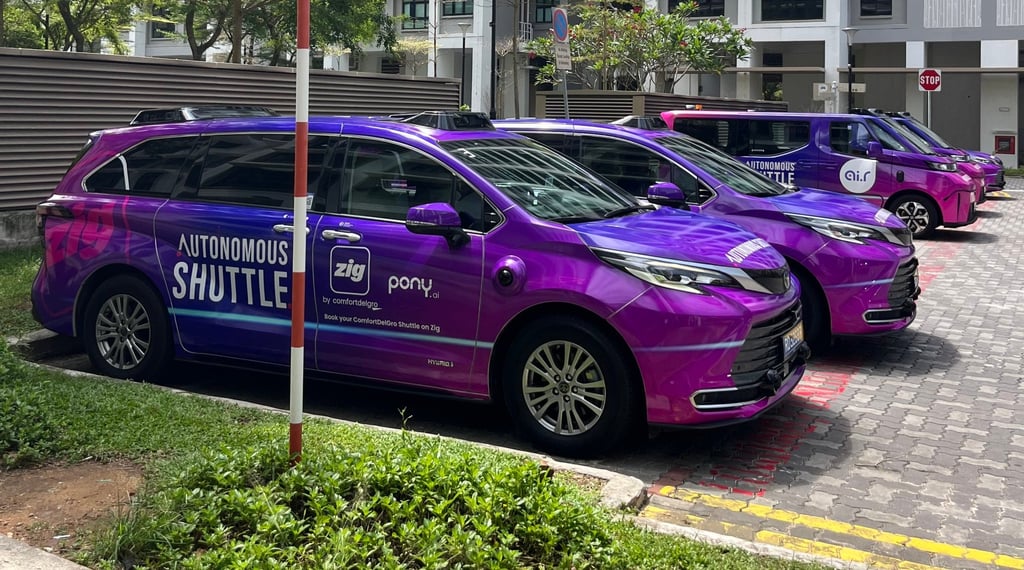
    A fleet of robotaxis is seen parked outside a building in Punggol, Singapore. Photo: Jean Iau
    A fleet of robotaxis is seen parked outside a building in Punggol, Singapore. Photo: Jean Iau

    Chinese AV companies are industry leaders, experts say, and are keen to show that their vehicles can operate in international markets – despite profitability concerns, as most are still in the start-up phase and rely heavily on investments.

    #Singapores #robotaxi #drive #revs #Chinese #leadersSouth China Morning Post, News, Opinion, China, Hong Kong, World, US, Asia, Business, Economy, Technology, Lifestyle, Sport">
    Singapore’s robotaxi drive revs up with help from Chinese AV leadersIn a quiet street in northern Singapore, a car plies the road like any other – except it is a left-hand drive from China and the person in the driver’s seat has been trained to keep his hands off the wheel and his foot off the pedals unless an emergency arises.Eventually, there will be no need for a safety officer or any human behind the wheel at all – mirroring the autonomous vehicles (AVs) already operating in cities such as Beijing, Shenzhen, San Francisco and Los Angeles.For now, Singapore is in the early stages of rolling out AVs, specifically robotaxis, to the public.Jeffrey Siow, the acting transport minister, said last September that the country aimed to have around 100 to 150 of these vehicles on the road by the end of this year.Major ride-hailing companies Grab and ComfortDelGro were given the green light to collaborate with leading Chinese AV manufacturers WeRide and Pony.ai, respectively, to test and deploy shuttle taxi services on public roads in Punggol.A fleet of robotaxis is seen parked outside a building in Punggol, Singapore. Photo: Jean IauChinese AV companies are industry leaders, experts say, and are keen to show that their vehicles can operate in international markets – despite profitability concerns, as most are still in the start-up phase and rely heavily on investments.#Singapores #robotaxi #drive #revs #Chinese #leadersSouth China Morning Post, News, Opinion, China, Hong Kong, World, US, Asia, Business, Economy, Technology, Lifestyle, Sport

    In a quiet street in northern Singapore, a car plies the road like any other – except it is a left-hand drive from China and the person in the driver’s seat has been trained to keep his hands off the wheel and his foot off the pedals unless an emergency arises.

    Eventually, there will be no need for a safety officer or any human behind the wheel at all – mirroring the autonomous vehicles (AVs) already operating in cities such as Beijing, Shenzhen, San Francisco and Los Angeles.

    For now, Singapore is in the early stages of rolling out AVs, specifically robotaxis, to the public.

    Jeffrey Siow, the acting transport minister, said last September that the country aimed to have around 100 to 150 of these vehicles on the road by the end of this year.

    Major ride-hailing companies Grab and ComfortDelGro were given the green light to collaborate with leading Chinese AV manufacturers WeRide and Pony.ai, respectively, to test and deploy shuttle taxi services on public roads in Punggol.

    A fleet of robotaxis is seen parked outside a building in Punggol, Singapore. Photo: Jean Iau
    A fleet of robotaxis is seen parked outside a building in Punggol, Singapore. Photo: Jean Iau

    Chinese AV companies are industry leaders, experts say, and are keen to show that their vehicles can operate in international markets – despite profitability concerns, as most are still in the start-up phase and rely heavily on investments.

    #Singapores #robotaxi #drive #revs #Chinese #leadersSouth China Morning Post, News, Opinion, China, Hong Kong, World, US, Asia, Business, Economy, Technology, Lifestyle, Sport">Singapore’s robotaxi drive revs up with help from Chinese AV leaders
    In a quiet street in northern Singapore, a car plies the road like any other – except it is a left-hand drive from China and the person in the driver’s seat has been trained to keep his hands off the wheel and his foot off the pedals unless an emergency arises.

    Eventually, there will be no need for a safety officer or any human behind the wheel at all – mirroring the autonomous vehicles (AVs) already operating in cities such as Beijing, Shenzhen, San Francisco and Los Angeles.

    For now, Singapore is in the early stages of rolling out AVs, specifically robotaxis, to the public.

    Jeffrey Siow, the acting transport minister, said last September that the country aimed to have around 100 to 150 of these vehicles on the road by the end of this year.

    Major ride-hailing companies Grab and ComfortDelGro were given the green light to collaborate with leading Chinese AV manufacturers WeRide and Pony.ai, respectively, to test and deploy shuttle taxi services on public roads in Punggol.

    A fleet of robotaxis is seen parked outside a building in Punggol, Singapore. Photo: Jean Iau
    A fleet of robotaxis is seen parked outside a building in Punggol, Singapore. Photo: Jean Iau

    Chinese AV companies are industry leaders, experts say, and are keen to show that their vehicles can operate in international markets – despite profitability concerns, as most are still in the start-up phase and rely heavily on investments.

    #Singapores #robotaxi #drive #revs #Chinese #leadersSouth China Morning Post, News, Opinion, China, Hong Kong, World, US, Asia, Business, Economy, Technology, Lifestyle, Sport
Madhyapradesh news

भोपाल में हिंदू युवतियों से दुष्कर्म और ब्लैकमेलिंग मामले में गिरफ्तार पांच आरोपियों की हाई…

International news

बलूच अमेरिकी कांग्रेस (बीएसी) के अध्यक्ष और बलूचिस्तान सरकार के पूर्व कैबिनेट मंत्री तारा चंद…

In a statement announcing the approval, the RDW said that, “Using driver assistance systems correctly makes a positive contribution to road safety because the driver is supported in their driving tasks; it is a supplement to the driver. Through continuous strict monitoring of the driver in the vehicle, the system is safer than other driver assistance systems.”

The update implementing FSD Supervised (version 2026.3.6) has started rolling out to a limited number of users. Drivers will need to watch a tutorial and take a quiz before self-driving can be enabled, which reminds people that FSD Supervised “does not make your vehicle autonomous. Do not become complacent.”

#Netherlands #European #country #approve #Teslas #supervised #Full #SelfDrivingElectric Cars,News,Tesla,Transportation">The Netherlands is the first European country to approve Tesla’s supervised Full Self-Driving

Dutch regulators, the RDW, announced that after over a year and a half of testing, it has officially approved Tesla’s Full-Self Driving (FSD) Supervised. This makes the Netherlands the first European country to authorize the use of FSD on its roads. This could open the door to wider adoption throughout the EU. Tesla’s European headquarters is located in Amsterdam, so it’s only fitting that the country is the first to embrace the company’s FSD.

In a statement announcing the approval, the RDW said that, “Using driver assistance systems correctly makes a positive contribution to road safety because the driver is supported in their driving tasks; it is a supplement to the driver. Through continuous strict monitoring of the driver in the vehicle, the system is safer than other driver assistance systems.”

The update implementing FSD Supervised (version 2026.3.6) has started rolling out to a limited number of users. Drivers will need to watch a tutorial and take a quiz before self-driving can be enabled, which reminds people that FSD Supervised “does not make your vehicle autonomous. Do not become complacent.”

#Netherlands #European #country #approve #Teslas #supervised #Full #SelfDrivingElectric Cars,News,Tesla,Transportation