In a quiet street in northern Singapore, a car plies the road like any other – except it is a left-hand drive from China and the person in the driver’s seat has been trained to keep his hands off the wheel and his foot off the pedals unless an emergency arises.
Eventually, there will be no need for a safety officer or any human behind the wheel at all – mirroring the autonomous vehicles (AVs) already operating in cities such as Beijing, Shenzhen, San Francisco and Los Angeles.
For now, Singapore is in the early stages of rolling out AVs, specifically robotaxis, to the public.
Jeffrey Siow, the acting transport minister, said last September that the country aimed to have around 100 to 150 of these vehicles on the road by the end of this year.
Major ride-hailing companies Grab and ComfortDelGro were given the green light to collaborate with leading Chinese AV manufacturers WeRide and Pony.ai, respectively, to test and deploy shuttle taxi services on public roads in Punggol.
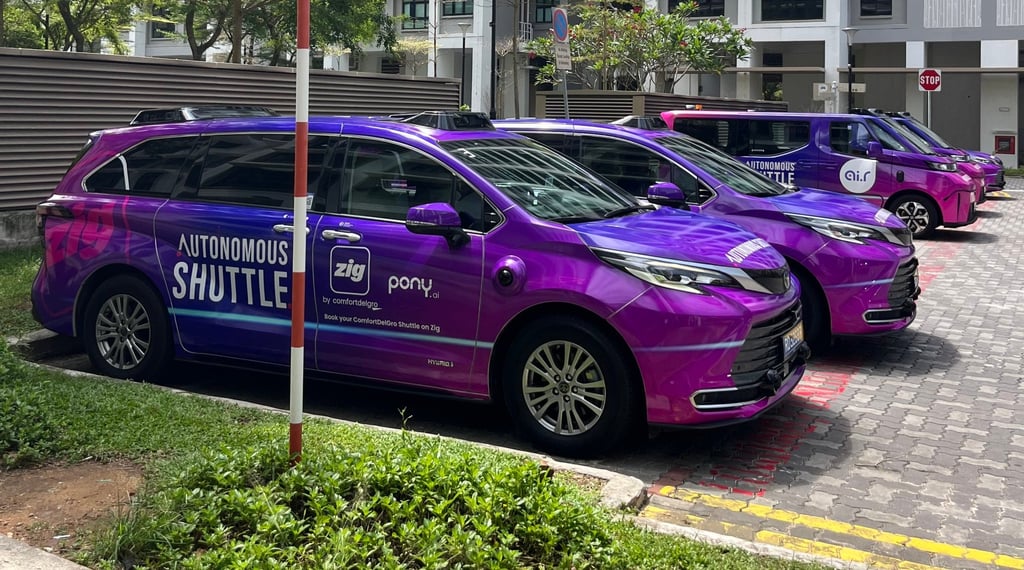
A fleet of robotaxis is seen parked outside a building in Punggol, Singapore. Photo: Jean Iau
Chinese AV companies are industry leaders, experts say, and are keen to show that their vehicles can operate in international markets – despite profitability concerns, as most are still in the start-up phase and rely heavily on investments.
#Singapores #robotaxi #drive #revs #Chinese #leadersSouth China Morning Post, News, Opinion, China, Hong Kong, World, US, Asia, Business, Economy, Technology, Lifestyle, Sport">
In a quiet street in northern Singapore, a car plies the road like any other – except it is a left-hand drive from China and the person in the driver’s seat has been trained to keep his hands off the wheel and his foot off the pedals unless an emergency arises.
Eventually, there will be no need for a safety officer or any human behind the wheel at all – mirroring the autonomous vehicles (AVs) already operating in cities such as Beijing, Shenzhen, San Francisco and Los Angeles.
For now, Singapore is in the early stages of rolling out AVs, specifically robotaxis, to the public.
Jeffrey Siow, the acting transport minister, said last September that the country aimed to have around 100 to 150 of these vehicles on the road by the end of this year.
Major ride-hailing companies Grab and ComfortDelGro were given the green light to collaborate with leading Chinese AV manufacturers WeRide and Pony.ai, respectively, to test and deploy shuttle taxi services on public roads in Punggol.
A fleet of robotaxis is seen parked outside a building in Punggol, Singapore. Photo: Jean Iau
Chinese AV companies are industry leaders, experts say, and are keen to show that their vehicles can operate in international markets – despite profitability concerns, as most are still in the start-up phase and rely heavily on investments.
#Singapores #robotaxi #drive #revs #Chinese #leadersSouth China Morning Post, News, Opinion, China, Hong Kong, World, US, Asia, Business, Economy, Technology, Lifestyle, Sport">Singapore’s robotaxi drive revs up with help from Chinese AV leaders
In a quiet street in northern Singapore, a car plies the road like any other – except it is a left-hand drive from China and the person in the driver’s seat has been trained to keep his hands off the wheel and his foot off the pedals unless an emergency arises.
Eventually, there will be no need for a safety officer or any human behind the wheel at all – mirroring the autonomous vehicles (AVs) already operating in cities such as Beijing, Shenzhen, San Francisco and Los Angeles.
For now, Singapore is in the early stages of rolling out AVs, specifically robotaxis, to the public.
Jeffrey Siow, the acting transport minister, said last September that the country aimed to have around 100 to 150 of these vehicles on the road by the end of this year.
Major ride-hailing companies Grab and ComfortDelGro were given the green light to collaborate with leading Chinese AV manufacturers WeRide and Pony.ai, respectively, to test and deploy shuttle taxi services on public roads in Punggol.
A fleet of robotaxis is seen parked outside a building in Punggol, Singapore. Photo: Jean Iau
Chinese AV companies are industry leaders, experts say, and are keen to show that their vehicles can operate in international markets – despite profitability concerns, as most are still in the start-up phase and rely heavily on investments.
#Singapores #robotaxi #drive #revs #Chinese #leadersSouth China Morning Post, News, Opinion, China, Hong Kong, World, US, Asia, Business, Economy, Technology, Lifestyle, Sport
#Armenia #Azerbaijan #civil #societies #hold #talks #push #peace #plansPeace process,Armenia,Caucasus">Armenia and Azerbaijan civil societies hold talks to push peace plans
The picturesque town of Gabala in northwest Azerbaijan hosted the fourth round of civil societies talks between Armenia and Azerbaijan representatives as the two countries continue to build on their process of peaceful future together after decades of tragic conflicts.
ADVERTISEMENT
ADVERTISEMENT
Amernia and Azerbaijan established together the so-called Peace Initiative Bridge format shortly after the two former foes signed their historic peace agreement in Washington DC. The Peace Initiative Bridge includes multiple participants from the two countries’ civil society who visit each other to conduct the ongoing peace dialogue by addressing all common issues openly and in an atmosphere of trust.
In an answer to Euronews, Armenia’s Areg Kochinyan, president of the Armenian Council and the Armenian coordinator of the Peace Initiative Bridge, said the two countries have to deal with a “gigantic amount of trauma,” as both nations are making significant efforts to move on as part of their historic peace agreement.
However, he added that “the normalistion and the peace in South Caucuses is well-needed in the West, in Europe, in the United States and that’s partially the reason why we have seen this level of interest of the United States in the region.”
On Azerbaijan’s side, Farhad Mammadov, director of the Center for Studies of the South Caucasus and Azerbaijan’s coordinator of the Peace Initiative Bridge, said that “the conflicts in the region did not have a negative effect on the peace-building process.”
“This is a two-way peace-building process and it is autonomous,” he added.
The focus of Saturday’s meeting in Gabala was on building momentum for the ongoing peace process between Armenia and Azerbaijan.
Armenia’s Lusine Kharatyan, writer and cultural anthropologist as well as member of the Peace Bridge Initiative, told Euronews that “it is extremely important to continue these talks in this world where violence and conflict grows around us, so it’s very important to keep the track of peace.”
“I think the talks went very well because we were able to discuss very important and sensitive issues for both societies and do it very deeply and very sensitively towards each other,” she added.
Eleonora Sargsyan from Armenia, a youth worker and member of the Peace Bridge Initiative said that “for 30 years, we’ve lived with closed borders and we haven’t had the chance of structured dialogue, which created a framework of mutual dehumanisation.”
“I believe that one of the primary objectives of peacebuilding initiatives and any civil society initiatives that untites Armenian and Azerbaijani experts is to start the process of rehumanisation.”
In its turn, Azerbaijan’s representatives underlined the importance to both countries to deepen the dialogue at civil society level.
Orkhan Amashov, Azerbaijan’s participant of the Peace Bridge Participant, described the discussions as being “incredibly comprehensive and wide-ranging.”
“The participants here are to prepare their respective societies for that ultimate eventuality – a peace agreement – and its consequences.” , he added.
Ramil Iskandarli, chairman of the Board of Azerbaijan’s National NGO Forum, and member of the Peace Bridge Initiative, described the symbolism of both sides crossing each other’s borders for peace talks.
“Both I and (the) other group members crossed the border between Azerbaijan and Armenia twice and our Armenian colleagues did the same to come to Gabala,” he said.
He added that “this particular meeting is important because it represents the fourth step actually. I am participating from the very first day of this process,” underlining that “there is also a certain symbolism in this process.”
Energy disruption has become a dominant challenge due to the global climate of instability also due to Iran’s Strait of Hormuz blockade crisis, which has shifted attention to the South Caucasus as a critical alternative route that Azerbaijan and Armenia are now working together to develop as a joint opportunity.
Hikmet Hajiyev, foreign policy advisor to the president of Azerbaijan, led Saturday’s peace talks and greeted each participant.
In a post on X after the talks, he announced that Azerbaijan is “fully committed to the Washington agenda” of the peace process and that “this commitment is not merely declarative or confined to paper; rather, concrete and pragmatic steps are being taken to strengthen the peace agenda,” in the context of both countries continuing the development of the major regional project of the Trump Route for International Peace and Prosperity, also known as the TRIPP corridor, which is a US-backed, 42-kilometre transit corridor through Armenia’s Syunik region which connects Azerbaijan to its Nakhchivan exclave.
Hajiyev underlined the fast developing economic cooperation between Azerbaijan and Armenia stating that “these include bilateral trade, transit shipments to Armenia via Azerbaijan, and people-to-people contacts, all of which reflect the concept of the economic dividends of peace.”
The participants concluded the Gabala talks agreeing that continued dialogue is an important step in maintaining communication between the two sides.
Sunrisers Hyderabad has made a rollicking start in its IPL 2026 match against Punjab Kings at the Maharaja Yadvindra Singh PCA Stadium in New Chandigarh.
Travis Head and Abhishek Sharma were in trademark form as SRH reached 105 for none at the end of the first six overs.
This is the joint-third-highest PowerPlay score in IPL history, tied along with the 105 for none put on by Chris Lynn and Sunil Narine for Kolkata Knight Riders against Royal Challengers Bengaluru in 2017.
SRH holds the records for highest and second-higest scores in the PowerPlay as well. Its highest score is 125 for none against Delhi Capitals in 2024, while its second-highest score is 107 against Lucknow Super Giants in the same year.
Here is a list of the highest PowerPlay scores in IPL: